
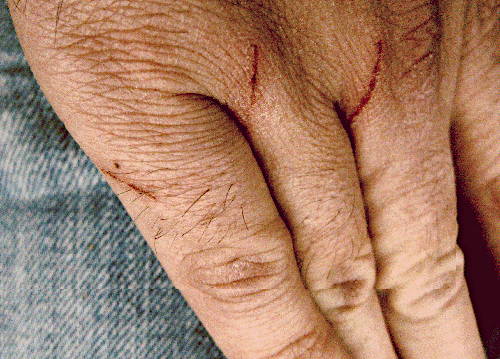
Before you grab it from the mouth of the dog, make sure it’s dead.
Better days
Sometimes, they let us down.
At the end of a season, half-a-dozen years in, you expert a certain level of professionalism.
Mostly you get it.
Then there are the days like Thursday. Her blood was up. After a series of birds, we got into some chest-high sage where she was tough to see. I lost sight of her and when I saw a bird get up 100 yards ahead I realized how far ahead she was. I tried to reign her in.
To no avail.
Though I couldn’t see her, I could see birds getting up in twos and threes well out of range. While I shouted frantically.
I’ve used my whistle sparingly this season. Thursday, I didn’t even have it.
I’ve just expected her to do what she needs to do.
Thursday I regretted not just the lack of the whistle, but the lack of a training collar.
She let me down.
It took me a few days and a couple of trips to get over it. But she got back to center, I think she noticed the lack of shots or dead birds.
And I remembered the times I’ve let her down, with lousy shooting, or work, or poor planning or a million other excuses.
She’s far from perfect, but so am I.
So we hunt on and we hope to be better.
Chasing Chuks
This is it
I hang a left at the stop sign and skid sideways in a little November fishtail.
Visibility is down to beer-can-chucking distance. I aim for the tire tracks in the snow and goose it before I get run down by one of the potato trucks that frequent this road.
The dog is panting in the front seat and the windshield is fogged to hell. I take a swipe and knock a pile of maps farther down the dash to clear the vent over the wheel. A circle clears in the dog-drool windshield fog, but it’s snowing so hard that my sight distance isn’t much improved.
On this, the last day of pheasant season in eastern Idaho, I could not have asked for finer weather.
“They’ll be holding in this,” I tell the dog, though I’m sure she already knows.
It’s been a late winter and we’ve hunted most of the fall in a t-shirt. We’ve seen the flushes get longer and we shouted at the TV weather report more than once about the lack of snow.
The storm was supposed to arrive this evening, but like a little last-day miracle it was hammering down snow by mid-morning.
We throw caution to the wind and knock on doors that have not been fruitful before. We figure it’s the last day and not many will hunt in this.
A farmer wearing house slippers answers at the first house.
“Sure,” he says, adding that we’re free to hunt another section not visible from the road.
A month ago, he was less free with the use of his irrigation ditches.
In ten months I’ll wonder what was different about today and if I might be able sweet talk him in October. But at this moment, why doesn’t matter, we’re hunting new ground.
The wet snow makes it through the waterproof layer and soaks me up to my belt before we’re out of sight of the truck.
It’s all I can do not to whoop. The dog works a tight quartering pattern with a little extra zip in her step and I talk to her as if she understands english or even cares what I have to say.
I’m feeling so good that my spirit is not one bit diminished when we get back to the truck without a flush. It’s early, barely lunchtime. I know we’ll find them. I know that at some point during the day, the dog will work a bit of magic and lead me into birds bedded in deep grass under two inches of snow.
When they flush, I’ll have time to examine the turquoise feathers on their shoulders as they rise to my gun.
The day will be fleeting, but the moments will linger. In the heat of July, it will be this afternoon that I think back to.
At season’s end the remaining hours stretch on before us, filled with promise.
GM
Pheasant on steroids?
If you want to get straight to the meat of the thing, just fast forward to 4 minutes in.
Hunishment

There is a game I play not far from where I lay my head each night. The game is the game of dogs and birds and big canvas. It is a game of otherworldly noses that belong to some higher order, and shotgun shooting that gets no better than my own, for my own is the only gun in the game. The noses pull the dogs, the dogs pull me. Sometimes, on the state piece, I take all four setters. Other times, I take just one. I never play this game alone, for there is always a canine in there, always one of the partners.
I load the old yellow Ford with a dog kennel or two, jugs of water, a dog dish, gun in the gun rack. There’s something special about driving an old F250 out hunting, something antique and retro, something 1970s 8-track, something manual, and honest. We (it is always we, not I, when I hunt with the Setter People) park near the old Van Sant place. Sometime in the previous century, the Van Sants looked out across a hard-bitten Montana mountain/prairie and said, Screw it. Can’t pay the taxes. Let the state have it. So, now, being a Montana tax payer, I have it.
And the setters follow their noses into the wind, pivoting and loping, metronoming, and wind-drinking. For a while, it is this rhythmic gambol, with a fluidity as practiced as the hand of a house painter on brush. Then, en masse, as if they share one nose and not four, they turn to the wind, noses high, tails a bit stiffer and they pull in one direction, forgetting the side-quarter, zeroing in on something only they know, something that exists only in their order, their rank, their world. Not mine. I can only follow, walking fast, then trotting, watching. They sneak now, tense muscle, setting down, slinking, as I imagine their kind did when the weapons of take were the nets of peasants, not autoloaders or double guns. And there it is, that minute, those precious seconds of memory-burn: all four dogs on point, a picture in the mind, burnt deep with the excitement slamming through my soul and right to the very tip of the right index finger that will push the safety off, and pull the trigger. All in one motion.
In a burst of chirp and wing, the entire covey is aloft and I swing and swing and swing. The wind carries the birds and the gun barks twice and two Huns go down and two of the dogs are on them, playing their own game of keep-away from the other dogs and I have two at hand. They are spun of soft feather and autumn hues, their feathers rippled like the brush of an autumn wind on a desert tank, the orange of old pumpkin at their beak and dome. I heft their soft warm in hand, thinking maybe I’ll keep a skin for tying soft hackles, and praise the dogs.
They are already gone.
Out in it, following the wake of the covey, the remaining dozen or so birds. The game must go on.
–TR
Pre-chewed
I waved at them as the drove past.
It seemed like the neighborly thing to do. I was hunting a narrow patch of public ground edged by a gravel road, they were cruising the road in their orange getups on a similar quest for ditch parrots.
When they jumped out of the truck a few hundred yards in front of me to hunt a prime patch of Russian olive I was obviously headed toward I felt a hell of a lot less like waving anything but my middle finger.
What kind of road hunting scum bags would cut in front of a hunter, park in the middle of a road, jump out and hunt a 50 yard patch of cover, then slam the doors and speed away?
The kind of guys who would wave as they drove past you knowing they were about to screw you, I guess.
I’m not sure if they saw any birds, but I know they didn’t fire a shot.
A few minutes later and 75 yards short of that sweet but now pre-chewed patch of cover, the dog put up three birds and I shot my first double of the season.
Justice is sweet.
If I see those guys again I’ll be sure to wave.
Coverage
We do this dance each year and not often enough: a trio of gaited fast-moving horses, a brace of gun dogs, a sprawl of wide country. Shotguns in scabbards, bird dogs out in it, horses mounted. We ride.

The first point is right near the truck and trailer and she is on them, with her male partner backing. She is always on them first, it seems. Ninety-five percent of the time, it is the female, that rare talent. And when she doesn’t find them first, she always honors, always. But to the first covey, a burst of Huns and a bark of shotgun. Over the next hill they flew and after the shots, we mount again and ride over that hill, searching blind.
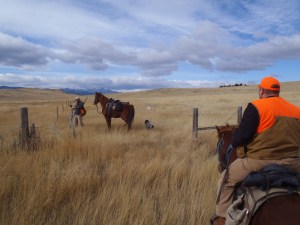
Where did they go? They were cupping their wings like teal stooping to decoy when last we saw them, but where they went, we do not know.
We grid the grass, sweeping one way, then another, for horseback your energy does not get exhausted by the endless plod of boot. Instead, you can cover the country, turn back, and cover it all again. And there they are: the covey and this time it is your turn to watch and hold the horses and the shotgun barks again.
You decide to find another covey, giving this one a break, for you have taken enough and one must always leave some “for seed.”
So you ride. In your saddlebags you carry old orange juice jugs filled with water and you stop occasionally and water hard-panting canines and then you ride on. The dogs vacuum up the country, running big, running hard and you cover it all and then there’s another point, and it’s your turn to shoot.
“Here give me the reins.”
And you walk in, loading the gun and moving to the point and the birds get up and you single one out and pull the trigger, then move to another as that one falls and then it’s “Dead bird. Dead bird.”
The dogs find the birds and bring them in and you mount again and find a new covey.
 As the day draws down and the dogs with it, you have found four big coveys over a reach of wide ground that it would take you two days to hike across. Afoot, you would maybe run
  one covey down and then be done, spent. Ahorseback, and you are fresh.
You are out of dog though, for their lope has slowed to trot and their range has gone from the horizon to just a few hundred yards. Except for her. She keeps going. Somehow. How?
Drive. A lust for the wide open. A beckoning to know what is over the next hill. A whispered promise of game before bird dog and joie de vivre. That is how.
Questions
Why have I developed a callus on the index finger I use to operate my e-collar transmitter?
How do Huns absolutely vanish without a trace, even when you and the dog saw exactly where they went down?
Why do they call it an “improved” choke if I don’t shoot any better when I use it?
Why does whiskey always taste better with a full game bag?
Why do the voices in my head sound like chukar?

Less than ideal
This is not the cover photo from a $9 upland hunting magazine.
Red, high-brass 12 gauge hulls litter the ground, always three together – as in BANG, BANG, BANG.
There are no Land Cruisers or Range Rovers parked in golden fields.
Just tall sage, Russian olive and the broken fence lines that litter this patch of BLM conveniently surround by private (and inaccessible) ground that doesn’t suck.
These public-land roosters have been chased by every labradoodle and aussie-cocker cross in four counties and fired on by snipers, road hunters and ground sluicers.
So when the dog goes into high gear and I know there’s a bird close, I look ahead just in time to see him slip away from the fence line into the sage 60 yards ahead.
I leave the dog to her business, working his trail up the fence while I head farther out into the sage on my right at an angle hoping to cut him off.
The dog puts up another rooster that held a little longer. He swings off to the left and I’m so behind that I never even take the shot.
I click the safety back on and as I start forward, I see the dog working back toward me. Just as I realize the first bird has cut back towards us, he gets up behind me.
I fire twice on a bad shot, miss the first but manage to clip him the second time.
He goes down and hits the ground running. I can’t see him through the sage, but I can hear the jingle of Roxy’s collar as she runs him down.
She brings him back with nothing but a broken wing.
Near a pile of beer cans and empty 12 gauge hulls I take the long-tailed, crimson bird from her mouth and wring his neck.
There are few niceties here.
This is a battlefield.
 Mouthful of Feathers