Agave recall

It’s a long way from dorm-room shots of Pepe Lopez, this Patron Reposada. I’ve mixed it with lime juice and a touch of Cointreau, even added just a little sugar. It’s one a hell of margarita.

But a smooth margarita on a cold New England winter night is a drink poured from the fountain of bittersweet. That little burn in the throat, almost medicinal in nature, always flashes me a few winters back to when I was a virtually unpaid editor of a small, quarterly bird-hunting magazine. In exchange for a laughable monthly salary, I had the chance to travel and hunt – with one of the most memorable trips being an exclusive bobwhite/dove/duck lodge in the Tamaulipas region of northern Mexico. There, the locally produced tequila was kept in an small oak cask, ours for the taking 24/7, if we were so inspired. That tequila was smooth and creamy and much like a brandy. We sipped it straight. No shots or lime or salt. It was infinitely better than the so-called good stuff I’m drinking now.

But, like good tequila does, it made my uvula spasm. So, whenever I feel that peculiar sensation at the root of my tongue I am reminded of my short stay at that lodge, of the brandy-like tequila, the Mexican guides, of the covey after covey of wild bobwhite quail exploding from the arid landscape. The 65-degree days and 35-degree nights.

We ate some sort of smoked chicken wrapped in tortillas and smothered with green salsa for lunch. I drank Coca Cola lite out of glass bottles. We hunted behind a pack of English pointers that were trial rejects from Texas and Mississippi. An older gentleman I spent a day with shot a rattlesnake he nearly stepped on. We hunted in orange groves. The guides unnervingly yelled “SHOOT, SHOOT, SHOOT!” when coveys erupted – like a parent screaming at a kid’s soccer game trying to will a goal through vocalization.

I missed, I don’t know, the first 10 birds I saw, unable to pick one bird out of covey rise and stay with it while others flushed. I finally connected. And connected and connected. So many points, so many shells, so many birds. Wild birds, all of them. My shoulder was sore. My hearing’s never fully recovered. I shot a double. Several times. We ate the birds at night, barbecued and spicy and washed down with that nameless mellow tequila.

I’ll probably never hunt wild bobwhite quail like that again. And tequila will never taste so good.

– Crawford

Ending it Right

We had decided that we weren’t going to accept the end of the season with anything resembling passive resignation. There would be no finding of lame excuses for occupying these end times with other, less worthy activities, while a few days of permissible bird chasing remained. No pathetic, “it would be nice to get out one last time, but it’s too cold now,” sniveling.

Perhaps most importantly, we wouldn’t be able to look these guys in the face if we simply let the season end with a fizzle:

And so, one last trip was hatched. A place none of us had hunted before, interest buoyed by whiffs of rumor and suspicion that an elusive, red-legged partridge might find such barren country to its aberrant liking.

It wasn’t easy, but frankly, in a perverse way, we wouldn’t really want it to be. This isn’t about “easy,” or we would be sharing this country with the hordes; McLodges springing up like blight on a country that deserves to remain desolate and wild and beyond the reach of those who think that with enough money, any sort of instant gratification can be had. These birds, in their wild state, will always demand more than you assume. Unless, of course, you go in assuming that an ass-kicking and a steaming hot plate of humble pie are on the menu.

In the end, we can unashamedly say that we wrapped up the season with deliberateness, with new country under our boots, with a few birds in the bag and the satisfaction of knowing we didn’t listen to any of the all-too-easy excuses for not going that can leave one staring out the window. No. We chose the only conceivable way to face the next seven, bird-less months with a modicum of fortitude, till we can feed our upland souls once again.

– Smithhammer

Hunting alone

The water is warm and gritty but it will extend our range, so the taste doesn’t matter much.
Out here in the flat, away from the roads and far from the convenience store world we live in, it is the space in between that is most relevant.

There is nothing but the dog and I, the rolling hills and a cup of chemically purified water. It tastes almost sweet with the sense of self reliance.
The muscle aches that flared near the truck are gone and I’m walking easy now. We’ve been into a few coveys and our steady pace follows the terrain lines.
There is no sign that anyone has passed before us.
It feels good to be alone.
Self sufficient.
I came for the quail but now it is the horizon that pulls me along.
Besides the dog and my shotgun I have a handful of iodine tablets in my vest, a zippo and a two-bladed Case knife in my pocket. Everything a man might need to cross a barren landscape.
The urge to continue – to journey – is ever-present.
A biologist friend of mine told me about a female coyote that was collared out on the eastern edge of the Edwards Plateau in south Texas in the early 90’s. She turned up a few years later in the middle of Arizona, nearly 1,000 miles from where she started.
I often think of that coyote when I am afoot in wild country. Did she get run out of her territory or did she just have a touch of wanderlust? Did she journey west all at once or did she just gradually drift across the open spaces?
The sun has dropped well below it’s apex and if I turn back now, I will find the truck only a few minutes after full dark.
With a last look west I turn for home. The dog circles wide, still hunting.

GM

Blood Oath on Giffy Butte

“Where you guys hunting?”

Really? Did I just hear that? Did he just say that?

My initial reaction–and all subsequent reactions– is “Giffy Butte.”

As in “GFY.” As in “Go Fuck Yourself.”
These are places earned in sweat. Toil. Research. Where you guys hunting? I’m gonna tell you that?  A stranger in a parking lot motel with a SUV full of bird dogs? Umm . . . . Nope. GFY, dude!

We came here, to this tiny Wyoming burg, with hopes of birds and dogs on hard point. We each drove a half-dozen hours. I told my friend that I’d take him there only if he swore that he’d never take anyone else and never go there without asking me if he could. In the planning phases, he had asked me about another hunter, who lived only two hours away.

“What about taking him?” he had asked.

My answer was something like, “A guy who lives only two hours away? He hasn’t earned it. We don’t need to spread the word.”

To the novice, or to the hunter with only a few thin years under his boots, or to perhaps that uninvited hunter (whom I’ve nothing against), this might seem like raw arrogance. This is, after all, public land. Everybody’s land.

But this place, and many others, is sacred ground.

We found it, another hunter and I, almost twenty years before. Then, as now, we swore we’d take only a smattering of people, those who understood the blood oath, who understood the scarcity of a place with good birds and great hunting and deep reward in a shallow land. We’d take a few friends who lived many miles away, but even they would need to honor the oath. We shook on it.

I had done the research, talked with a warden and a biologist, and when we first stepped foot on Giffy Butte, we saw bird tracks in snow dust. This was a year or two before his best dog was even born. My best dog was between us, a pup of eight months with a heart full of talent. We got into the birds, killed limits. Swore on our souls.

His best dog and mine are dead now. Mine is buried out there, in a shallow grave scratched in a hard land.

We’ve gone annually, kept it quiet, and watched as a few more people found the place. Maybe they were researchers and big walkers and diehards who found the place on their own like us. But maybe, one of the few we’d shown had talked and pointed a betraying finger to a map. We wondered about that–And then they told two people, and so on and so on and so on and so on.

Today my friend I’m showing this place understands. We load his fine young dog and my pack into my truck and we drive there. There will be no revealing of this secret place to others–and certainly not to brazen eager turds in a motel parking lot.

I knew I could trust him.

My other friend, a kindred soul and fellow addict, called the other day. He was livid. Two friends who had taken the oath had lied. They had shown another that sacred spot and yet another leak sprung. Will this new addition honor the oath? Unknown. I barely know him.

But there is a resentment there. He hasn’t done the homework, nor, in fact, did those who showed him Giffy Butte do theirs. They were guests on the coattails of my generous friend’s sweat and hard work. For that gift, they gave him and me more competition on a place that we hold very dear. Thanks guys. Such betrayals are hard to forgive and I know that my friend will not be likely to share a new secret spot with them again.

For the hardened hunter, the avid dog man, such places are the core of the soul. The sharing of them is a time-honored ritual, a blood oath, a sacred trust. I have another friend who has walked many miles with me, a person I’d trust with my life. I’m even the designated executor of his will instead of his own son, but he never showed me his very best blue grouse hunting spot in Colorado. I never asked him to. And if he had, I would have never shared it nor even gone there without him. I would have held it as tightly as I’d hold an heirloom from my family’s ancestral trek on the Oregon Trail.

Sacred places. Some, even, are on private land. Many are on public. In a sport where territory sifts away each year like sand through an open palm, good hunting places are slipping. A place where I used to hunt Wyoming wild pheasants is now locked up tight. Another place where I chased blue grouse in high mountain holds has been nuked by greedy sheep and I’ve found more and more empty shotgun shells every autumn.

Herein lies the creed: do the homework, find your own places, walk long, sweat much, go birdless, find reward. If you want to share it, then do so. But share it knowing that life changes. Others discover. The land changes. The birds cling to life. Yours is a rare honor. Honor it.

–TR

Joint custody

Greg was the first friend of mine I could remember having divorced parents. Since I didn’t have to deal with the emotional fallout of the mess, my role was often to simply pull up a seat on the over-compensation gravy train and enjoy all the cool shit Greg’s parents heaped on him in exchange for them abdicating their full parental responsibilities.

These days, I’m the one spoiling – only it’s not my kids, it’s a shotgun. More precisely, it’s a 20-gauge Fox Sterlingworth that my wife’s grandfather (which would be my mother-in-law’s father) left in his estate.

The gun was supposed to go to my wife’s brother, Larry. Trouble is, Larry’s wife grew up in beautiful Hartford, Conn., where guns are bad – mmmmkay? So She Who Must Be Obeyed handed down a “no-guns” decree in Larry’s house and it ended up in my hands. For safe keeping, because it’s still Larry’s gun. Technically.

But you can’t keep a good gun down – and even though it’s choked tight and tighter, I trot the Sterlingworth out a couple of times a year (usually later in the season) and try to kill a bird or two with it. The gun is spoiled all right, spoiled because I don’t have the go-ahead to add it into the full-time rotation. So it sits for much of the year in my gun safe. It must be lonely and depressed. Sort of like Greg was when he was shuttled between parents.

Ideally, I’d like to have the stock refinished, I’d like to open up the bores a few hundredths of an inch and I’d like to make sure it fits me well. But I can’t. It’s Larry’s gun, and while it sees the grouse woods a couple of times each year, for the most part is just sits around waiting.

Maybe I should file for sole custody.

When the Weird Turn Pro

There is a headspace you sometimes get into on road trips. Or a headspace that I tend to get into, anyway. In this particular case, it was the pernicious result of a hangover, a couple Reese’s, a bag of cheese puffs, some strong coffee and three surreal days of seeking chukar. I was driving home, the trip behind me and the Tetons in ominous storm shroud before me, killing time by playing the game in my head of trying to explain all this to someone.

Sometimes in the midst of these hell-bent junkets, it feels like the things you see along the side of the road have been deliberately placed there to conspire against your already zoned-out, chemically-fueled, tenuous grasp on road reality. These must be documented in the event that your sanity is some day put on trial. It may be the only defense.

An entire life lived in the West, and there are times when the scale of things still screws with me. I look up at vertical caprock, trying to gauge if it’s 500′ or 1500′ above, though it really doesn’t matter – I’m going up there regardless.

An hour or three later, I’m standing on top, looking at telltale tracks in the snow, the sore legs and lack of oxygen already an afterthought as the little bastards take control of my brain, yet again.

The dog vacillates between ranging too far and alternately doing exactly what he should, still working to find that fine, triadic balance between enthusiasm and focus and teamwork. He slams on point; as dramatic as if he’d hit a brick wall at full speed, and I try to get to him before one of the parties involved breaks this fleeting impasse. Later, it’s not the bird getting up, not the passing shot, not the satisfaction of finding my mark that I will remember – it’s that deranged, amber fire in his eyes as he holds point and lets me know that we’ve found what we’re looking for. This continues to haunt me as I type; those blazing, otherworldly apertures etched into an obscure corner in the back of my brain reserved for a few indelible memories. The same eyes that now just belong to a goofy pup laying on his back with his legs in the air on my living room floor.

In the end, what would I say to the uninitiated? That I had driven over 500 miles round trip, to stay in a cheap motel, eat a lot of bad food, spend hours driving on rough two-track across tragically over-grazed former bird habitat, with but one bird in the cooler to ultimately show for it? And that for whatever twisted reason, this had fed my soul?

– Smithhammer

Does Not Taste Like Chicken

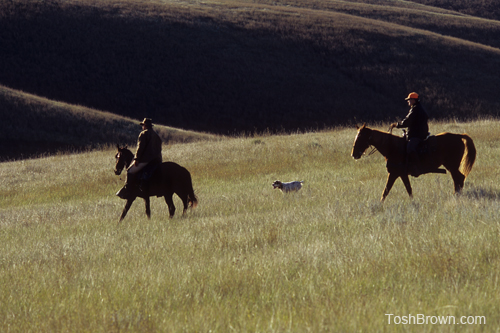
Whereby two southern blokes don their riding finery and chase sharptails with fanfare and cheap scatterguns.

(Not cooking sharptails)

A dog’s calling

The early, excited conversations about bird dogs and shotguns have died out.
Now there is little but the quiet jitters of a sleepless night and an oncoming hunt, the silence punctuated by conspiracy theorist postulations on AM radio.
It’s 365 miles from my driveway to the first decent patch of public pheasant hunting at the southwest corner of Kansas. That’s a little over 5 hours of hard driving, leaving at midnight, arriving in the cold well before sunrise.

The early, excited conversations about bird dogs and shotguns have died out.
Now there is little but the quiet jitters of a sleepless night and an oncoming hunt, the silence punctuated by conspiracy theorist postulations on AM radio.
It’s 365 miles from my driveway to the first decent patch of public pheasant hunting at the southwest corner of Kansas. That’s a little over 5 hours of hard driving, leaving at midnight, arriving in the cold well before sunrise.
The dog is sleeping, finally past the nervous whine that pierced the first hour of the trip. Now she’s settled in, conserving energy for the day she surely expects at dawn. I am positive that she believes the trip is for her sake and this time she’s right.
She has hunted almost every western specie of upland bird, but as a springer her calling is pheasants.
We blast through Boise City, Texas and I open the windows and let the sharp, cold air in to keep our eyelids pried open.
In the jet black of predawn Oklahoma, the rural world is stirring.
Old Ford pickups are idling in dirt driveways, creating little clouds of exhaust while their owners enjoy a few more minutes in a warm kitchen.
It’s late season and the early crowd at the cafe is mostly Stetsons and John Deere baseball caps, devoid of the hunter orange that litters the tables in November.
Back in the truck, Roxy starts the nervous whine again. We’re out of town, racing down dirt roads past cut grain and CRP looking for any sign of terrain in this vast expanse of ocean-flat prarie.
We bail out of the truck at a small draw with a thin strip of amaranth down the center. White, Walk in Hunting Access signs, the siren song for out-of-state pheasant hunters, border the edges.
The dog is booted. Last trip the sand spurs were prolific. She prances for a few steps then settles down to wait for us.
Barely 20 yards in Roxy makes an abrupt stop, miscalculates the boots and falls flat on her side. Her legs are sticking straight out and her nose is in a clump of switchgrass that erupts in a hen pheasant.
Before the hen is even out of sight, a rooster cackles out of heavy cover with Roxy tight to his tail feathers.
This dog chases quail and on occasion will refuse to make a retrieve on a bird she deems too big, but she was born to hunt pheasants.
A few years ago I heard there was a springer pup with a local rescue organization in the next town over. I called and asked about the pup, tempted to bring him home. A few questions into the conversation, the woman on the other end of the line changed her tone.
“Would you be using this dog as a hunting dog,” she asked.
After the obvious response, she told me that the pup wouldn’t be allowed to go to a home where it would be required to hunt.
“It’s not good for the dog,” she told me.
I imagine that pup ate every plant, chewed up all her left shoes and destroyed most of her furniture with its pent up energy. While the thought of all that sweet justice makes me smile, I feel sad for the pup that likely never discovered what he was hard wired to do.
My own dog quarters through thick CRP, hunting hard and barreling into and through the thickest cover. The deep grass sometimes covers her completely, but she reappears momentarily in vertical leaps that are her breed’s namesake.
A nose-to-the ground, brush-busting springer has no greater desire than the trail of a wile old rooster, staying afoot and trying to hunker down or run out of range.
This is her calling and it’s worth the drive.
GM

Staked

Three hundred lots. A handful of open space tracts. Bull-dozed new ponds. Jogging trails along the streams where the new residents can enjoy wildlife watching.

But for now, a half section of farm ground in old wheat, a smattering of snowberry along the cricks, gone-awry tansy and thistle. Cover.

You walk this ground as you did last year. It’s good for one hunt a year, maybe two. You take only one dog. One dog, the old one, who stays close and hunts pheasants better than the others, more thoroughly, less ram-charger-hell-bent-go-daddy.

This place is close to town. Closer to the blade. They came here as your kind has come for centuries: lured by word-of-mouth, tantalized by brochures, urged by magazine articles that rated your town as a “Top Ten.” You came then too, so you are well aware of the dark crow of hypocrisy perched on your shoulder.

Farm ground went under the blade. Tracts surveyed. Nail guns spit. Places to live and raise your children and clean air to breathe and those amazing mountains on all sides. Good country.

But soil as black as an Angus turned over for the last time, covered in asphalt, concrete.


Then it all fell out.

The money stream dry. The realtors waiting tables. The construction guys on the road somewhere else. Some other boom.

Now it is as it has been for one hundred years. Farm ground. The surveyed and staked ground before you like some glowering storm off in the distance, a storm that promises to drop ice on the highway and force you elsewhere.

You are aware of time here. Aware of economics. Aware of change. When you come here as you have come every year for a half dozen, you wonder if you’ll have to find some other place next year. If this place will be no more. You do not think of these things in other places where change seems to creep as slowly as lichen across granite.

You walk behind the old dog and watch him move through the snowberry and tangle rose. You scrape along behind him and look for tracks in the snow. You start to pick up some, tracks of running roosters, a covey of feeding Huns, a doe-fawn combo. The old dog cuts parabolas on open ground, then finds a line that only he can feel and follows it, as if being reeled there. Then, a point. The cock bird goes up and you swing and pull and touch his warmth when the old man brings him back.

You go on now, thinking about hunting and unaware of time and change and development. There’s a hen beneath a solid point, and then another rooster warm in your hand and then you are out of cover and out of ground to hunt.

Two roosters on good ground. Two is enough. Save some for next year. Save some now. The ‘dozers will get the rest.                                       –TR

Learning curve

The dog and I are fresh into New Mexico, a return of sorts for me and a new adventure for the dog. We are out of our element here, short grass and cacti, everything spiny and dangerous.


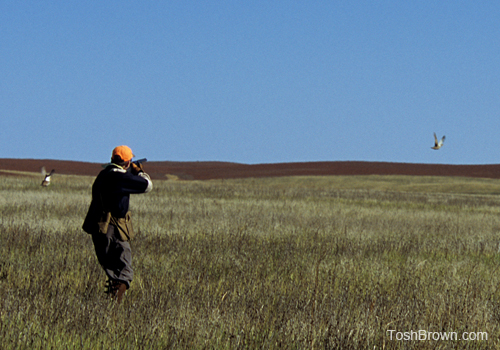
The scalies and the gambels are sprinters. The first few coveys we tried to close in slowly, the dog straining against the tenuous strings of obedience as I waited for them to hunker down.
Instead, they simply ran away from us, climbing to the top of the ridge then jumping off the other side, never to be seen again.
That was ages ago, months and seasons and dog years.
Now, I let her run.
Bust them like an out-of-control mutt loose at a city duck pond.
I watch the covey rise and hear the mad beat of wings as the devil birds surge away just out of range. I whistle her back to heel and she comes, ecstatic, thrilled with the flush.
I mark the birds down and know that they will hold for a few minutes. We hike across the rocky hillside, past the cholla and up to the saddle where we saw them anchor.
Now we’re set, this flushing dog and I. The birds are holding tight and she knows it. She flies headlong into the clumps of tall grass, powers through a creosote bush and flushes a single.
At my shot, a second bird erupts from my near my feet and I spin to my right, unable to see him for a moment. Then I’m on him, swinging my gun past the square of my shoulders as he swerves downhill.
I miss.
She pauses for a moment and I like to think she is checking to see if the bird goes down, but I know it is not her belief in my shooting but a yearning – a fiery urge to chase that keeps her gaze locked on the disappearing speck.
Then we’re back in the saddle, working the patches of grass that won’t hide a dropped 28 ga. shell but can somehow cover a dozen birds. The dog lights up, shortening the strokes of her zigzag as she hones in on the foot trail of a quail. A flurry of feathers and they’re off. It’s half-a-dozen birds and I’m leaning hard, wanting the double and somehow connecting.
We pick up our birds. The dog is still hunting but we both know they’re gone, somewhere in the bottom now and not holding this time but running, hard and fast and without looking back.

GM