Color

This year there was no vibrancy to the slow fade of summer. A norther came down out of the high arctic and froze everything in early October, dropping temps down to singles, dropping a foot of snow on the backs of surprised baby partridge. The leaves on the aspens, the alders, the cottonwoods, turned black and fell off overnight.

Now deep winter.

Any hint of summer is long gone, drained from the grasses like blood from a corpse, the horizon sprawling out and the light as flat as the land. Petrified and pale. Along  the empty and benumbed ditches are the stems of red willow, but even they have no verve, no splash, no elan. A man could get despondent in such a landscape with its off-tones and nothingness. When your partner compares the coming day to the soft pastels and dim light a Russell Chatham watercolor, you realize why you’ve never found the man’s art all that appealing. Why hang “Depression” in one’s living room?

Twenty below. Weather for fools and cattle feeders. The fools carry shotguns in refrigerated fingers. The cattle feeders feed from the heated cabs of tractors because they have to. You want to. Dolt.

Out into that drab vista with the only real vibrancy at your feet, panting and wiggling and dancing and wagging. Hell’s bells. It’s 20 below.

The sun splashes a little bit of yellow across the snow carpet, but still, nothing much more colorful than a hard-water stain in a commode. You crunch on in complaining squeak-snow and blow on the plastic whistle only once. Only once because the damned thing freezes to your lips and the end of your nose hurts and the lobes of your ears remind you of the last time they were frost nipped. Skiing a January or two ago. Skiing. Activity that makes sense. Or ice fishing. In a hut. With whiskey or schnapps or hot buttered rum. Not this idiot’s plod with a shotgun so cold the receiver glues  to your glove and when you stop to get rid of some coffee, you worry about frost nipping the business end of your business. Jesus H. Jack London.

The path is a canal that in summer probably runs bank to bank with silt water but now is as empty as the land itself, its banks lined by brown brush and black weeds and reddish stems and here and there an acre or two of bled-out cattail. The dog charges into it and tufts of hair from the cattails drift and blend into the frost and you push on, coagulated limbs working, pulled only by the dog and his vivacity. In those thick cattails. Now quiet. Silence. A point, you think, and you pound into them, pushing through the floating cattail dust and the 20-below crystals and find him there, iced-over himself, and yet absolutely on fire at the same time and you kick about and hear a frantic beating at your feet and up she goes. Brown and black and a little white and flying. Hen! Dingy bitch.

A mile like this, along that canal, through blankness, your toes cold, your lobes slowly going from ‘nip to ‘bite, the whistle tucked away and forgotten, the dog stopping now and then to bite out chunks of ice between his pads, but bursting on, still giving it all. Would have liked to have that kind of drive and no-quit on your college football team. Who is playing probably right now while you are out here freezing your junk right the hell off. A simpleton’s trudge, yours. The farmer out there in his growling tractor, feeding faded green hay to his black cattle. Even that sounds more appealing.

You near the end of the canal where a big gray cottonwood presses into the sky and a ferruginous sits fixed on a limb, puffed out and gray and brown and black and reluctant to move. Does finally, launching silent into the freeze. The dog doesn’t see the hawk, though. Occupied and animated. When he stops again, solid again for the fifth or sixth time, you think: Probably another damned hen but you wade in anyway.

Your toes hurt from kicking the cattails and then a chaotic splashing at your feet and a cackle. A cry that is in reality probably one of fright, but you’ve imagined it a scold, an angry, cursing, pissed-off mean-ass sumbitch.

And there he is. A  flying box of Crayons: Purple! Red! Green! Russet! Rouge! White! Black! Yellow! Chartreuse!

Color!!!                                                                                                              –TR

I got da blues dis mornin’….

Dawn on the first day of deer season. The cracking reports of high caliber rifles, some of them sounding more apt for buffalo or urban warfare, can be heard in the valley below. We gratefully stand on the ridge high above as dawn light strikes the far side. We are at 8000′ in mixed blue and ruffed grouse habitat, but blues are on the brain and at the top of the priority list. Hank clearly has a bug up his ass, and I suppose I do too. He’s ranging far – too far – and I’m letting it get to me a little too much, probably symptomatic of other things in the back of my mind that I’m trying to sort out.

Eventually, I remember that he is young and in his first season, that an occasional day like this is to be expected, that it would probably be best to just call it and head home. There are days when you just know it’s just not going to come together, and it’s best to listen to that. As we make our way back down the hillside, still several hundred feet above the truck, I break the action, unload and give a whistle. Wait. Another.

Hank hasn’t been seen for several minutes, which means he could easily be in the next county. I’m getting pissed. And then getting pissed at myself for getting pissed. Eventually, he comes charging in on my right at mach speed, scaring the crap out of a random blue that happened to have been holding in the brush nearby. The bird lofts right in front of me, the easiest passing shot in the world. I raise my now unloaded gun, swing through and say, “BAM” out loud. Hank looks at up at me like I’m insane, and takes off barking like the piss and vinegar pup that he is. It will be the last blue we lay eyes on this season.

– Smithhammer

Excerpts from a Quail Quest…

From the Upland Lexicon of Essential Euphemisms (3rd Ed.):
Main Entry: 1quest
Pronunciation: \ˈkwest\
Function: noun
1) Typically used in retrospect, to summarize the unsuccessful pursuit of an elusive, small bird in a big land. 2) An attempt to put a valorous spin on failure. 3) Also used in place of such platitudes as “it’s just good to be out here.

Az. Fish & Game agent: “Yeah, the Mearns numbers seem to be really down this year. Dry spring and summer did a number on ’em. So what are you guys hunting out here?”

Us: “Mearns”

AZF&G: “Oh.”

“We scouted that road last weekend. It’s pretty rough, and **** ‘s truck wouldn’t make it, but I’m sure your rig will be fine.”

“Hmmm….where do you think those folks are going on ATV’s, in head-to-toe camo, ski masks and handguns?”

“Note to self – when you go on a road trip, bring the keys to the locking gas cap.”

“Javelina’s are basically just big cranky rodents on steroids.”

“We could always move down lower and see if we can find some Gambel’s…”

“I’m not ready to slum with Gambel’s yet.”

“That’s gotta be the weirdest Johnny Cash song ever.”

“Looks like that big pot of beef stew flipped over in the back of your truck.”

“Should he be chewing on that?

“Well, till next year.”

“Yep.”

– Smithhammer

Four–aka Taking Duke

The day my friend died.

That day is on the list–you know, the list we all pack around. The personal list of the days that sink into your core, the days you will remember for a long, long time. Days like 9/11 and the day the Broncos won the Super Bowl for the first time. Bad and good. Burned deep. Days to remember when you are old and worn and pooing in your own britches and eating soft food.

So the day my friend died. Here’s another one–the day his family asked me to take his dog.

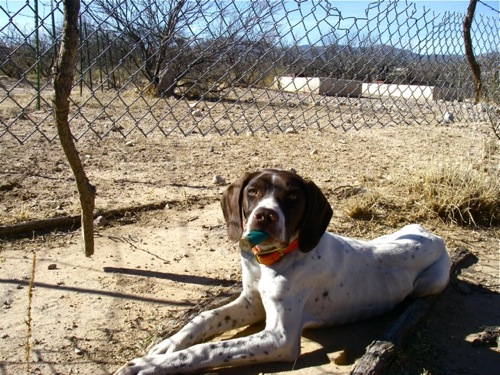
His name–the dog’s–is Duke. My friend had three dogs, two Brittanies and a setter. I’m a setter man.

“Would you maybe take him, Tom?,” Dave asked. “Dad would have wanted you to have him. He needs to be hunted.”

I gulped and goosebumped. “I’d be honored.”

Three were already at home, a team of setters that sweep the country and miss little. A fourth? Really? A fourth? There would be no bird safe from here to Great Falls with that kind of canine vacuum power. Four? I gave it about three minutes’ thought. Yes, four. I’d do it for my friend, but I’d do it for Duke too.

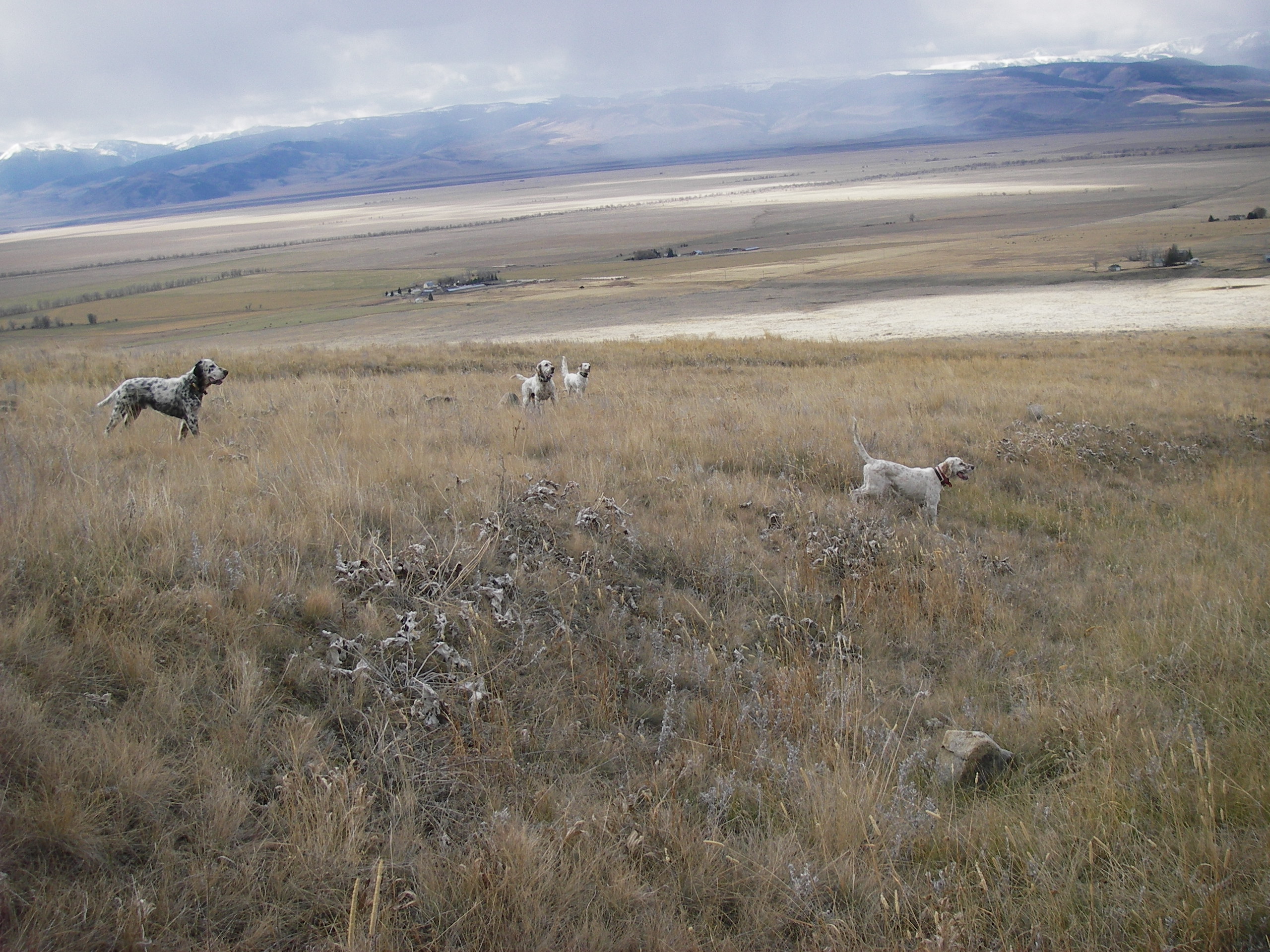
He came home with me in October, a thin high October with filtered light from the sky and a vast stretch of partridge prairie out before me. He was out of shape and a little overweight, which for a setter is about one pound. But he had fire. I had seen him hunt and I knew it was there and that he’d burn hot and long and get it done. And so it was and then all four dogs were out on the ground–a huge canvas of grays and browns and four white setters dancing across it like notes on sheet music. Glory.

They swept out into a southward Montana wind and spun in it. The original three following each other and swapping leads and going cautious when birdy. Why would I screw that kind of a trio up with a fourth? And then I saw him, off left.

Tail high noon. Stunned. Stopped cold. The trio did not see him and I loped his way and called to them and then they saw him and all three honored, then one moved ahead, stealing the point. Poor form. I spoke and she stopped then and there it was–four frozen. The frozen four.

The covey went up and the shotgun barked and a hun was there. Down and Duke on it.

My friend smiled.                                                                                       –TR

In the Hall of the Chukar King

Out of breath, I stop to leave a little water in this otherwise dessicated landscape. Looking down, I note that my boys are as red as chukar legs in that detached, objective way not uncommon to moments of pain and survival. This trip is beginning to take a toll on me. Looking up, I survey a thousand feet of loose scree and caprock and cheatgrass above, and hear them laughing from on high. I try not to take it personally, though it is most definitely personal, and I continue scrambling to reach their steep patch of hell, simmering with murderous intent.

I know they are close – the dog starts getting birdy and then locks, just as half the covey pulls a flanking maneuver, running around behind him and then they all get up simultaneously – a dozen chukar exploding and tormenting him from all sides. He predictably loses his shit, jumping in the air and spinning and barking. Poor little bastard. No good dog deserves this. Instead, some of them, like some of us, simply become addicted in spite of better judgment; gluttons for punishment.

As the chaos subsides and I tell Hank it wasn’t his fault, I hear the lone holdover bird flush behind me. Wheel and fire and the bird drops decisively. Mistakes are unforgiving here; a maxim that applies to us as much to us as it does to them.

It wasn’t a classic take over a point, but you don’t always wait for that in this country, on this quarry. No, this is guerrilla warfare, and I don’t mean that lightly. Refined gentlemen and their traditions and their rules remain far below, looking up at places like this through binoculars.

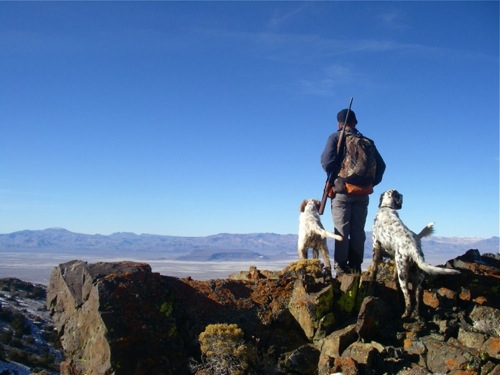
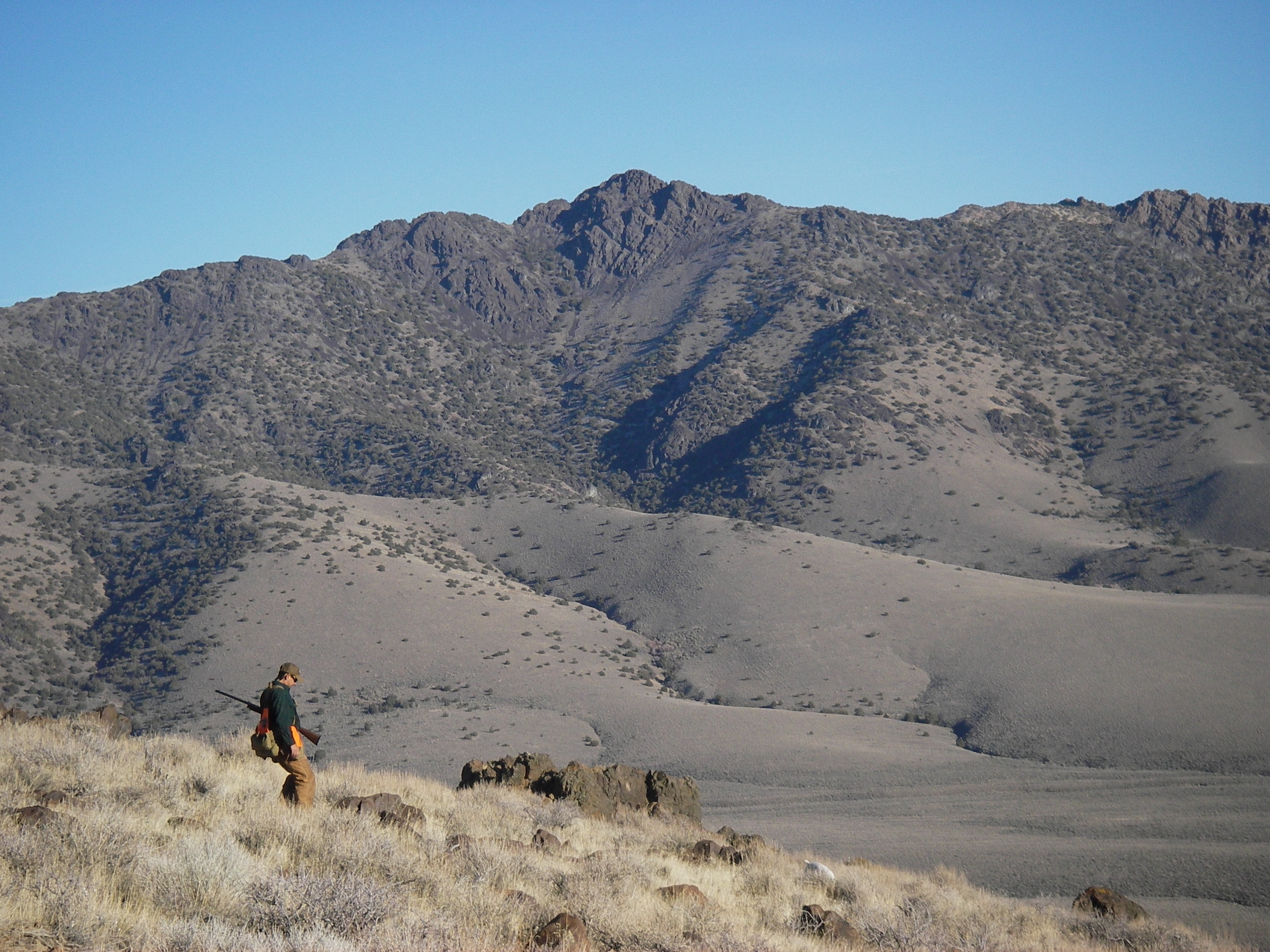
From above the saddle I watch the covey flush wild and take cover in a jagged outcropping, disappearing into the crevices. We learn from their flanking tactics and return in kind. It’s so damn steep I practically have one knee braced into the hillside when I see the GSP locked up hard, balanced on a boulder. I catch my breath, taking a second to admire the work of this first-season pup, and release him with an “ok.” He rockets in and the little devils get up and I promptly send two of them to meet their infernal maker. I watch the birds drop 75 yards below me on a 50 degree slope of nasty, loose, volcanic talus. Even in death these fiends make you pay.

Lest the wrong impression is given, I spend the next day going through an entire box of shells with only two hitting their mark. Fast passing shots on birds dropping from above at mach speed, whiffed. Shots taken at birds that I knew damn well were out of range, solely out of frustration, hoping to bend physics to my will. It didn’t work.

Evening is not exactly  the affable return to the sprawling lodge after a jaunty day afield one imagines in the sportsman tomes of yore. It is instead a deliberate refueling with piles of greasy sustenance; a licking of wounds with corn liquor salve and barley-based anti-inflammatories. Plotting, debriefing, refiguring tactics – a team effort to recharge before tomorrow’s redeployment. The banter is generally about as offensive as you can imagine. The easily affronted might want to camp somewhere else. Far away.

Dawn reaches our cold little camp in the arroyo and high-octane joe eradicates the last vestiges of rust from sore muscles and we’re off. We ascend to the Hall of the Chukar King yet again – knowing they await far above, assuming they’ll be no easier than they were yesterday, working like you would for no other upland species, to return spent, with maybe a few birds in the bag and the weary contentment that only comes from having your ass handed to you by a small, crafty partridge in a vast, alien land.

We’ll be back.

– Smithhammer

Generations

In camp and around the house, he is a big loveable goofy bastard.

Right now, though, he’s on point and it is as classic a point as a setter man in a life of setters is likely to see. He is white and handsome and up against the skyline behind a juniper and frozen. Solid. A salt pillar.

One covey back, he had pointed and then broke with the shit-hell expression of a pup on his mug, flushing birds like playing cards shot into a stiff wind. Rotten sonofabitch, with a smile.


This time, I tell him “hold, buddy” (one does not command this dog, one converses with) and stumble-skip across mean footing and see the covey.
They go up in a flurry of gray wing and clown’s mask and I swing carefully and pull the trigger and one goes down. I do not think about a triple or even a double. One is enough, one good chukar after one good point.
His name is Echo and he’s here on the mountain with me as a partner, not as a dog doing the work for a walking man. For the most part I am not in that run-and-blast, stagger-and-fall, curse-and-bleed rant that is chukar hunting in on-end country. Instead I am largely lost in thought. Soaking. Absorbing. I’m all in.
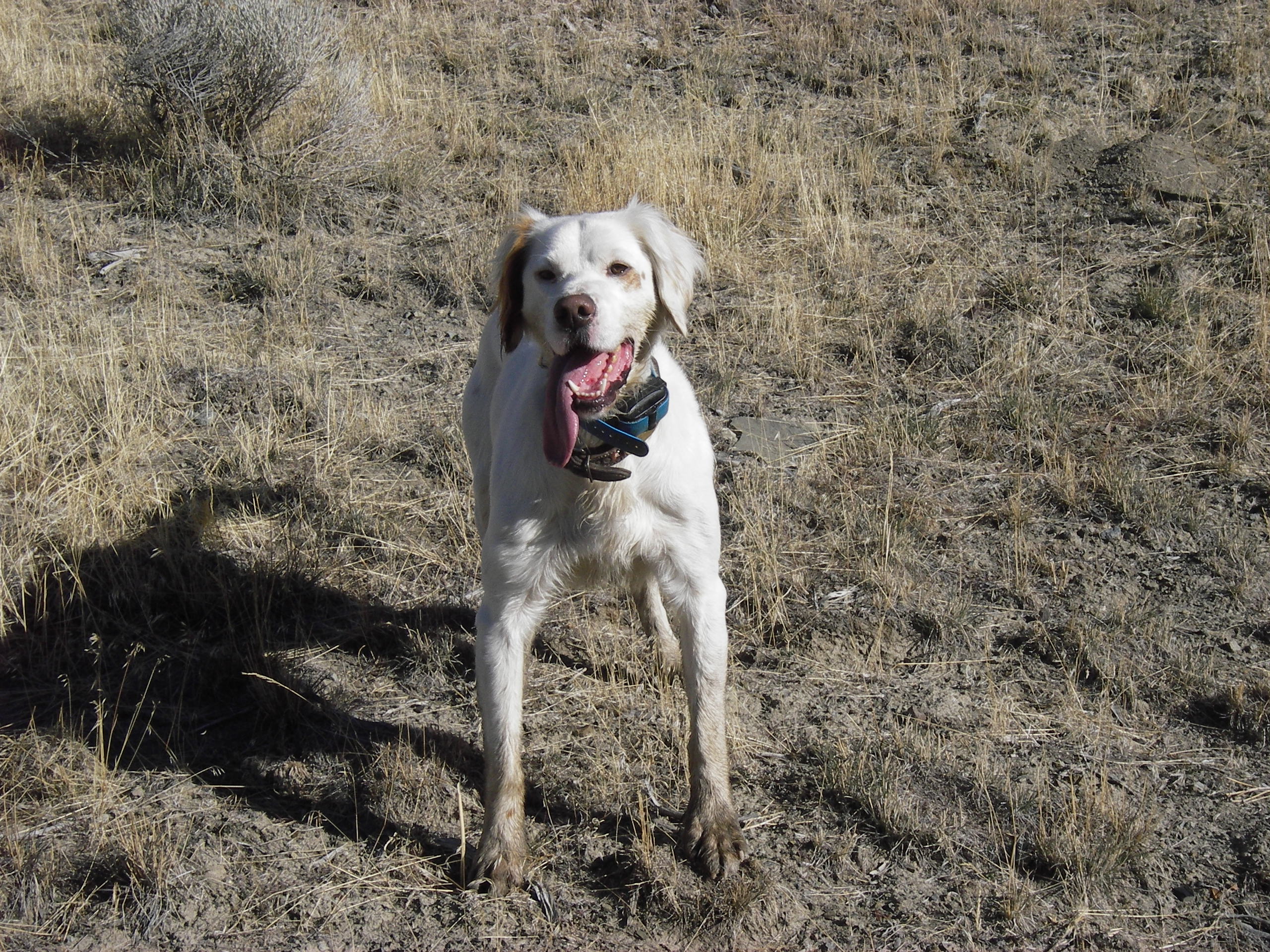
His real name is Greylock’s Hank’s Echo. Greylock is a good kennel back east, but this dog is a western lad. It’s the “Hank’s Echo” that is the important thing.
Sage and juniper and greasewood run through his veins. Hank was his grandfather and in this country of echoes on rimrock, Echo is his echo.


A decade before, I climbed the same hill with Hank–a dog all bones and balls–and we shot chukar left and right and Hank pinned them all and brought them all to hand. In the cooling light of a northern Nevada day going away, we walked down to the truck one thousand feet below, Hank at my side and the warmth of a half dozen chukar dead against the small of back. The caprock across the valley splashed pink then gold-red and then it was gone and the chill of December was on me.
A decade gone by and a bird dog buried at the base of a chukar cliff in another state, a place where chukar walk across his grave and his name is carved in soft yellow sandstone above. Now his grandson at my heel, then cast out into the thick of it–the old cold lava, the junipers, the sage, the cheatgrass greening in December sunlight and a fresh-dead partridge in that same frayed-by-years bird vest. Dead and warm against the small of my back and a honed-hard, bones-and-balls white setter out in it, after them.


The third generation hunter after perhaps the fifth or sixth generation quarry. Life ticks on.                                                                                 –TR

The Skeleton Crew

My family owns a piece of arid ranchland in Maverick County Texas. When it rains, down there, it rains quail. When the pasture grasses reach the truck bumpers, and the grasshoppers billow from the bar ditches in clouds, we’ll have covey counts that’ll make an undisciplined pointer blow a gasket.

As of today, however, our county is now entering month 30 of the Mother of all Droughts. Normal rainfall in our area is 28 inches. So far this year we’ve had 6 inches. Last year we had 4.5. This past summer we had 80-plus days over 100 degrees. We sold our cattle back in June when our stock tanks went dry. When (if) we buy back in, we’ll pay twice what we sold them for. Two months ago, most of the Texas drought map was colored orange and red. You probably heard about it on the news. Since then, most of the State has gotten a good soaking; but not Maverick county.


Over Thanksgiving my family gathered at the ranch to hunt whitetails and stuff ourselves with food and football. Quail weren’t even mentioned and no one brought a shotgun. On Saturday I was sitting in a deer blind and looking for a fat doe to put in the freezer. It was warm and windy and dry, and a fat doe was looking like a tall order. About thirty minutes before sunset, a cock bobwhite staggered out of a clump of withered prickly pear and began pecking aimlessly in the blowing dust. A bit later he was joined by another cock and three hens. It was a sad scene. They were skinny and disheveled and they looked oddly out of place; they reminded me of Mad Max and his band of post-apocalypse refugees. Two birds enter; one bird leaves.

The weather dweebs are calling for an El Nino year–and it does appear that the rain patterns are shifting (slightly) in our favor. Will that little five-bird covey make it through the winter with scant forage and no screening cover from bobcats and avian predators? Will this be the drought that finally eliminates bobwhite quail from Maverick County? Over the past thirty years I’ve seen these birds bounce back from severe droughts. They’re prolific little bastards when range conditions are good, and a few timely spring rains can kickstart a fury of whistling and nesting.

For now, though, we wait. We watch the radar and we hope Al Gore was wrong. We fondle and admire our shotguns and we thumb through the gear catalogs. We pay our ad-valorem taxes and we feed our dogs and we tell them to hang on. We consider buying a package of shrink-wrapped pre-marinated quail from the grocery; but that would suck, so we don’t.

Stupid is communicable

The first time we got stuck out there, you could probably forgive. The second time? Not so much.

Out there is Northern Nevada. Washed out, flung out, far out. Out so far that satellites don’t even pass over. We were there, me and the Jack Mormon brothers, for chukar. Or probably more correctly, for our dogs. Is there any reason to drive 14 hours from home to run around in some of the remotest country in the states, get your vehicle stuck for days, and end up getting stuck again . . . if not the dog? Come to think of it, there probably are, but those reasons are not the subject of this tale…

The first time we got stuck out there, you could probably forgive. The second time? Not so much.

Out there is Northern Nevada. Washed out, flung out, far out. Out so far that satellites don’t even pass over. We were there, me and the Jack Mormon brothers, for chukar. Or probably more correctly, for our dogs. Is there any reason to drive 14 hours from home to run around in some of the remotest country in the states, get your vehicle stuck for days, and end up getting stuck again . . . if not the dog? Come to think of it, there probably are, but those reasons are not the subject of this tale.

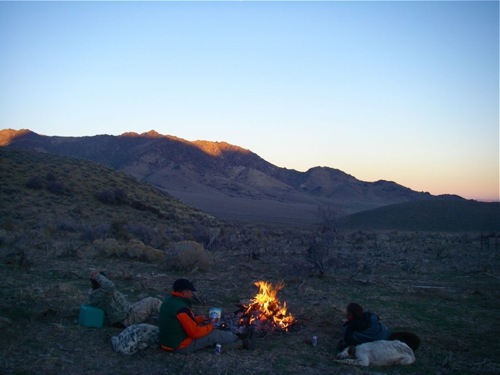
The first sticking came as we set up camp–a wall tent for cooking and a couple of sleeping tents. Two diesel trucks and an old Ford Bronco. Six bird dogs–four labs and two setters. Two cases of beer per person. A woodstove for the walltent. Firewood for the stove. A handful of cigars for the apre hunt. We got camp set up well enough, then I decided to move my old ’92 Dodge and the frozen earth I’d parked on dropped out from beneath me like Grandma’s Angelfood cake. We tried to pull it out with the other truck and sank that one too. Then we spent the entire day and half the next digging. We had radio coverage, so we dug and listened to the first game of the first round of the NFL playoffs, then we listened to the next game and the next. Gained a foot. Sank a foot and a half. The diesels were too heavy for the old Bronco to pull out. We put all of our firewood under the truck tires and not in the woodstove. We dug some more. I crawled under the guts of my truck and dug with a hand trowel. Got the Bronco stuck. Unstuck it. Broke a Hi-Lift jack. Got into the beer. Broke a tow strap. Went to the wall tent for more beer. Climbed out of the wall tent and retrieved muddy wedges of firewood from beneath the truck, light a fire, ate elk burgers and went to bed.

The next morning, we were at it again, digging. Broke another tow strap. Gained two feet. Listened to another NFL playoff game. Sank the trucks deeper. Then, anticlimatically, were out. Out.

Went hunting, one brother one direction, the other the other, me another following a wash of pent up dog-dom wound tighter than an eight day clock after 14 hours in the truck and 36 waiting for their human partners at the campsite mud bog. Six chukars later, I staggered back to the truck and found the Jack Mormons also with limits. We’d taken out our revenge on the birds. Reverse karma. It usually goes another way.

The morning hung low and gray and depressing, threatening more rain. We hadn’t seen a soul in three days. Not even an airplane. Rain would mean more mud. We piled into the Bronco, three guns, three dogs, three beers each for the post hunt.

The chukar were at the far end of the valley, up on a torn up patch of real estate, rock and mountain mahogany and sage and cheat grass piled up like tossed laundry. Between us and them were two stream crossings. In other weather, the crossings were arroyos. In this weather, streams. The first went well enough, the Bronco grinding and spraying water in brown sheets and then we were across. The second was less honest–an eroded bank and a cold stream of mud water and a sharp drop of more than two feet to the water, and the run out was not pretty either–another sharp bank that the Bronco would have to climb and then up onto the two-track and onto the chukar ground.

There was little discussion before the trouble started and if you talk to enough accident survivors, this is a common mantra–all of a sudden, without discussion, you are screwed. And we were. The drop to the stream lurched us forward in our seats and then the water pushed us hard left, downstream and the throttle roared and we washed out into the stream and farther downstream and then water came up over the running boards on the upstream side and we were indeed, screwed, blued and tattooed. We bailed. Dogs out. Guns out. Packs? Out. We scrambled to empty the old truck and the water washed it farther downstream. For a minute there, like a herd of elk taking rifle shots from an unknown location, we milled. Then the moment was gone and we were going, frantically pulling gear and tools, wading knee deep in strong current, balls puckered. Damn. Really? Did we just do this? My friend’s face was the color of piss porcelain.

“I’ll start walking.”

There wasn’t much to discuss. It was mid-morning and camp was eight miles away.

“Okay.”

I ran for a while, then slowed. Hunting boots. Ike jogged beside me in that loose-jointed, toe-dragging gait of his and I walked fast then broke into a run for a while. I’d been running to train for the chukar hills and it felt good after a day and a half of crawling beneath the pickup and only a half day of hiking. So I did this for a while, thinking now and again, of our predicament.

We had two good pickup trucks back at camp, but there was that first crossing of the stream. No jack. A tow strap that had been broken and retied and was now about six feet long. A broken shovel.

I ran again. Then speed walked. Ran. Walked. Ran. Walked. Ike wondered where the hell the chukars were. Ran some more. Ike jogged.

I heard it before I saw it, an engine somewhere, so far off it sounded like an airplane and I looked skyward and saw nothing except gray bile. Walked some more.  It got louder and then, it came around the corner like some sort of yellow metal dinosaur–a backhoe. We were well and truly stuck and here came the one thing that could really make a difference–a backhoe. The operator slowed and opened the cab and asked with the heck I was doing out there and I told him and he said climb aboard. And so I wrapped my right arm around a strut on the outside of the cab and Ike jogged alongside, going back the other way.

The Jack Mormons welcomed me like a snowbound wagon train cheering Jeremiah Johnson to the rescue. I hopped off and slapped skin and the operator–who was traveling to his mine site in the desert and just had happened to come that way that morning–extended the arm of that big hoe and tied a tow strap to the Bronco and half lifted, half pulled it out of the water. We fired it up and water and gravel shot out the tailpipe but it ran and we backed up away from the stream and damn near kissed the ground. We promised a bottle to the operator and then looked at each other and shook our heads and, without consultation, waded out into the stream and forded it, to the knees, then thighs. There were chukar to hunt, by God.

There are no photos. You are just going to have to believe me.

–TR

Occupational Hazards

“Hey man, hold his head so he don’t bite me…”

WSDGD21

WSDGD22

The End of Days

You could count the number of days remaining in the Idaho sharpie season on one hand. It had been a tough year, with a bird or two here and there, but the coveys were few and far between. Still, with the help of an up-and-coming first-season pup we managed to put one in the bag now and then.

Yet with the days waning in a season that always feels too short, time spent in the field was becoming less and less productive. We’d go to formerly fruitful areas, cover them thoroughly, and find nothing. I began to question if I knew what I was doing – truth be told, a state of mind as familiar to me as my favorite old Browning boots.

In such vast country, you try to cling to informed opinions about where the birds may be, and sometimes that works, but too often they simply burst skyward from places that hold no distinguishing characteristics. We’d been walking for hours, working our way through the subtle highs and lows of the landscape, hoping to stumble across the one indistinct anomaly that, for reasons I may never fully understand, just happens to hold birds on this particular day, at this particular hour. Nothing.

It was becoming downright frigid, and I was beyond spent. We headed back to the car, with Hank valiantly still trying to find birds right up till I opened the door. We got inside and sat there for what I think were a few moments but could have been much more, listening to the wind range southbound, shaking the truck, watching the light fade. I started the truck and drove slowly out on the gravel road. Looking up from starting the radio I watched the sharpie fly across the road, right in front of us, and disappear over the horizon.

Ultimately, the birds are not particularly fond of being shot, and they owe you nothing. You better be able to laugh or this pursuit will drive you crazy.