Genesis, Chapter III

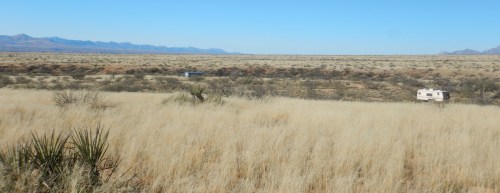
Our camp is at the base of one of those short mountain ranges that are so much a part of this part of the desert. Sky islands, they call them, where points of pine and even spruce wring snowfall from a dry Southwestern sky on a December night and a good walker can move through a quarter dozen life zones on a big day.

For the dog man, the islands offer much promise. The deep grass toe of the island—the beaches—whisper to you of scaled, or blue, quail. The catclaw-choked canyon mouths farther up the island’s flanks, speak of Gambel quail. Higher still, up in the oak savannah, that most treasured of quail—the pointing dog’s quail—Mearns, Montezuma, harlequin.

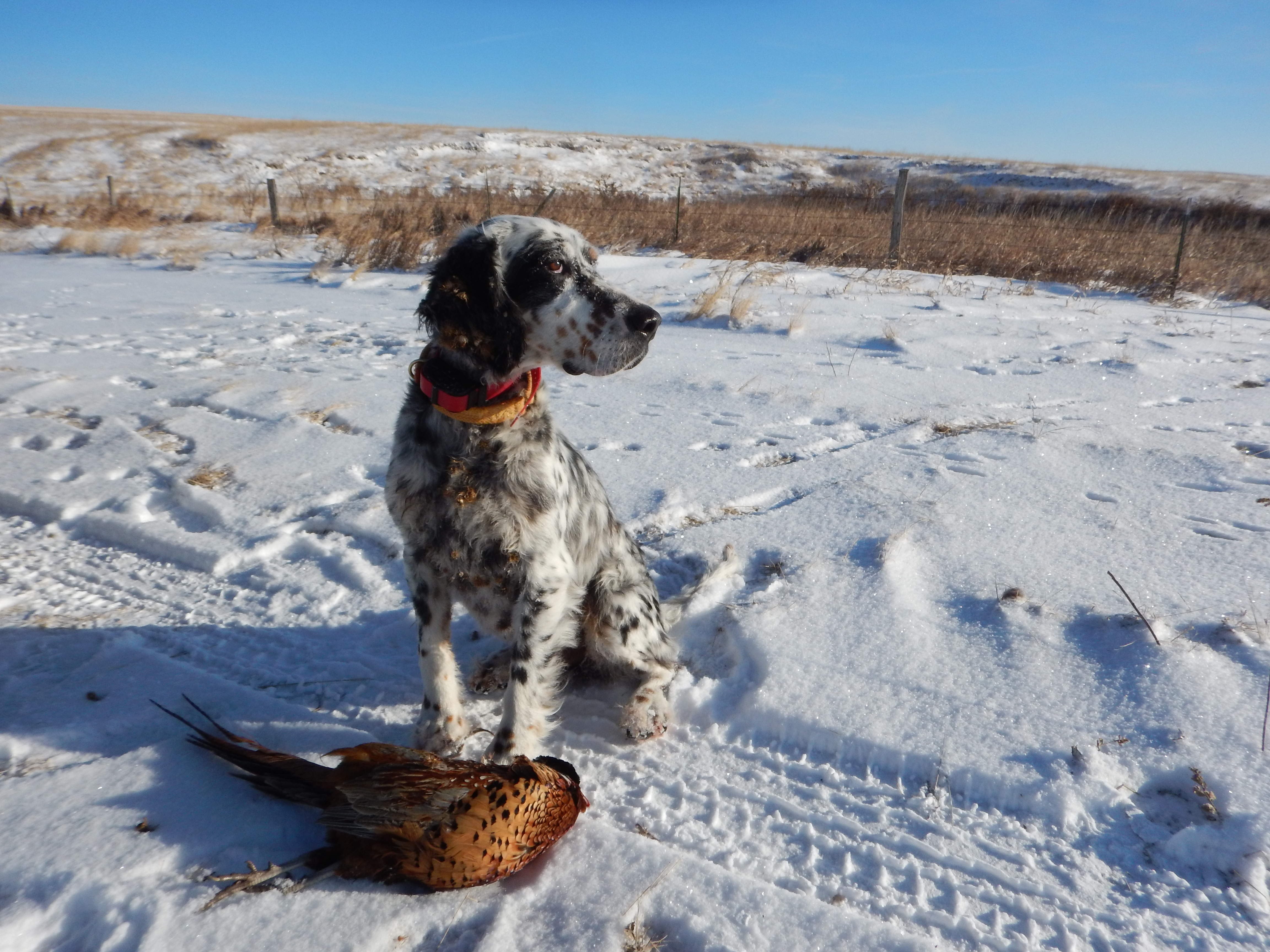
My companion on this month of adventure is a mentor, a best friend, a life-long personal legend. He’s 83 and he carries a good Belgian Browning 20 that he picked up in a Denver pawn shop more than a half century ago. Jim has one dog, a young female setter. I have three, but only the streak called Mabel is functional. The other two are old timers, males whose saddles have a lot of leather worn off the tree. They are along for the ride, and because I didn’t have the heart to leave them in wintery Montana. I pay for my softness with periodic visits to the truck in the middle of the night so they can get out to empty. I lift them down to the ground and when they are done, I lift them back up to the tailgate beneath a star-splattered sky. They groan with the miles. They have given their everything to me. A lifetime of everything and the least I can do is get up in the middle of the night to let an old dog piss.DSCN1264
I did all the driving and do all the driving. Often, Jim stays at camp while I climb out of the trailer, load up my water and Mabel’s, thumb shells into my vest, pack lunch, load the gun, turn on the e-collar.

Sometimes, I come down off the mountain tired, my game bag heavy with a half limit. At night, we cook quail and vegetables in a Dutch oven over mesquite coals, accompany the meal with New Mexico chilies.

In the mornings, I do it all over again. The days are as I want them to be. On some, I get in the truck and drive the two-tracks north along the island’s run, looking for new canyons and new coveys. One evening, I come back to a few fingers of good bourbon and show Jim a license plate from 1954 that I found on a rusted truck bumper out in the middle of nowhere, pinned against the thick tough trunk of a mesquite by a flash flood long dead.

It’s the same year I bought that Browning, says Jim.
 

Genesis, Chapter II

We climbed, this morning, on a rising bench from camp. The dog and I. We. We is just her and I.

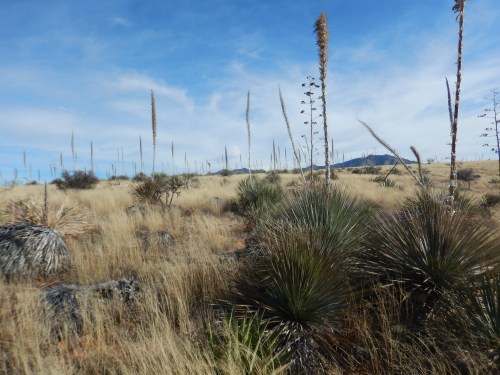
I followed her into the tall grass and the coming sunlight, sometimes seeing her bounce through, then gone again. Pushing past Spanish dagger and catclaw, hoping for desert quail, heading toward a distant patch of oak up the mountain. The ache of two days of hard driving, of nights spent in a cold trailer on the side of a road, of more road, and more ‘truck butt’ and a diet of spitters and Mountain Dew is not even really a memory. Or an ache. It is winter and I am wearing a t-shirt and worrying about the heat on a dog that is used to Montana late pheasants.
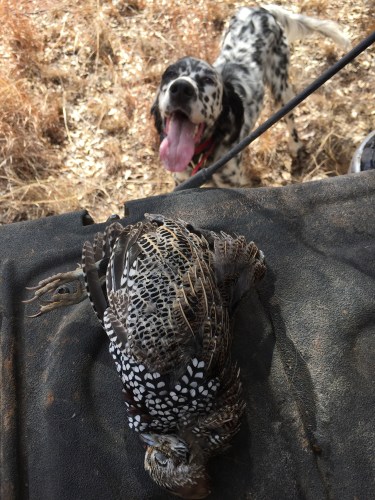
Now, with two Mearns in the bag, we are above the bench and several miles from camp. The morning produced no desert quail and no points. Two quail shot off wild flushes, two “training birds.”

We sit for a time, me to slow pulse, her just because I make her. She waits. Doesn’t want to. She leaps to her feet every time I shift. And I make her sit down again.  And finally I rise for good, and we work down off the mountain, trying for new country, new cover.DSCN1268
At the base, down from the oak savannah, we hit the century plants and mesquite of a different life zone, and work past the remnants of an old mine. The shell of a Model A Ford rusts away in a dry climate, intact save being shot full of number eights from what no doubt was a frustrated quail hunter.
I whistle her in again, calling her close as we head toward a water hole where I’m hoping she can cool off. The heat is rising now, full sun and pushing up into the 60s, maybe even the 70s. Coming up.

She has only a moment to lap muddy water when a covey of Gambel quail burst from the other side of the arroyo and fly one hundred or so yards. I mark them down, call the dog in, keep her close, and move in, knowing they probably won’t be there when we get there. Nevertheless.

We drop into the leavings of the most recent flash flood, then scramble out, moving closer to the place the covey went down. Thirty birds, maybe? I talk to her softly now, keeping her close, trying to walk light on soil that is more granite crumble than dirt.

She flanks left, then slams to a stop, tail up. Point. Point! By God.

Three birds burst from the cover.

Genesis

The first bird up is a harlequin male, whirring a bit behind, left to right and going fast. The gun is up, swinging, leading, barking. The bird is down. Just because. Just because this is what we are after. Not a tweety. Not a meadowlark. Not a kangaroo rat. Quail. Mearns.

She is on it now, picking it up, spitting it out. Setter-style. This is what we are after.
The “making of birds” had been a furious tail wag, but the human translation of canine language saw it little different than mousing or tweety-birding. No offer of pointing. Making birds, yes. But hunting birds? Not even. But the male Mearns is down and dead and I’m squeaking happy noises and she’s grinning and jumping up on my belt and I’m good-girling in an excited voice. Oh, this is what we are after.

IMG_1113
The next bird is the same, frantic wagging, but the bird out wild before she can point. Shooting this one too and she is sprinting and sniffing at it again.
There have been Huns and roosters and grouse and chukar.

These are the first quail.

—TR

A MOF update

You can tell it’s a good bird year because everyone would rather hunt than write. Still, it’s been unusually quiet around here, so I thought I’d let everyone know that MOF is alive and well and give you status reports from a couple of the writers here.

  • Tom – Bought a new truck, loaded his herd of dogs in the back and threw his computer in the river. When January rolls around he’ll either be back with a ton of new MOF material or we will have to turn MOF into a fundraiser to free Tom and his pack of setters from a Mexican prison.
  • Bruce – I think he’s out hunting recovering from a bike accident, but it must be a super secret spot. I checked all his usual secret spots and didn’t see him, so I hunted them just a tiny bit…
  • Chad  – AWOL. I’ve heard that bird populations in the southwest are exceptional this year and that may have something to do with it. Chad said, “Tell everyone bird hunting sucks in Oklahoma and Kansas.”
  • Greg – Went old school and had another baby. Look for late-season MOF posts with baby in tow. The good news is, his shooting can’t get any worse if he carries a baby instead of a gun.

One good dog. And then another.

DSCN1234In this life of dogs and birds and the march of boots across the uplands, we are often struck by the unfortunate irony of losing a good dog after only a dozen years. It is unfair, we dog lovers think, that we humans are awarded with such long lives and such a wonderful animal as the canine is cheated with a short one. This past April, I put another good dog into the soil after a baker’s dozen years on this blue marble and I thought to myself, “that was the dog.” One good dog, one good woman, one good horse, one man once said.

Twenty years ago, on a hot June day, I put a good dog into the sand at the base of a chukar cliff in the middle of nowhere and as the sweat ran into my eyes and the tears ran out, I thought to myself, “that was the dog.”

And while it is true there will never be another Hank or another Sage, that old maxim of “one good and that’s all you get” is as false as the twinkle of pyrite in a prospector’s pan. The truth of this comes home to me this season as I try to rein in another amazing soul that has come into my life. She is fire and charge and zip and zing. She is faster than I can remember any of the others before her. She is smarter than them too. Or at least as I remember them. And therein is the secret: memory is a trickster. And another truth: there will be another one; it won’t be the same, but it will be different in some ways, better in some ways, and a gift. A true gift.DSCN1196

From the dog’s perspective, perhaps a dozen years is a cheat. But on this day in deep autumn in the full throat of another season of following the perfume of the uplands, I vow to myself to make her years varied and spectacular. I promise to grind the tires off my pickup and the soles from my boots in pursuit of her ultimate joy. And mine. There will be more moments of spectacular glory and pure puppy chaos and I will walk on, shotgun in hand, thinking about what a fortunate man I am, have been, and will be.

—TR

Six Months


A blue grouse is in trouble.

In my stronger moments, I tell myself it’s going to be okay. That it has been a good run and she has been loved. That she’s been my bird dog and I’d like to think, somehow, that this life I lead is a kind of version of canine heaven. Especially for gun dogs.

But I have weaker moments. Sometimes, they come in daylight while she lies in her dog bed beside my desk. Sometimes they come in darkness when I lie awake and listen to the sound of her breathing, a sound not unlike the crackling of plastic wrap in a fist.

I’m home this week early, a trip to Oregon’s coastal rivers of steelhead cut short. I don’t mind. I want to be here, not there.

It started a month or so ago, the huffing cough like a throat-tickle that can’t be cleared, and in a thirteen year old dog, I didn’t think much of it. But the kennel where I boarded her when we went on holiday vacation is owned by my veterinarian, and she, being an alert practitioner of the medical arts, asked. Have you noticed a cough?

So we shot a film and drew some blood and tried a dose of antibiotics, thinking, perhaps, that the shadow in her chest was an abscess from an inhaled grass seed, a common affliction of dogs who drink the wind that brushes bird. A month later, the coughing still there—sounding wetter—and another film. This time a gloom in her lungs like boiled smoke from a slash pile that had jumped the dozer line, metastasized and blown up into a wild fire. Even before a layman’s eyes.

There will be no chemotherapy. I will not make her final months any sicker than an old bird dog at thirteen can stand.

Six months. In six months, it will be bird season again. Another September.

There have been other old dogs. But this one has owned my heart more than any other. This is the one that inspired my friends to buy their own pointing dogs. She has been a spectacular finder of wild birds, a retriever whose retrieves are as memorable as the vision of the Comet Hale Bopp (and only slightly less rare), and never-fail backer of other dogs’ points. She has made so many stunning bird finds that they are lost to my memory just like living at the base of the Tetons makes one forget about the staggering scenery on the horizon.

The other old dogs went out of my life without a clock ticking. One day they were old and I could see the dwindle  in them and then they were gone. There was no egg timer to the whole thing. So we have six months until bird season. Maybe longer, maybe shorter. Six months of riding in the pickup cab with me, six months of jerky treats, six months of canned dog food and pretty much any damned thing she wants. Six months when I will try to be here rather than somewhere else.

Six months and one day, perhaps with September painting the grouse woods and grasshoppers rattling along North Willow Creek where I will do the sad work with sharp spade, I will know.

I will know that the countdown to the end of the dog has ended.

—TR


Two for the pot.
Two for the pot.

On getting even

DSCN0634It would be, by all measures including wallet width and vacation time, the last hunt.

As if to commemorate the occasion, a blue storm swept out of Saskatchewan, carrying that thin, cruel snow that comes only with subzero weather. Too cold for big flakes. Mean little ones.

Six hours on the road turned into seven and then we were finally there, at the bar, beers before us. Minus twelve outside. Tomorrow, into it. Minus twelve boosted down to minus thirty-two courtesy of our northern wind. Thank you.

I looked at her, sipped my beer, and grinned. “Tomorrow,” I said, “we get even.”
She looked at me as if I were crazy. No, check that. Not as if.

At seven the next morning, coffeed-up, cafed-up, we were at the first cover, snow screaming beneath our boots. The dog paddled out into it, stopping to chew clumps of snow from his toes, but pushing on, collecting burrs as he went, but eager. Minus thirty two with the wind. What the hell? I couldn’t stop grinning and then a rooster went up. Close, cackling and the auto loader was at my shoulder, barking once, twice, and the bird was down and the dog on him and then the bird in hand. Getting even.

Getting even for all of those wild flushes two hundred yards from the gun even after you’ve been careful with the truck doors. Even after you’ve whispered to the dog, heeled him tight until ready. There they go, a whole fucking field full of those bastards, all at once all in the air, all gone before you even have time to piss, zip up, and load the gun. Motherfuckers. I do not apologize for foul language and feral fowl. Pheasants. Or chukar, too, for that matter. Neither are a gentleman’s bird.

The blood in our veins flows like a slow river of lava into a cold ocean. We turn, move back to the truck a mile away, frozen, fingers tight. The dog chews more chunks of ice. Thank god for wool everything. Fingers and toes cold. The tip of the nose. But we are getting even with the bastards.

Drive to a new cover, trying to warm in the old Dodge, the heater going full blast and the temp gauge still not up to normal, despite an hour of idling. Dog out again and then we are in the chokecherries and another big gaudy sonofabitch gets up and swings out overhead and the gun barks and then jams solidly in the cold, doesn’t feed the second shell, but no matter because the bird is down and and the bird is dead.

We move on. The dog makes birds again and another big rooster gets up tight and close and I swing and shoot and the gun jams again. Too damned cold. But the bird is dead and by the time we get back to the truck and gut both of them out, they are cool and stiff and going frozen. But we’ve gotten even. For one day. A limit of roosters. Makes the vengeful heart happy.

Coffee handed out from the gal at the kiosk, a big smile and a shake of the head for anyone out hunting pheasants in twelve below. No one understands. It’s late season. It’s pheasants. It’s revenge.

The next day, out in it again. Up to minus twenty-two now. Wind chill. Still air, if there were such a thing, minus ten. A heat wave. Plugged the truck in at the motel last night. Good move.

Different dog this time. Same technique. Close, quiet, slow but before we’ve had to a chance to enter the good stuff, birds start going out, threes and fours and fives, some cackling. One hundred yards away. Not our fault. The doors were shut quietly, the dog close. Different day. More out wild and I get one quick shot, freezing and slow and a miss. Hit well yesterday. Missed first shot today. That’s all. We try to hunt up the singles, the pairs, but they go out wild before we can even crunch over there, frost in my beard, frost in my lady’s long hair, making her look prematurely gray. It’s a good look, I’ve got to say. A harbinger.

Different cover, another dog and the same result, birds out wild before we’ve even straddled the barbwire. Not the dog’s fault. Not the doors. Cursing.

We move up and even the hens are wild, going out in twos and threes, the dog working close and well, a veteran dog. Chewing snow and ice from pads. Too cold for more than one good run with one dog and then trade off. Finally, at the end of the quarter section, he goes on point, fairly close, a solid-something-is-right-here point and a big old gaudy cockbastard goes up and I swing up. And fumble the safety with my gloves in the subzero. That’s my excuse. And the bird is off and away and I shoot little more than a send off shot. A wide miss that I know is a whiff before the sound even comes to my ear. The day is an empty bag.

Not getting even at all.

—TR

Where it went

DSCN0595I will never get used to it. The suddenness of it. In human, it is difficult enough. Wake up one morning and you’re having to use one point five readers for the newspaper. The tromp through the cattails seems to go a little slower, the truck’s warmth a little more welcome. The fire for another push needs more stoking. It’s more of an erosion, a slow spin.

But in canine, the slap of years is stunning. One day you look down at her and she’s an old lady, her joints swollen by arthritis, various bumps and warts in her hide, a once-stunning feathered tail now something a rat might sport. She totters where once she used to float. She huffs and coughs at the fountain she once drank.

We drive east, across the roll of Montana, past coulee and pine, pump-jack and silo. Past corn and scrubland to the Dakotas. It has been a long span for me and for her, this leave from the Dakotas and now it is late in this season and late in her life and I wonder how it all happened.

She gets the princess perch, behind the driver, the other dogs in back in the camper shell. She rides in the warmth of the cab for after a dozen years of bringing me to all of those different birds, the least I can do is bring her into the truck where she can curl in a tight ball against that rat tail and snore.

There have been other trips. Many.  I view her mostly backward. Pups are forward, what lies ahead. Old dogs are what you have been and what they were and what it once was. Over the shoulder, behind, when she was young and the truck had one hundred thousand miles instead of twice that and she had ten thousand miles instead of twice or thrice that. I will make one trip to the Dakotas this year, one visit to the river of scent that is hundreds of pheasants in one section of CRP. This journey, I tell myself, is for the young pup who is fire and burst, an uncontrollable effervescence of puppy joy. But really it is for grandma, kinked with time, crippled by the uplands of the Dakotas, Montana, Wyoming, Nevada, Idaho, Arizona, New Mexico. Knotted and rusted by roosters and blues, sharpies, ruffs, sprucers and sage chickens, chukar, Huns, Mearns, cottontops, Californias, mountain and Gambel. It has been one hell of a run.

So she sits behind me as the diesel growls east, through Baker and Hettinger and Lemmon and Mobridge. East. Toward. One last trip, one last bird, one last point. Please, God, just one more.

—TR

Worn

The price of admission is what your are willing to put in and how much are you willing to sweat, not just in October, but in April and July.

The sun is dropping to the southwest as we slog 200, 500, 800 feet up. The dog ranges ahead while I put one foot in front of the other, sometimes searching for a footing, sometimes skidding and sliding, clawing at the scree and the grass.

At the top, sweating and panting, my fingernails caked with dirt, I take a drink and feel the wind instantly turn the sweat of the climb into an uncomfortable liability. I look west and see the sinking sun against the backdrop of the Snake River Canyon. I know we may find a covey of birds before sundown. Or we may not. There are no guarantees. There are no planted birds, no mowed pathways. Flat ground is a rarity and birds, when you find them, are always uphill.

GregMcReynoldsBootsOct2014 (1)

What brings me to this place is the rawness of it. The opportunity to go where I wish without the burden of “posted” signs and knocking on doors begging for permission. There is no freedom like the freedom to Go. Miles to cross, mountains to climb, spaces to camp or hunt or hike, places to push ourselves and stretch against the bounds of modern convenience, here are the last places where we are unrestricted. Truly Free.

So I find it particularly galling that a few greedy bastards want to try and take it from us. For many of us, the loss of our public lands would be akin to a prison sentence. We can’t afford to buy access and we have no desire to take up golf or play video games.

For the most part, the public lands we hold so tightly are not the verdant lowlands, those were snapped up by settlers 100 years ago. They are hard, wild places and what we do is a hard scramble. There are days where I don’t even fire my gun. This is miles of hiking, climbing and pushing to find the secret spot – the one place so difficult that no one else has hunted it. The spot where the price of admission is so steep and daunting that only we would dare to chase birds in this place. Some days my dog gets one solitary point and all I have to show for it are sore legs and worn boots. Those are good days. Out here, It is not about killing birds, it’s about earning birds. In this crowd, people rarely even say the word “limit.”

A lot of other folks don’t understand. They tell me they gave up hunting when the bird population dropped, or that there is nowhere left to hunt. And if we talk about the flat-ground fence rows that used to hold hundreds of roosters for the price of asking, they’re right. Those places are gone, tilled up or simply sold off to folks richer than us.

And that’s the beauty of what we do. There are millions of acres open to hunting. All it takes is a good pair of boots. A good old American-made leather pair with heel counters and high tops, laces and spares, toe caps and Air Bob soles. The price of admission is what you’re are willing to put in and how much are you willing to sweat, not just in October, but in April and July.

I spend three times more money on boots than I do annually on shotgun shells – because I wear boots out.

The greedy bastards who want to sell my lands – the ones who want to carve the choicest parcels for themselves while selling the bulk of it to the multinational corporations to pillage and plunder – they have not earned that right. No one who has worn out a pair of American made hunting boots thinks we should sell our public lands. No one who has climbed to the top of Giffy Butte or Nowhere Ridge looking for chukar or elk or muleys thinks we should sell off those places to a bunch of rich, foreign bastards with Land Rovers and jacked-up golf carts.

My boots are worn and cracked, but I have paid the price of admission and my heart is full. The new robber barons who are calling for the sale of our hunting lands under the guise of “states rights” have not paid the price of admission. They have never worn out a pair of hunting boots in their lives.