
It might be another ground squirrel, but you gotta check it out…
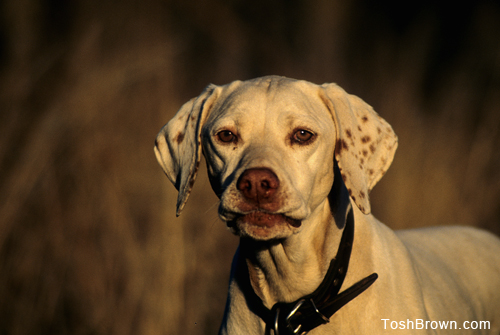
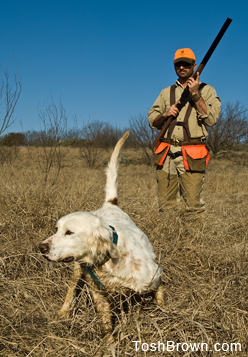


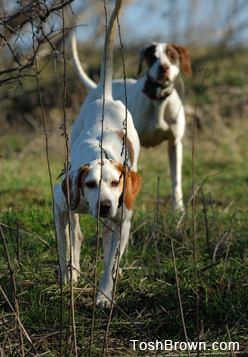
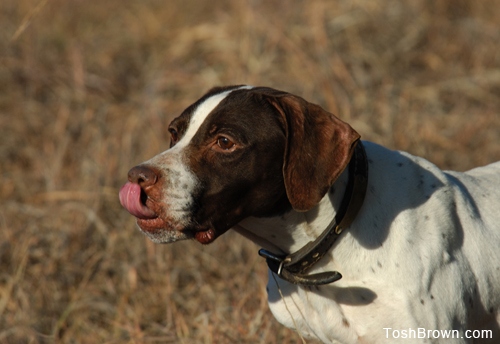


Sometimes, she is lost in the crowd, run-over, crotch-sniffed and dry-humped by big males.
But somehow, she always finds her way to the front and she is there, frozen and steady. Cat-like on the creepers. Chukars and pheasant and sage chickens mostly. The walking birds. Moving now. Then frozen.

The males, if they pay attention, nearly always come in second. When she is second, or third, or fourth, she gives quarter without complaint. She honors. Literally. She honors friends’ Griffons and short-hairs. She honors big white rocks. She honors feed tubs and salt blocks.
And she honors me, especially on the days when it is just her and her fine nose and her glide and float, her creep.
A friend watches her from horseback. She’s working sage chickens. She is a cat, and looks over her shoulder: “Um is someone going to come shoot this bird?”
And she moves as the bird moves, never pushing too far, stopping now and looking back at us and the friend is off the horse and moving in. “Okay, it’s about time.”
And slinking and then frozen and then the bird goes up and the gun barks and she has honored me once again. Make it last, this rare privilege, this fine honor, this sweetness.
– TR
There is just this. Windswept cheatgrass and sage, gradually ascending, wrinkled and folded in places like a well-used blanket. In the distance, steep rock and dark forest and blue grouse and elk and cougar all move under cover, but out here it is only the sheer vastness that aides concealment.
The steady gait of a horse, covering time and distance you’re unaccustomed to on foot; a horse that exudes the sort of disposition you want to take to the horizon. The rhythmic creak of saddle leather mixing with the wind and gurgle of ravens, trading precedence with your thoughts.
Dogs, possessed of incomprehensible drive, vacuuming the arid ground for scent before you. A sudden point – the kind of full speed to a stop that makes you think the dog is going to flip ass over tea kettle with the abruptness of it. Men, horses and dogs all stop in honor. A quick dismount, a few steps forward, a release command. A bird gets up and then tumbles over the knoll.
You can make more of it, if you’re so inclined, but really, sometimes, it is far better when it is just this.
– Smithhammer
Hunilingus?
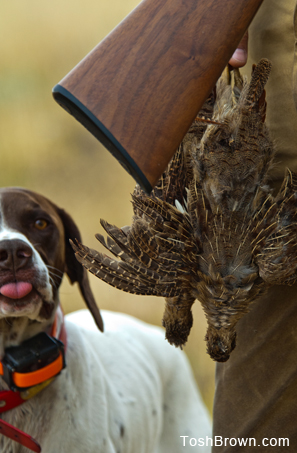
Sometimes, I forget what I’m doing. Seeing him locked up like some ancient, graven image, with a level of simmering, white hot focus beyond anything I’ll never truly know, yeah, I’ll admit that I can easily forget everything else, including why we’re supposedly here. That there is an unseen third party somewhere close by. That this is merely the prelude to an explosion that can go any one of several different ways. I want the moment to continue; this traingulated tension to be savored indefinitely, but all such swings of the pendulum eventually seek equilibrium, and the longer the build up the more abrupt and chaotic the release tends to be.

But sometimes, all of this just goes out the window, and I look at him, truly dumbfounded by the capabilities of this high-performance animal, and the ways he must experience the world so differently from my own, though we stride through it together. I’m so distracted with admiring the beauty of this point that the bird gets up and I’m not ready and I feel like a head in clouds idiot. And the briefest of glances from over his shoulder makes me feel even more so. But he immediately forgives and forgets and throws every bit of himself into getting out there and doing it again, and it is this, not the missing of the shot, that lets me know I’m the lesser of two creatures here.
The frequency of this doesn’t decrease with experience. In fact, quite the opposite.
– Smithhammer
 Grasshoppers whirl at my feet like playing cards snapped into a stiff wind, a sound that is enough like a rattlesnake to skip my heart a couple of beats. This is snake country, and they are still active, even now with mornings frosted and the aspens stripped naked. I tell the white setter to watch out and stay close to my side.
We have only a few hours of light left in the afternoon and one thousand feet to descend. The air seems frenetic, everything sun-baked, hot, late in the day and year. Even the hoppers seem hurried. Or maybe it’s just me.
Most people are hunting elk and deer, but the river calls. I can’t hear it from way up here, but it sings to me. I know the flow is low enough now to wade and the water clear enough to fish. The last hoppers are on, defying autumn. Go. Headlamp in the pack, hair-and-feather hoppers tied the past winter in the box, cold dinner of elk salami and Havarti in the bag. Go.
So we drop off the rim, and I can feel the pain of it in my quads almost immediately, half jogging, power hiking down into the canyon. There is a faint game trail that someone, damn them, has flagged with plastic tape. My secret place discovered. I’ve been scrabbling down into this canyon every year for ten years. This is my one trip for the year, and this one only a few hours squeezed between walls of sheer limestone. Not many make the effort. There are easier fish and gentler places.
I stop long enough to yank the flagging down and call the dog off a family of grouse he’s pointing. The trail fades and then disappears, and I’m in the thick north-side Doug fir with gravity as my only guide. I ignore the feel of my toes hammering into the boots. Is that a hot spot developing? To heck with it.
Finally, the river. It is squashed down here, flowing season’s-end-low through limestone boulders shed from the top. The river pools, then rushes, twisting. Both banks are too steep and tangled to hike. The river is the only path and only if you are willing to get wet. I rig the fly rod and tie on a hopper, wading into the first pool, heading upstream. The dog stays at my side, pointing fish now instead of birds, happy to be trembling in cold water, watching the trout rise.
The first is a brown, ten inches, sides sprinkled like he’s been rolled in black pepper and cayenne. The fight on the two-weight is brief, fun, then over. The next is a rainbow, complete with rainbow acrobatics. The next is a brookie. And so it goes, good fishing in clear water with big flies. Reward for sweat. Made sweeter by the effort of the hike, the urgency of the late hour and season. We wade upstream in the shade of the canyon walls, in the fading light of an October day.
By the time I fish back downstream to my stowed pack, I can no longer see the hopper riding the waves. The hike out, up, will be in moonlight and headlamp. We will take our time on the climb, however, for now there is only sleep ahead.
Fall comes with a quickening in the heart. You smell it early, maybe. Even in the hot years, perhaps as early as August. It happens suddenly. One morning you are standing on your front porch sipping your coffee and it dawns on you how cool it is. There’s a smell in the air, too, a smell of grass cured by the sun, of leaves, of sap, of faint thin wood smoke. Now your attention turns to the aspens on the hill above town and to the alder along the creek, watching, waiting for them to signal the beginning of it.

One morning, you notice a thin line of ice on the horse trough, like salt rimming a margarita glass. It won’t be long. Not long now. You start to dream when you are awake, just as you did back in April. They were vivid conscious dreams of salmonflies and caddis and trout rising above willow-blanketed islands. Dreams of summer coming. But now your dreams are laced with the smell of wet, happy dog, of elk bugling, of leaves changing and falling, of grouse warm and sun-dappled in your hand, of gunpowder and dog bell.
Autumn is a season that sings of harvest and bounty. Yet, on some days, it is still hot and sweat streams down the center of your back and you worry about hanging meat and fret about blowflies and rattlesnakes and loud leaves crunching under your boots. But it is time to harvest and there is not much time. Most days leave you happy, harvesting, collecting, breathing those great smells.
And yet with fall comes a sadness that washes over you for no apparent reason until you realize you are mourning the good things of summer lost. Still, you remind yourself of the peril of this melancholy path, of the fact that summers, like loves, are remembered only for the good things. Summer may be gone, but gone, too, are the blistering long, hot days, the parched landscapes, the mosquitoes, the horseflies, and the rivers with water too warm and low for healthy trout.
Early on, you look at your calendar and cross out days. You’ve hoarded your vacation time for this season and the Xs made by your pen take up days, then weekends and finally, whole weeks. Bird hunting. Antelope hunting. Berry picking. Wood gathering. Bird hunting. Harvesting the garden. Canning. Elk hunting. Deer hunting. More bird hunting. Listening to the Denver Broncos and the Wyoming Cowboys on AM radio. Hauling hay. More wood. You are awash in a frantic river of activity and then it hits you.
Fishing. You almost forgot fishing.
Autumn fly fishing is for the dedicated. The rivers have cooled and the action, at least the action of humans, has chilled a bit as well. Most have gone home and are settling into a season of football and cheese dip. So here, at long last, you have the rivers to yourself. If you are lucky, the hoppers will still be going, sometimes as late as mid-October. And if you are really lucky, the big browns will be on the move.
In late October, from the Miracle Mile to the Big Horn to the Green, the fish that we have credited with legendary intelligence, a trout worthy of kings—King Brown himself—will be on the move.
They run into the rivers from the reservoirs and up the rivers into the streams, and up the streams to the cricks. In October, it is entirely possible to catch a brown trout as long as the crick is wide. Big spawners, with sides as yellowed as the meat of a ponderosa pine. If you tie into one of them on your new four-weight, you’ll pray for its spine, its soul, and thank gawd that the manufacturer has a breakage guarantee, and you thought to bring a back-up rod.
The big brown boys of autumn react quickly to well-presented flies, as if enjoying the cooling of the water. They’ll slash and slam into grasshoppers and other big dries, while beneath the surface, they hammer Montana nymphs, girdle bugs, and wooly buggers. There’s nothing subtle about a fall-run brown trout. They have sex on the brain, and like bull elk, thinking about sex can get them into trouble. No longer are they delicately sipping those size 22 midges on 7x tippet. Instead, they’ll knock the snot out of a size 6 muddler fished on 4x and leave a hole in the water that seems to take forever to fill back up.
Rainbows and cutthroats, too, seem to frolic in the cooling waters, taking some of the smaller stuff on top, perhaps following the spawn of their brown cousins, perhaps just feeling the urgency of the shortened days. Brook trout run now as well, wearing colors almost too gaudy for nature, reds and blues and greens. They are hungry, and they act quickly and seemingly without premeditation.
The beauty of fall fly fishing is you can wait for the sun to come up over the rimrock before you leave the truck. You can wait for the waters to warm a bit and for the scattered hatches to come on, for the frost to metamorphose into dew, before you rig up and pull on the waders.

You’ll fish well, for the whole summer of fishing is behind you and your moves are practiced and honed by solstice-length days.
This short fall day finds you moving carefully among spooky trout, false casting just enough to get the job done, easing over boulders slick with the dying algae of summer. In the cool water, the fish you land fight vigorously and swim off defiantly, still full of spark. Each one you land has you wondering, Is this the last one? Is this the last trout I’m going to land this year?
If you have planned your day well and have had enough smarts to leave the shotgun and bird dogs at home on this rare fall day, you will perhaps—midday and six trout landed—have enough time and the good sense to sit on the bank for a while. Here you can contemplate the vicissitudes of the sporting life in this urgent, too-short, best-of-all-seasons season. You’ll watch golden aspen leaves spinning boat-like in the water and once in a while, you’ll rise to your feet and cast again. You may even have planned well enough to have packed a lunch into your fly vest. Perhaps, you’ll take a break from this quickening of season, from that hurried feel in your heart.
But more likely, you’ll fish hard and return many trout to the water and then you’ll start to think about that dog. It sure would be nice to put him on some ruffed grouse today.
–TR
This essay is excerpted from Blue Lines, A Fishing Life, published September 2010 by Riverbend Publishing, Helena, Montana. For more information, check out http://www.tomreedbooks.com
Because you can always rein a pointer in, but you can’t make him go…


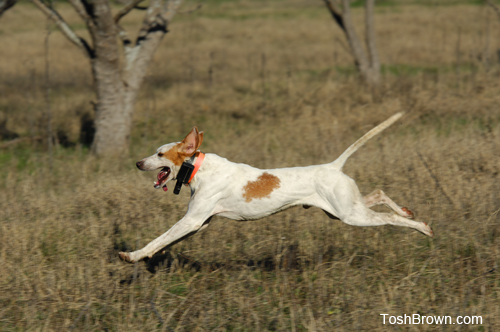

I surreptitiously scan the rim, then the fence, looking for anyone with a badge, ticket book or binoculars. Seeing no one, I reach down and slip the leash from her head. She’s still waiting.
“Let’s hunt,” I tell her. There’s no whistle today and she rockets past the big white sign and its list of rules (No glass bottles. Dogs must be leashed. No hunting…) before she checks back. I hike up near the escarpment coiled leash in hand.
She knows there won’t be hups or yells, so she’s watching closely and only takes a few tenative steps after the big old jack she jumps.
Then she tightens her swing and I know they’re close even before I hear them. It’s a pair and when she puts them in the air, they stay low and only fly 50 yards or so before landing in a shallow wash not far from another sign listing the rules. Breathlessly happy, she comes to heel and I slip the leash over her head.
These are fat quail, gambels and scalies that thrive on sprinkler water and bird feeders before heading back to the basalt and cacti to hunker down at night. Like the patch of open space they inhabit on the fringes of the city, they straddle two worlds.
They shouldn’t be here. According to the big white sign, neither should we.
GM
The solstice is weeks away, but the heat has arrived in New Mexico and the prairie rattlers are sun bathing. This guy was hanging out not far from my house last week. It may be the Hopi rattlesnake sub-species, but I’m no herpetologist and that’s only a guess.
It’s time to step carefully and keep the dog on a short rein.
GM
A couple of weeks ago the guy in front of me at the grocery store was paying for his sixer in change and I was browsing the magazine rack when I came across a quarterly publication called iPhone Life.
There is a magazine ($6.99) that is dedicated to the iPhone? And it’s in its second year of publishing?
I’m sure I don’t have to mention that there were no outdoor magazines on the rack. Not even a copy of National Geographic.
Not a single periodical relating something of the human experience, or any experience. Just celebrity gossip and a magazine dedicated to a cellphone.
This news so disturbed me that when I got home, I went to said rag’s Web site.
 The lead post on the Web site was titled “Why I Bought My Kids iPhones.”
The post starts out, “My kids are not spoiled (well, maybe a little bit), I bought them iPhones for economic reasons. Let me explain. The cost of a new Nintendo or Sony PSP is…”
My kids aren’t old enough to want anything other than milk and attention, but it seems to me that buying kids an iPhone might be counter productive to being a kid.
A phone is a tool. Hell, I have a Blackberry and I’ll be the first to admit that it makes my job easier and me more productive. Still,
I don’t want my kids to start obsessively checking their e-mail until someone is paying them to.
Much like a shotgun, it’s nothing more than a means to an end. I love shotguns, but the reason I buy them is the high lonesome country that I visit with them in hand.
The existence of iPhone Life suggests to me that some people might think their iPhone is actually part of their life or that it somehow matters what kind of phone you have or what you can do with it.
All this tells me that there are a lot of people who don’t spend enough time outside in the company of a good dog.

 Mouthful of Feathers