Hard to Argue With

The sign on the diner read, “If You Don’t Stop We’ll Both Starve.”

Hard to argue with, so we did.

And over cheeseburgers and home made fries we basked in all that days on end of hunting new country, on foot and horseback, with friends old and new, can do for the soul. Meanwhile, tired dogs curled up and slept in the way that only hard-working, contented bird dogs can – satiated, and I like to think, already dreaming of being afield again. By the time the pie arrived, there was more right with the world than seemed possible.

Though the hunting may be behind, the trip isn’t over till it’s over, and all these other details are still relevant – almost as important as watching a covey of Huns explode. Almost.

– Smithhammer

Unrequited

It’s not you, it’s me…

It’s not you, it’s me.
You are great – beautiful, classy, refined – but it just wasn’t meant to be.
I knew it couldn’t last when we met. You were out of my league – unattainable. Through some bad decisions on the part of your previous owner, I lucked out and we ended up together.
What we had was beautiful, but we both knew it wasn’t forever.
Let’s just go our separate ways and cherish the time we had together.
I’ll go back to my old, lowbrow ways. You will go on to someone special.
Someone with a gunroom, and maybe a collection of leather-bound books and an apartment that smells of rich mahogany.
I wish you all the best, and I will remember you fondly…

– GM

In Praise of Working Guns

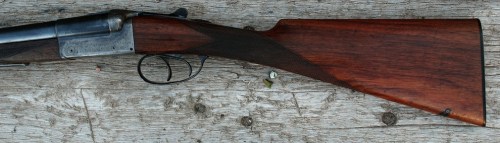
It is the gun I take into harsh, unforgiving, devil bird country without thinking twice. The gun that gets grabbed to ride in a scabbard lashed to the side of a saddle. It has broken my fall, more than once. It has taken doubles on wild chukar in near vertical terrain. It has been carried on in the pouring rain without thought of turning back. It doesn’t get cleaned much, but then again, it really doesn’t seem to need it, either. It doesn’t shrink from dirt and dust, it seeks it. It is, in short, a working gun – one who’s sheer, stripped-down functionality is it’s primary virtue.

There is a part of me that would love to be so resolutely practical as to own only this one gun, and in many ways, I’d probably be all the better for it. As the saying goes, “Beware the man with one gun, he probably knows how to use it.” But the truth is, I own others; guns which are nicer, though stop well short of aristocratic – a line that my pocketbook and my ego are loathe to cross. But this simple, unadorned pump has a well-earned place in the gun closet. Perhaps a place disproportionate to its cost given the company it keeps, or more likely a direct result of it.

And while I’ll probably never be self-disciplined enough to limit myself to this one gun, I’ve developed my own, similar adage – “Beware the man who doesn’t have a simple, working gun in the gun closet at all – something’s not right.”

– Smithhammer

Sweetness

Sometimes, she is lost in the crowd, run-over, crotch-sniffed and dry-humped by big males.

But somehow, she always finds her way to the front and she is there, frozen and steady. Cat-like on the creepers. Chukars and pheasant and sage chickens mostly. The walking birds. Moving now. Then frozen.

The males, if they pay attention, nearly always come in second. When she is second, or third, or fourth, she gives quarter without complaint. She honors. Literally. She honors friends’ Griffons and short-hairs. She honors big white rocks. She honors feed tubs and salt blocks.

And she honors me, especially on the days when it is just her and her fine nose and her glide and float, her creep.

A friend watches her from horseback. She’s working sage chickens. She is a cat, and looks over her shoulder: “Um is someone going to come shoot this bird?”

And she moves as the bird moves, never pushing too far, stopping now and looking back at us and the friend is off the horse and moving in. “Okay, it’s about time.”

And slinking and then frozen and then the bird goes up and the gun barks and she has honored me once again. Make it last, this rare privilege, this fine honor, this sweetness.

– TR

Waiting For Godot (Upland Version)


Scene:

Late October, overcast. Two hunters are conversing in an SUV, driving through CRP fields somewhere in Idaho. Though it is 35 degrees out, windows are partially rolled down in defense against persistent dog flatulence. As a result, wind turbulence fades in and out in the background throughout the conversation. Both hunters have hardly worked at all for the last month in order to devote more time to chasing birds. Hunter #2, in particular, has hunted something like the last 25 days in a row…

Curtain Rises:

Hunter #1: Talked to Q last night. She said she’s taking tomorrow off.

Hunter #2. Cool.

Hunter #1: She said she’s got some stuff to do in the morning, but it sounds like she’s psyched to hunt the rest of the day.

Hunter #2: I thought you said she was taking the day off?

Hunter #1: Yeah, I did. She’s taking the day off.

Hunter #2: But….you just said she’s going hunting.

Hunter #1: Yeah. She is. She’s taking the day off.

Hunter #2: But…how can she be taking the day off if she’s going hunting?

Hunter #1: (Turning to look at Hunter #2) What? Yeah, she’s taking the day off – taking the day off from work. She has a job.

Hunter #2: Oh….from work….taking the day off from work…gotcha.

(Scene ends with both hunters now quiet and staring ahead at the road, dangling on the precipice of self-examination. Sandhill cranes are heard in the distance.)

Curtain Closes.


– Smithhammer

Lightning


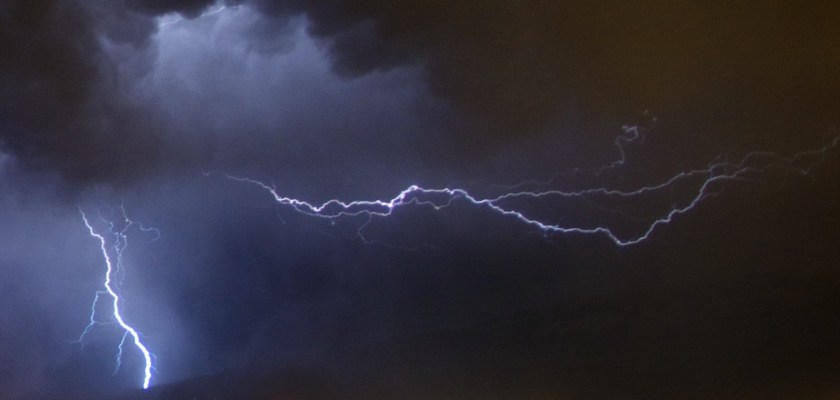
My skin tingles and for a moment I feel the lightning before it strikes.
Synapses fire, screaming at my brain and flooding my body with adrenaline.
I flatten myself further into the dirt, too late and to no effect.
The blinding white light explodes onto my retinas while a simultaneous explosion rocks my ear drums.
“Shit that was close,” I hear my mouth say.
I’m lying flat on my face in a copse of small pines on the edge of a high-country meadow. The towering ponderosas to my left are like lightning beacons.
The last summer storm of the year is chasing a cold-front across New Mexico, giving the mountains and those in them one last lashing before the snows fall. The truck – and my rain jacket – are a couple of miles south, two 10,000 foot treeless meadows away.
Another flash crashes close and I ponder briefly the possibility that I have been struck and my brain doesn’t know it yet.
The smell of wet pine needles is overpowering. When the thunder rolls into silence I can hear the hail pinging off of my pack and feel it stinging my skin.
I’m alive.
More so than I have been in weeks.

– GM

This.

There is just this. Windswept cheatgrass and sage, gradually ascending, wrinkled and folded in places like a well-used blanket. In the distance, steep rock and dark forest and blue grouse and elk and cougar all move under cover, but out here it is only the sheer vastness that aides concealment.

The steady gait of a horse, covering time and distance you’re unaccustomed to on foot; a horse that exudes the sort of disposition you want to take to the horizon. The rhythmic creak of saddle leather mixing with the wind and gurgle of ravens, trading precedence with your thoughts.

Dogs, possessed of incomprehensible drive, vacuuming the arid ground for scent before you. A sudden point – the kind of full speed to a stop that makes you think the dog is going to flip ass over tea kettle with the abruptness of it. Men, horses and dogs all stop in honor. A quick dismount, a few steps forward, a release command. A bird gets up and then tumbles over the knoll.

You can make more of it, if you’re so inclined, but really, sometimes, it is far better when it is just this.

– Smithhammer

Meat hunting

I’m two woodcock and a couple of spray-and-pray shots at ruffed grouse into the day when Henry’s little French Britt, Koda, goes on point. Or at least the beep-beep-beep of  his electronic collar tells me he’s on point.

I jam my way through the nasty tangle not yet suppressed by a real hard frost toward the dog. In this thick stuff you’ve got to be within 15 feet of the dog to see him, so I’m walking with the 20-gauge at the ready, unsure how close the bird might be. And then Koda moves, or least the tinga-ling of his bell tells me he’s moving.

And he’s back on point. Then barking. Then moving. And barking. And seemingly on point again. Weird.

“You see him Henry?” I yell.

“No,” Henry yells back. “He’s closer to you.”

Koda barks again, about the same time the beep goes off on the collar.

“What the hell is going on with him?” I yell to Henry.

And then I see it. At first I think it’s a fawn stuck in a muddy depression, but when my brain catches up with my eyes I realize Koda is standing – barking – a few feet from a mature whitetail doe with paralyzed hindquarters .

“Christ, Henry!” I yell. “It’s a deer!”

Henry emerges from his patch of thick alders just as I notice a quarter-sized hole on the doe’s spine. It’s a fresh wound, oozing blood, not a lot, and she thrashes around at our feet using only her front legs. I can see her backbone in the hole.

It’s archery season here, and I know the landowners have a couple of treestands hanging not far from where we are in the cover.

“We’ve got your deer!” I yell, thinking the archer would be within earshot if they were still in the woods.

Once it becomes clear there’s nobody but Henry, Koda and me in the woods with this deer we have to devise a plan. I run back to the truck to get my cell phone and a knife. I call  the landowner’s son – who’s still in high school – and ask him if he might have shot at a doe from his stand in the last 24 hours.  No, he hadn’t. Maybe his brother did? No, he hadn’t, either. A couple of phone calls later and it’s clear that whoever shot this doe is neither the landowner or still around. The game warden is called, and he’ll come around to tag it for us so we can get her out of the woods without violating any big game laws.

With little fanfare, I lay on the doe’s front legs, holding them tightly so she can’t swipe us. She doesn’t protest much, her bulging eyes the only real sign of panic. Henry takes the knife, tenderly caresses the doe on her neck just once, and plunges it into her jugular. She doesn’t die quickly, the blood gurgling in her throat as she bleats.

“They are tough bastards,” says Henry, as she flops and flutters. I notice he has blood stains on the knees of his pants. Finally, after a period of time longer than you’d think, the life drains out and her heaving chests stops moving.

The warden comes with the high schooler and his brother. We meet them on the edge of the woods and we drag her out. She’s legally tagged. They clean her and bring her to a butcher shop.

Henry and I finish our hunt – we found the deer in what’s really the sweet spot in the cover – and I manage to knock down one more woodcock.

The woodcock, too, is still alive when Koda finds it.

I just rap its head against a small tree. The bird does not bleed. It immediately goes limp.

– Matt Crawford