

Today is the end
The quail season that wasn’t
The drought lingers on
Today is the end
The quail season that wasn’t
The drought lingers on
Wind wedges its way between the boards, slowly deconstructing at a pace that could only be observed via time lapse imagery. A place where the roof was repaired with scrap tin lifts up, levitates for a few moments, and slams down in the breeze like a bad combover. Shards of glass and porcelain and square head nails and the remnants of a kettle litter the yard.
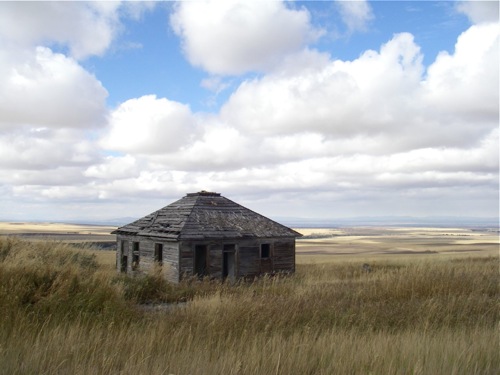
Was it a family that lived here? Did children grow up and fertilize their foundational memories in this eastern Idaho soil, sweating through hot, dry summers, shouldering the bitter winters with tough, rural stoicism? Did the children continue to think about the imprint of this place as they got on with their lives elsewhere?
Was it all harsh, toil and drudgery, or were there days when you could take in that view and feel the heart lift a bit from what was no doubt not an easy life?
Did they sometimes take an evening to stroll these fields in search of a few grouse for dinner, as I’m doing now? Did they venture into the high country not far from here in hopes of an elk to fill the winter larder?
These thoughts swirl around as my attention from the task at hand wanders and I explore the old house, testament to the existence of ghosts. But then I hear barking far in the distance, and a young GSP, who likely held a point as long as a revved-up two-year old pointer possibly can, is trying to leap in the air at three flushed sharpies, and he’s barking at me as much as he is at them, and rightly so.
In the age of high-tech fabrics and two-man tents that require you to spoon your hunting dog and leave your boots out in the rain, I had a revelation.
Wall tents are awesome.
The Romans knew it. And the Souix, the Vikings, the gold rush miners, the military, the Bedouin…
You can stand up. Room for the dog? Hell, there’s room for the dog and her kennel. Not to mention chairs, gear and that holiest of holy, a stove.

Yes, it weighs 60 lbs and no, it will not replace my dog spooning, ultralight, no-room-for-boots backcountry excursion tent.
It will however, keep me out of bed-bug infested hotel rooms where you can play “what’s that shape” with the stains on the sheets.
I don’t like hotels. I often don’t sleep very well in them and if it’s warm, I prefer a bedroll near the truck off some Forest Service Rd.
Of course, late season bird hunting and frigid, wet weather can sometimes mean cheap hotels. Not that I mind that they’re cheap. I like that part.
It’s the smell of stale smoke and mildew and lingering doubts that anything has recently been washed that makes it tough.
I stayed in a hotel a month back and as my dog surveyed a donkey-shaped area of discolored carpet, I wondered, “was DDT really that bad?”
Enter the wall tent.
It’s warm, roomy and comfortable and it is really no different from the tents used for hundreds of years by outdoorsmen of all sorts.
In the age of polypro, Gore-tex, nylon, pop-up campers and ultralight dome tents, it’s good to know that you can’t really improve on 10oz treated canvas.
That’s to centuries-old technology, I have a base camp. It’s dry and warm, free of bedbugs and since it’s mine, I can be sure there was never a burro massacred inside.
GM
It’s only after I have been through the drive through, paid and taken the heart attack in a paper sack from the teenage boy at the window that I notice my hands are covered in blood.
It’s only pheasant blood, but in hindsight, he probably didn’t know that. In my head, I start working on my explanation for when the blue lights flash and the questions start.
Luckily, I make it across the state line, no sign of pursuit.
On the short-grass prairie, near the Canadian River, I water the dog and wash the blood from my hands.
I have escaped.
It’s cold.
Seeing as it’s winter, it shouldn’t come as much of a surprise.
Apparently surprises the shit out of a lot of people though.
They are so surprised that many of them forget how to drive, or how to dress, or even how to take it in stride.
They forget how to talk about anything else. Don’t they know there are two weeks left in the quail hunting season? Or that ice on the river concentrates the ducks?

When you live in the Rockies above 5,000 ft, you have to know that’s it’s going to get cold sometimes.
The thing is, so many people never do more than brave the cold between their car and the front door of their office.
It makes them soft.
Unless they’re hunters that is.
If you have pounded through the snow clenching a 7lb chunk of frozen steel in your hands while following a deliriously happy dog, then what’s a little cold weather?
If you have felt your truck do the diagonal slide, where you look a bit like a crooked-gaited hound dog going down the road and asked your buddy, “We have a shovel, right?” Then what’s a little snow on the roads?
If you have knocked the ice off of your fly-rod guides so you could get an extra couple of feet on your cast, or sat shaking in the frigid predawn dark listening to elk, or taken off your gloves to cut the ice balls out of your dog’s toes, then what’s a single digit temperature mean to you?
Nothing.
It’s winter.
It’s what happens in the mountains.
It’s cold.
So what.
– GM
The road there  sings anticipation. Dogs grumble from the shell, butts and junk sniffed, dominance decided but as tentative and thin as September ice. In the cab, laughs and Dew and miles to go. This year a new place relayed by another with “don’t tell any-damn-one caution,” a place of memories yet made and you push it, this road. It stands in your way, between you and the reason, between the dogs and the birds, in the way of the canvas that awaits your paint and your brush. So you grasp steering wheel, cradle caffeinated drink in your crotch and shovel mini mart popcorn. At the end of the road, you will work it off on canyon rim and shale.
Once in a while you find a safe and lone ranch road–“no service”–and you pull down it and stand spraddle-legged and piss on cracked gumbo and tumble-weed scrap and let the pack out to piss on each other and sniff ass and walk stiff-legged around the stranger and grouch at him. Goddamnitttttttt, c’mon, Ike. Sonafabitch. And back onto the road, slab concrete beating radial in three-quarter time. When finally you hit dirt, ten hours of truck seat imprinted on your butt, BLM map folded out in your lap, camp circled in pencil, ridges marked with “CKR,” you crack the first beer and crescendo down gravel-clay. The dogs up on all four, nose to the crack-wind coming through. Wagging, whining. The blank sheet awaits your notes, maestro.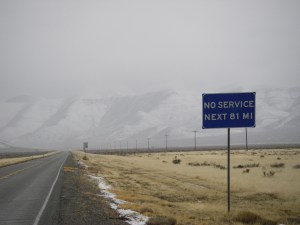
A week later the road home. Carrying one hundred pounds of Nevada gumbo in the undercarriage. One spare flat. Rock break. Cab stale cigar and jounced beer. Feet hot and damp in two-day socks. Legs tired and complaining of the hop from gas pump to steering wheel. Dogs flat and dead out, not moving for ten hours and then only to stiff-sore piss and back to bed. No whine no grumble. Founder on Winnemucca Basque, sleep in Motel Six between pipeline workers grilling Sunday dinner on homemade grills in pickup beds. Up at 3 into a gray dawn as overcast as your mood. Heading out, heading home and the road slapping on rubber . It went too quickly, this road, and a year is a long time.
“Language shapes the way we think, and determines what we can think about.” – Benjamin Lee Whorf
We have come to refer to rivers and forests, trout and elk as “resources.” They have become units that inhabit still other units. We now frequently hear the act of hunting referred to as “harvesting” or “collection,” or other, similarly clinical terminology. We have abstracted and reduced one of the most real, visceral experiences we have left in this modern world to the language of the bureaucrat and the commercial extractor.
There has, of course, been necessity to this. In order to converse with the bureaucrat and the extractor, to be taken seriously and to have a seat at the table, it’s become necessary to adopt their language, for this is the language that gets things done in our time. But in this linguistic shift, I believe something at the heart of this whole thing is lost, stripped of greater significance, reduced to the soulless level normally reserved for inanimate product or commodity.
Wildlife managers, and some in the conservation profession, maintain that this is the required approach for science-based conservation, and in a broad, and regrettably bland and mechanical sense, they are absolutely correct. Management of wildlife, and wilderness, has largely become about numbers, stats, population counts, carrying capacities, “maximum sustainable yields” and the like. It is not my goal to naively criticize this work, for I fully recognize its importance, just as I do its limitations. As mentioned above, statistics and quantifiable figures are essential in our day and age, if only in order to demonstrate value to a wider audience who apparently can value nothing else as highly. I know that this work is both important and well-intentioned. I support it as much as I possibly can, and am eternally grateful that there are those willing to fight the good fight on these stark terms.
Yet we also see this shift in language occur in yielding, consciously or otherwise, to societal pressures; to distance the dialogue surrounding hunting from being about something as disagreeable as “killing,” and even from it being something that involves living, breathing beings at all. I suspect that these modifications in terminology are not coincidentally linked with greater shifting views in our culture toward hunting. How much easier, and more palatable, and less disruptive to the casual atmosphere of the cocktail party it is to say, in the presence of a hunting critic, that you spent the day “harvesting a local resource,” than it is to say that you killed several quail or a deer? Pass the smoked salmon, would you?
“Language is not an abstract construction of the learned, or of dictionary makers, but is something arising out of the work, needs, ties, joys, affections, tastes, of long generations of humanity, and has its bases broad and low, close to the ground”
– Noah Webster
Is the recently dead grouse, whose warmth I can still feel through the game bag in the back of my vest, merely a “resource?” Moments ago, it was an eruption of wing and feather and cackle and native life. It will also soon be cooked as part of a special meal, relished as it should be, with respect for the life it was. To consider a wild river, or an expanse of old, healthy forest, and the marvelous things that inhabit these places, as mere “resource,” or “unit” would mean a fundamental part of me has withered and died. I know these places, and their inhabitants, too intimately to do them that disservice.
As a hunter and angler, deeply involved in this wet, dirty and sometimes bloody process, I have to draw a line and distance myself from this linguistic trend. This terminology can stay where it should – in offices and negotiation rooms and urban environs. Words reflect how we perceive things, and I can’t let the sterility of agency-speak infiltrate my own word choices. I can’t consider the process of hunting and killing an animal as “resource collection,” and I’m at a loss for what to say to anyone who has come to view this sacred, ancient act as anything so sterile. I won’t distance myself from what this really is. It is hunting, and a part of hunting, at least sometimes, is taking a life. While this is far from the sole reason I am out here, neither is it a thing I take casually. Nor am I willing to trivialize or sanitize this act out of consideration for those who have become so removed from the fundamentals of natural processes, and the manner in which food arrives on their plates, that they can’t deal with it. That is their burden to philosophically dance around, not mine.
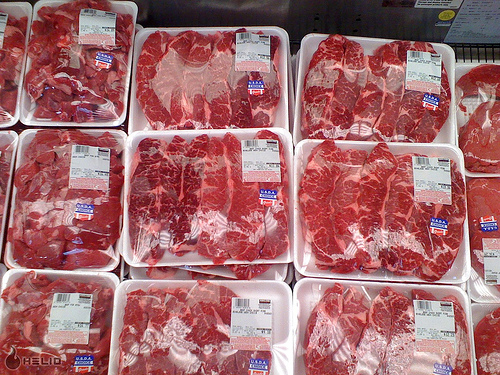
Do you prefer to detach yourself from the singular act of having to kill what you eat? Does the reality of it make you squeamish or offend you, yet you still crave your burger or breast or steak? Well then it’s easy – all too easy, really, and it comes in a plastic wrapped, styrofoam tray in the refrigerated section at your local grocery store. But don’t try to drag me down that frigid, flourescent-lit aisle with you.
The small army is gone. The skirmish line and the blockers have packed their bags and headed across the horizon, leaving a mile-long cloud of dust.
This time there is no, “how should we hit this one” conversation. No waiting on slowpokes or getting into position only to watch the line dissolve into a grupetto.
Now, it’s just the dog and I and a simple plan. Head up wind, as quickly and quietly as possible.
No whistle, no yelling, just a quiet “easy,” then we’re moving. A few dozen yards in, she sniffs hard, inhales something bigger than bird scent and snorts a bit before working two hens into the air. Their flight sends a jumpy rooster up, just out of range.

We round a corner and two roosters get up. I whack the first one and when the second one drops, I’m momentarily disappointed that there is no one to witness my shooting, then Roxy drops a bird in my hand and returns to complete the double and I recall how many birds we have watched flush from 500 yards away on this trip. I snap back to reality and think about how often this game of wild birds and dogs comes down to chance.
Sometimes, for a few brief moments, the dog is flawless, the birds hold and my shooting is clean.
It’s just us and it’s perfect.
– GM
How do you kill them?
Do you hope the dog takes care of them before he brings them back to hand or are you such a good shooter than you stone every one of them?
Or are you like me? Do you find a few of them, blinking and half alive? Do you stand there for a moment and think about what’s transpired in the last few seconds? You made a decision, a big boy decision, to pull the trigger. You hit your target. You brought the bird down. It flopped and flapped and absorbed more lead than you though avianly possible, but it’s n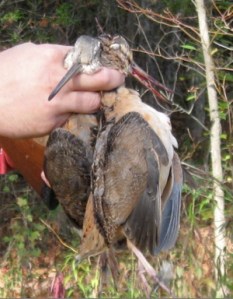 ot dead. Not yet. That last part is now up to you. And your hands.
Do you dispatch, terminate, put ’em down, finish ’em off, snuff ’em out, exterminate or harvest ’em?
I don’t. I kill them. Quickly. Swiftly. Without fanfare. Without much thought really, because too much thought and you’d stand there like a fool leaving everything open to contemplation.
So it’s a twist of the neck, maybe a head rapped against a nearby tree. Not pretty, but not overly dramatic, either. The hunter bringing the end near. Life running out of the hunted. You can feel it go. Almost like when you’re fishing and the hook dislodges. It’s just…gone.
Not so much remorse as just a pause. And then you move on.
– Crawford
It wasn’t a conscious decision; we had merely started moving in slightly different trajectories, and in this sort of country that means that before long we were almost a mile, and a deep gorge, away from each other. I look across the rim at the small figures, the even smaller brown and white dots that represented the dogs. Even at this distance it is obvious that they are covering ten times the amount of ground that the humans are.
I find reasonably stable footing amidst the slippery skateboards of sandstone talus piled atop each other, and look over the rim. Even in February, the creek flows assertively. Yes, people would have lived here, and probably would have done pretty well at it, considering the harshness that lay to the horizon beyond.

In the distance, the rooftops and glass reflections of a border gambling town can be seen. I am less than an hour hike from the road, but I know that no one has likely stood where I am in a long time. They come in vehicles of sealed, conditioned air, never leaving pavement, and head straight to the dim cacaphony of casinos where it could be any time of night or day. Indeed, this lack of any reference to time of day is the deliberate strategy from the casino’s point of view. And then, broke, satiated, guilty, elated, hungover or maybe even lucky, they get back in their cars and move on, their feet likely never touching real soil, their menthol-pickled lungs taking in as little fresh air as possible throughout the entire endeavor.
I drop below the band of rimrock and continue to parallel the ridge, the creek now audible below. Here and there are concentrations of tiny obsidian flakes on the ground, doubtless in the very same spot where they initially fell, as someone ages before fashioned a tool or killing instrument of some sort. I continue on, lost in various thoughts of the people who used to live here, losing recollection of the quarry I came here to find, not even sure exactly where my dog is. It feels good to be alone in this place, walking, consumed by the moment, surrounded by scatterings of human evidence, reminded that I am but one in a long chain that stretches way back. Something incongruous catches my eye and I bend down. A tiny chert arrowhead, perfectly formed.
I move on, still deep in thought, looking down as I pick my way along, only half-heartedly still in the hunt. Hank pops over the rim above to check on me and then disappears again.
And then suddenly, there it is.
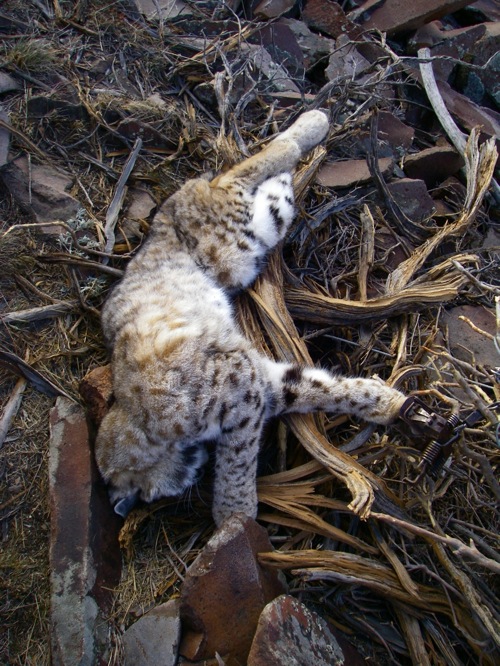
I stand there stunned as everything around me slows and focuses in the middle, on what lies in front of me, blurred around the edges, like an old tintype. Despite the mid-day temps hovering around freezing, it is clear that the cat hasn’t been dead for long. It is also clear that this had not been a quick death; that nothing dies quickly this way. There would have been hours, if not days, of struggle, of life slowly ebbing, of creeping cold, until this. Wind moves the soft fur, and I can’t resist – I kneel down and run my fingers through it. There is this brief, purely sensory moment where my thinking, judgmental mind is as numb as the carcass before me. This incredibly soft coat. I want to continue running my hand through it and not think about anything, but thoughts begin to creep back. I stand up and wonder if the trapper is watching me from somewhere in the distance. This is easy country to remain undetected in.
I try to get it back, but the rest of the day is not the same. The usual burning desire to continue hunting and covering country has been dimmed to a flicker and all I want to do is put the gun and the rest of it all away and go sit somewhere with a flask of whiskey and a good view and not think about anything but the biting February wind chafing my face and the little chert arrowhead, smooth between my fingers.
– Smithhammer
 Mouthful of Feathers