The Dark Side

Finely-finished wood. Detailed, craftsman engraving. I confess to loving well-made, beautiful guns.

But I also confess to hating the painful experience of seeing a nice gun that I’ve spent hard-earned money on getting scratched up. I know this is silly, and I believe that guns are meant to be used, not sit on the shelf. If you’re buying a gun for hunting you should expect that it’s going to start looking well-used after a while. But still, every time I put a new scratch in a nice piece of walnut, I feel the pain.

And with that pain, the dark thoughts began creeping in. Thoughts of a gun I wouldn’t have to worry about so much. Thoughts of a field gun that *gasp*  – didn’t have nice wood or a fancy receiver. I don’t exaggerate when I call these “dark” thoughts, as they became filled with visions of sacrilegious black synthetics.

I’ve had these thoughts for years, but have never gotten around to acting on them. I always rationalized the idea to myself with the notion that it would merely be a dedicated chukar gun. That harsh, nasty, devil-bird country would be the singular application for which I wouldn’t prefer to have one of my nice wood guns in my hands. And I kept telling myself that as I tracked down the model I wanted and tentatively pulled out the credit card. It would still be a few weeks till the first chukar trip, so I figured I would take it out that afternoon for grouse and just, “see how it shot.” The first thing I noticed is that it was light. Very light. As in a 1/2 pound lighter than my esteemed Browning “Superlight.” I could carry this gun all day and hardly notice it, I found myself thinking.

And as these seductive thoughts started to pervade, I saw the dog slam on point. Three birds got up and the gun flew to my shoulder like it was meant to be there and with the very first two shots out of this dark new piece of machinery I dropped a double on sharpies. Holy shit, I mumbled. Far more than just being a pragmatic choice for limited applications, this gun really shoots. And with that, the dark thoughts dug their roots in further and began to grow.

By the time I got home, concerns that my dirty little affair might blossom into something more were taking hold. I broke down the gun and cleaned it, finding the task no more complicated than disassembling and cleaning an O/U. My old bias about semis being a chore to maintain was thrown out the window. I went out again the following afternoon with the same gun, and again limited on a double. And with that second outing, the lid was permanently blown off the Pandora’s box and the deal was sealed.

I’ve even started to see a certain unconventional beauty in this new gun. A sleek, stark, functional aesthetic, combined with design that is no less craftsmanship for being modern. And I began to acknowledge that this might not just turn out to be a dedicated chukar gun. That lamentably, some of my “nicer” guns might just be spending more time in the closet. That this might become the gun I grab whenever I want something lightweight and well- balanced, that I shoot as well as anything if not more so, and that I don’t have to worry about. Which is to say, pretty much all the time.

There. I’ve gotten it off of my chest. I own a black gun. Nothing ‘traditional’ about it. A testament to pure performance. And dammit, I’m loving it.

Pre-Game Strategies

They are out there, even as we speak, going over the playbooks. Refining tactics. Brainstorming new evasive maneuvers. Reviewing the videos from last season. Running scrimmage.

But that’s ok. We’ve been doing the same.

The one thing you can count on is that the bastards won’t be the least bit sportsmanlike.

Some prefer to hunt in groups, walking abreast in a regimented grid pattern, throwing enough collective lead on a single flush that no one knows who actually connected. Not to mention that what would have been edible is now likely sluiced. I guess it’s a social thing. And that approach certainly works, but frankly, I think I’d rather drink light beer and slam my dick in a door.

Give me tangled, twisted bottom lands and a fast-moving pointer who can 180˚ on a dime. A dog who amazes me, just often enough, at his ability to beat them at their own wily game. Just the two of us, scrapping it out through dank ditches and walls of willow and boot-sucking mud, hitting the margins and forgotten corners, far from the crowds. Emerging with tails sticking out of the game bag, covered in the mire and vegetation of their little jungle and looking like extras on the set of Apocalypse Now.

Bring it.

Review: “Hunting Gambel’s Quail” by Ben Smith

Certain birds are tough to hunt, and by “tough” I don’t just mean “challenging.” I mean birds that live in the kind of rugged terrain that can be truly harsh on both people and dogs. Wild pheasant in certain places can fit this bill, as do wild chukar in most places they’re found.

But I would also certainly add Gambel’s quail to the list. For those who’ve never chased this particular quail, picture a hot, dry, rocky landscape. Now throw in several varieties of cactus, thorny mesquite, catclaw and acacia, dense creosote and other wonderful obstacles. And while we’re at it, add venomous snakes and occasional packs of javelina (that don’t tend to take kindly to dogs) into the mix as well.

Now that you have an idea of the landscape and some of it’s lovelier denizens, it’s time to add the bird. Gambel’s quail will not tend to hold politely for a pointing dog, so forget about quaint notions of a “gentlemanly” approach to this. They will run, as evolution has taught them to do, and they will tend to run for cover – which means right into the thickest, thorniest, nastiest stuff they can find, drawing your dog in after them. If this doesn’t work, as a last resort they may flush. But a “flush” in this case tends to mean getting up low and fast, sometimes just a few feet over your dog’s head. And, at the end of the day (if not sooner), you can expect to be spending time with a good pair of tweezers, extracting lots of painful, pointy things from your dog, and probably yourself. Are you in?

Maybe I’m being just slightly dramatic here, but not really, at least not in my experience of trying to hunt these birds. But the flipside of all this is that despite everything I said above, hunting Gambel’s quail is a frickin’ blast, and you will certainly gain a newfound respect for this tough little bird. You may also gain a greater appreciation for one of the most amazing, and surprisingly diverse environments on the planet – the Sonoran desert.

Our friend Ben Smith, over at the fine blog AZ Wanderings, has been chasing these quail for some time now, and has thankfully decided to offer his thoughts and advice for those thinking of giving it a try. Available in e-book format, “Hunting Gambel’s Quail: A Beginner’s Guide to Chasing Southwestern Quail” is packed with great info, especially if you are new to this particular game. Trust me – you will save a lot of wasted time wandering around the desert by first absorbing all the tips that Ben has to offer in this guide, from behavior and natural history of Gambel’s, to finding the best habitat, to gear tips. I would highly recommend it before heading off on your first desert quail trip.

Other nice features of “Hunting Gambel’s Quail” are a pictorial guide for quick and easy field dressing, a couple of great recipes, a printable gear list and links to important online resources for planning your trip.

As an aside, I also have to add that one thing I really like about the e-book revolution is that old publisher’s notions about how many pages a book needs to have, in order to be commercially viable, are being thrown out the window. In the past, this led to many books being far longer than they really needed to be, just to achieve “X” number of pages that a publisher deemed was necessary for the book to succeed. With e-books, a book’s physical thickness has nothing to do with it anymore. And Ben’s book is a perfect example of this – at 29 pages, it would likely never have seen traditional publishing approval. But really, who cares about page count – isn’t it about focused content? The book contains all that it needs to and nothing more. And that’s a good thing.

“Hunting Gambel’s Quail” can be purchased and downloaded online directly from Ben’s site at this link, and is a steal given all the quality information it has to offer.

The Quiet Road

Sun tipping west and another day done.

Evening is the quiet road. The hunt is squeezed by daylight, the ridge has been climbed in a frenzy of pumping heart and heaving lung. The shotgun has barked, once, twice. Fresh dog work for the young Griffon, old hat for the tottering legs-wobbling grayed setter. A single blue grouse lies warm against your back and shooting light is slipping by. You turn, head down the mountain, chasing the fading sun. An elk chortles off in the timber, undaunted by the sound of shotgun and whistle, dog-holler and grouse-burst. Poisoned by lust, judgment suspect.
Down the ridge now, dead bird and fading sunlight, down past all of that hard hurried late-afternoon work, down to cold beer. Another day is down, another day in this best of all the best.

—TR

The Best Kind of Tired

Opening day for sharpies. You escape work early. Pull the necessary gear out of the closet. Instantly the dog knows. He sits by the door, stoically, not the least bit worried about whether he’s going on this adventure or not. He’s maturing.

A half-mile long plume of dust kicks up behind you. Ryan Bingham sings of bread and water, of dessicated places. In the actively worked fields, the last cut is happening. You pull over for large equipment on a road with no shoulder, leaning into the ditch.

Warm enough to hunt in jeans, shirt sleeves rolled up. You have the place to yourself; something that still isn’t hard to find around here. You wonder if/when this will change. Will you grow old watching one cherished spot after another disappear, as those before you have?

The dog is learning to slow down at times, beginning to learn finesse. This is new. The first bird gets up not ten minutes from the rig. It’s so close you have to wait to pull the trigger, lest you sluice it. It folds and falls. Clearly a first day of the season bird, you think. In a few weeks it won’t be so easy. The second bird offers a long passing shot, just far enough out that you ponder for a second whether to take it or not. Swing through and lead it and hope a skeet choke will get it there. It plummets into the grass as feathers blow back toward you in the breeze.

And that’s it. You’ve limited, short but still sweet. You stop at the river and clean the birds. Sharpie stink on the hands for the first time of the season, and as it hits your nostrils, a flood of memories from previous years come back, reminding you that more than just fun, something about this is essential to feeding your soul.

You turn down a dirt road you’ve never been down before, just because you’re in no hurry to get home. Crumbling old homesteads intersperse with sporadic spec homes, their yards having gone wild, weathered realty signs leaning at odd angles. But there are still small pockets of errant field, hedgerows, aspen stands that might hold a few birds – just the kind of pockets best hit in a clandestine manner, alone, with one dog. Gun and run, like fishing the illicit golf ponds of your youth.

You finally hit pavement again and the pointer curls up in the back, content that he’s done what he needed to. Before long you can hear his deep breathing over the Random Canyon Growlers pining about being in the doghouse again. Soon, you’ll follow suit, the kind of tired you welcome and savor. October is always at least a month too short. This year, you aren’t going to waste a minute of it.

Setters in the mist

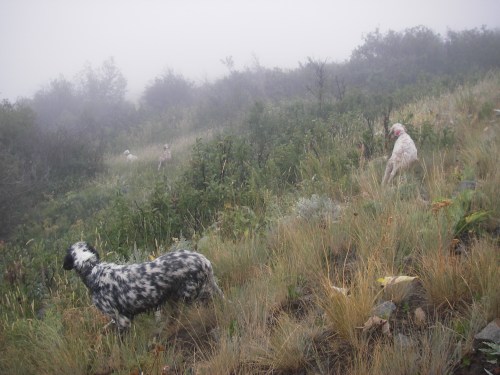
Pre-dawn rise. Collars charged, canine chargers kenneled in the pickup. Black sky and drizzle. Fog. All four released into tall grass and ripening berry. Fur wet through to skin. Running hard and hunting as if it were the last day of the season instead of the first. All four into the mist of this first day of the best month of the year. Pause now, lead dog pointing, others backing. Walk in. Five birds rise. Autoloader: three raspy barks. Three young grouse fall. It doesn’t, it can’t, get any better. No way, no how. Not even with dry feet.

Diversions

Dove: it's what's for dinner...

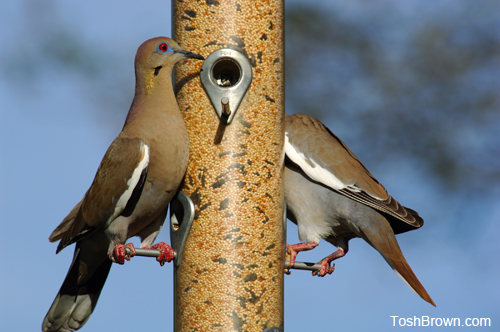
First, a disclaimer: I’m fully aware that whitewing doves aren’t considered “upland” in the classic sense.  But here in our state of Hellfire Apocalypse Formerly Known as Texas, I am forced to write about them because it’s 112 degrees and quail are now extinct and ditch parrots may be too, but I haven’t looked.

So here’s how it goes.

Twenty years ago, we had to drive way south to hunt whitewings. There were huntable numbers in the Rio Grande Valley, but the proper flyways were in Mexico. In those days there were lodges in Tamaulipas staffed by wonderfully accommodating folks who would fetch your birds and hand you margaritas and nachos when your barrel became too hot to touch.

In December of 1983, an Arctic blast descended upon the Rio Grande Valley and wiped out massive groves of citrus trees that were favored nesting habitat for whitewings. Everyone assumed that would be the end of the Texas population, but instead of moving south to join their Mexico brethren, they began trickling north. They first showed up in San Antonio around 1990. They liked the massive liveoaks for nesting, the adjacent grain fields, and the abundance of backyard bird feeders. By 1995 they were in Austin, in 2000 they arrived in Dallas. And now they’re everywhere. In San Antonio, alone, the population is now 50 times as big as it ever was down in the Valley.

Grainfield in a can

They adapted, and so did we.

Nowadays, instead of sitting on a tank dam and waiting for a trickle of mourning doves, we gather around large fields adjacent to urban whitewing concentrations and wait for the daily assault. The first waves normally leave the towns around 7:30 am. They fly high and cautious and if you’re good with a full choke, they make a really neat “thud” when they auger in from the stratosphere. If you’re lucky enough to be in the field in which they want to feed, they come in undulating waves, juking and dive-bombing at eye level and making fools of those that forgot to switch from full to improved. While the bag limits aren’t as liberal as they once were in Mexico, it’s still a lot of fun, especially when your dog that once pointed quail discovers that shagging birds in a manicured farmfield ain’t as lame as it sounds.

Not shooting at quail

And what happened to the once fertile whitewing grounds in Mexico? I’m guessing that the birds are still there, but the lodges are now shuttered and the blenders are idle and those once accommodating locals will now shoot you in the face for no plausible reason.

Hey Gringo, fetch your own dang birds...

We’re coming for you

I packed the dry box already.
A month from now, the bottom will be filled with empty hulls, spilled dog food and an indiscernible assortment of shotgun shells, granola bars, trash, mud, blood and feathers.
Now though, it’s neatly packed with organized boxes of labeled shells and dog supplies.
Meanwhile, the dog and I are aching to hunt. We took a walk early this morning. We jumped a fork-horn bull and saw the remains of a fox-killed ruffie. We savored the cool air of early morning, pretending that it wouldn’t hit 98 as the sun fell from its apex.
On the walk back to the truck, the dew fall glistened on the still-green grass in the high country. The promise of a flush and a fleeting shot against an aspen-filled backdrop are no longer idle thoughts of summer, they are valid mental exercises.
Before leaving, I turned back and looked across the hillside.
For the first time in an equinox, it wasn’t a look of longing.
I loaded the dog in her box and said softly to the unseen birds, “We’re coming for you.”

Here’s to the . . .

. . . warm motel rooms

. . . home-cooked meals

. . .  local watering holes

. . . rural day-spas

. . . comrades in arms

. . . the scent of the quarry

. . . the thrills

. . . the cool refreshing beverages

. . . the tipsy-taxi cabs

. . . the hunting camp love

. . . the Mouths-Full-Of-Feathers

. . . and the hunt itself. Bring it!

The Purge.

There are those that are diligent about cleaning their gear at the end of the season, putting it all away properly. Truth be told, with the exception of guns, I’m not one of those.

My bird vest usually gets tossed in the closet shortly after chukar ends around the first week of February, and doesn’t emerge again ’till…well, right about now – a few days before the next season starts.

Somewhere in Idaho

Empty purple and yellow shells clink together in the pockets as I take the vest off the hook.

A granola bar wrapper is still in there, which I ate the contents of atop Nunya Peak, as the increasing wind ushered in a black wall of storm in the distance, and the birds called each other into the safety of the cliffs below me. We proceeded to take a few stragglers from the base of that cliff; birds that didn’t heed the call to safety. It was snowing sideways on the way out, and it took a while to find the truck, even longer to regain the feeling in my hands.

There is still a smorgasbord of remnant feathers all mixed together in the back of the vest, representing a rough stratigraphic timeline from early season ruffies at the base, through the solid mid-layer of sharpies and roosters and the occasional Hun, topped off with a dusting of chuks. Dirt, dried grass and twigs hold it all together.

There is that small hole that should probably have been mended (but likely never will be), from where I took a break against a fence post that hid a rusty old square nail, somewhere in southern Montana.

A small projectile point made of chert that I almost stepped on walking the canyon country of Nevada. I stood there for a while after I picked it up, sliding the cool smoothness of it between my thumb and forefinger, taking in a view that extended far, far into the distance.

Drops of dried blood remain on the lining of the game bag, reminding me that this isn’t just a game.

In some weird way, purging my vest of all these things is almost as difficult as accepting the end of another season. I put the vest back in the closet. There are still a few more days before this really needs to be done.