Cowboy Logic

Call me pretentious or a purist, or worse if you must, but some things are just inherently better than others. Dry-fly fishing and homemade bread, film photography and pasta from scratch, wing-shooting wild birds and archery elk all hold intangibles that make them superior to their analogues. That doesn’t mean there’s anything wrong with Wonderbread or bobber-fishing, they just lack the same charm that stems from the countless hours spent developing a specific set of skills to accomplish what is, in essence, a more difficult and less efficient task. To do anything in such a way, to sacrifice our most precious commodities of time and effort, can only mean that we truly care about it. Not just in the end result, but also in the process of getting there.

Working cattle with horses and heelers certainly falls into this category and there are places out there where cowboys still cowboy. Where they still sort cows on horseback and drag calves to the fire come branding time. Where a hat and a slicker aren’t cosplay but still tools of a trade mostly done in unwelcoming weather.

Places like Battle Creek, SK , Broadus, MT and Kaycee, WY

As well as Longview, AB where I happened to find myself at a table with just such a gentleman. Bill sat there all crow’s feet creases and taciturn manner, nursing a Kokanee while his nephew Jake and I talked bird dogs.

I was there, back in my wife’s hometown this past summer for the occasion of her mother’s wedding, a marriage between a couple widowers well into their 70s. I was letting the dog out of the camper for a leak and some fresh air when Jake came up to me with a question I get fairly often.

“What breed is that?”

“He’s a Small Munsterlander.”

“I’ve never seen one. Knew it couldn’t be a mutt though, he’s just too well put together. You hunt him?”

This was all we needed to spend most of our evening drinking too many beers and conversing about all things out of doors, while the grandkids did the “Juicy Wiggle” and everyone else did their best to politely decline the groom’s homebrew.

Jake ran Springers, preferred to hunt pheasants and had recently converted to a hardcore lake fisherman because the rivers had gotten too damn busy for his liking. Jake and I talked of places and people we both knew, while Bill didn’t say a whole lot of anything. His only tangible contribution to the conversation was to offer a quiet correction when I got a piece of local knowledge mixed up. Bill’s family had a ranched “out West” for four generations and had land with a certain creek running through it that I would dearly love to get access to. Any tentative query I offered about said access, wasn’t met with much more than a shrug.

As always seems to happen with birddog folks, we ended up talking about the past exploits of our dogs, which inevitably left us just talking about dogs that have passed. Jake and I had both recently lost beloved dogs. Mine had a good run, 15 years until time finally told us “that’s enough”. His favourite springer Molly, cut down pretty much in her prime still. Jake’s wife, Susan, sat next to him holding back tears as he recounted Molly’s last days.

“There’s just something special about a bird dog.”

“There’s nothing like a good bird dog.”

We kept repeating some iteration of this phrase for lack of any way to move the conversation forward after reopening fairly fresh wounds, when another guest, Shane who’d been lingering around, took a seat at our table.

“Shit. All dogs are special” he chimed in, a few too many whiskeys deep and intent on talking before doing any of the prerequisite listening.

I’d met Shane a few times, he’s loud and brash and opinionated, not exactly a rare breed nowadays, but all in all he’s probably a pretty good guy who would be the first to stop and help if he saw you broke down on the shoulder, but reading a room ain’t his strong suit.

Jake just looked at him.

“Oh for sure, they’re all special, but there’s just something more to it when you have that bond you only get when you and a dog are working together as a team.”

Shane did a sort of half chuckle.

“You bird hunting guys make me laugh. You guys just think you’re special, is all it is. The dumbest birds. They just sit there. You can just shoot them with a .22 driving around on a side-by-side. “

Susan got up and left the table, Jake and I looked at each other.

Anyone who has ever hunted behind a birddog knows about the beauty and magic and value in doing so, and the only reason we personally feel special about it at all is because we got to witness it. I was about to get up on the soapbox and launch into a longwinded soliloquy stating just that, when the old timer in the Stetson to my left finally spoke in earnest.

“Sorry son, I didn’t catch your name.”

“Shane.”

“Shane. Nice to meet you. I’m Bill. You, uh, seem like the type of fella that would rather fuck five twos instead of make love to one ten.”

I suppose that’s one way of putting it.

Maybe not as eloquent as I was hoping to have said it, but then again I don’t spend most of my time speaking to a herd of Herefords.

Target Clientele?

Me: “Hi. I’d like to please be removed from your mailing list?”

Well-Spoken Southern Accent Customer Service Girl: “Ok sir, I can do that for you, but can I please ask why you’d like to not continue to be informed about our fine offerings?”

Extremely Polite Southern Accent Customer Service Girl: “Hello, welcome to “_______.” How can I help you?”

Me: “Yeah, hi. I’m not sure how I got on your mailing list, but I’d like to be removed, please.”

EPSACSG: “Ok sir, I can do that for you, but can I ask why you’d like to not continue to be informed about our fine offerings?”

Me: “Uh, you’d like to know why I don’t want to receive your catalog?

Well, since you’re asking…to be honest, I don’t think I’m exactly your “target clientele.” You see, I live in the West, and hunt for wild birds on public lands, on foot. I’ve never been to a private $7k/week plantation lodge. In fact, I’m pretty sure that someone in a position of influence would make sure I never even made it to the front door of such an establishment.

image-pro-shop

Nor have I ever been transported from one planted bird location to another in a horse-drawn carriage. Do those things have a wet bar?

I’ve also  never faced the peculiar dilemma of which sportcoat I should pack for standing around the fireplace after a day “afield,” while discussing my many and varied accomplishments in both the realm of canned hunting and finance.

Also…Are you still there?”

EPSACSG (practiced politeness eroding quickly):I am, sir.”

Me: Great. Also, I can’t ever imagine myself in a pair of your $200 bright green jackass slacks with the embroidered Labradors and ducks on them. In fact, I would fully expect that these pants come with a clown nose, a ball gag and a pair of handcuffs. Is this true, or are these accessories extra?”

Click.

Me: “Hello? Ma’am? I still have a few more reasons I’d like to share… Hello?”

The Book

A project we’ve been kicking around for some time is finally happening, and frankly, we’re damn excited about it. In early December of 2013, Mouthful of Feathers: Upland Hunting in the West will be released…

A project we’ve been kicking around for some time is finally happening, and frankly, we’re damn excited about it. In early December of 2013, Mouthful of Feathers: Upland Hunting in the West will be released, featuring a collection of original, full-length essays by:

  • Tosh Brown
  • Reid Bryant
  • Michael Gracie
  • Chad Love
  • Greg McReynolds
  • Tom Reed
  • Bruce Smithhammer
  • Bob White

With an introduction by Miles Nolte.

Cover art by Bob White.

The book will be published by Pulp Fly, Ltd. and available on Amazon, iTunes and Barnes & Noble for Kindle, Nook and iPad platforms.

More to come soon – please stay tuned. And if you haven’t done so already, the best way to stay tuned is by signing up as a follower of this blog, which you can do on the menu on the right side of this page, and by “liking” our Facebook page. Thanks.

Almost Gone.

I see him disappear as he drops off the cut bank and into the river, purely intending to cool off. By “river” I’m referring to the South Fork of the Snake, currently running at 12,000 cubic feet per second.

The uninterrupted force of the river is cranking along the undercut bank where he went in. There is a tangled strainer of logs and debris just downstream, reaching out like a wicked, gnarled hand dragging long fingernails across the galloping surface of the torrent.

I sprint. He’s clawing at the bank without purchase, and then I see him starting to get sucked under and swept. His eyes go wide as dinner plates as the reality of his predicament dawns on him. Somehow sinks through that knuckle-headed pointer cranium of his. It’s a look I’ve never seen on his face, and my own probably didn’t look much different.

I dive to the edge of the bank, grab a fistful of collar and pluck him from the current with little time to spare. Fall on my ass.

I think about what would have happened if I hadn’t been right there, and able to respond so quickly. What if I was still back in the cottonwoods, looking for morels, as I had been just minutes before? He’d be gone. Pinned below the undercut, or swept into the strainer. I’d have lost my bird dog.

On terra firma again, he shakes the water off and tears off back into the forest, following the onslaught of spoor that rules his better judgement. Living as he always does – entirely in the moment. I give up on the morels and decide to call it a day. Too dry anyway.

Off-Season Pursuits

He was fully immersed in his second favorite thing to do in this world – chasing a tennis ball.

Without warning, he abandoned his second favorite thing to do in this world, which could only mean one thing.  He hooked a hard left and headed toward the houses, nose to the ground, inhaling scent at a full run.

From a distance, it was obvious he was on point.

A standoff had ensued. The fowl held its ground briefly, before making a fatal mistake.

As the yardbird turned and ran, the shorthair was on it in seconds, shaking the life out of it.

We’ve been politely invited to help our neighbor build a new fence.

vintique_image

The inmate needs constant supervision

During her evening yard walk, she must be shackled or watched by an armed guard.
Around the cell block, they whisper about her, “Her dad was a badger,” they claim when she’s out of ear shot. “No,” another says, “the sire was a setter, the dam was a beaver.”
One of the things that got her here in the first place was stealing stuffed animals from children and then mauling the stuffing out of said stuffed animals.
On more than one occasion, she has literally taken candy from a baby. As you would expect, she found it rather easy.
She’s jumped bail so many times that she doesn’t even have another parole hearing for a month.
Still, it doesn’t faze her much.
Even now – the tail end of a bird-dog summer – she lives life like a tethered rocket. You can shorten the rope but she’ll just run faster laps.
And time in the box can’t break her spirit.
Not that she hasn’t been there often enough for violations like digging, chewing, chasing, destroying and insolence.
Given even a moment of freedom, she will dig a crater-sized hole, remove whatever plant material that previously resided there and mulch it.
It happens so quickly that the guard often pleas on behalf of the inmate, sure that he has not fallen asleep on watch.
“It couldn’t have been her,” the guard says, not quite meeting the glare of the warden while hanging his head in shame.
He begins his protest anew, then glances at the inmate and sees the white paws covered in dirt.
So he turns away and goes to get a shovel.
He takes the inmate with him.

A Blessed Pursuit

An excerpt from Steve Rinella’s worthy new book, “Meateater:”

“Earlier, I wrote of the things that I’ve suffered while in pursuit of a lifestyle that makes sense to me. Things such as cold, hunger, loneliness, and fear. What I failed to mention are the ways in which I’ve been blessed through that same pursuit. While hunting, I’ve cried at the beauty of mountains covered in snow. I’ve learned to own up to my past mistakes, to admit them freely, and then to behave better the next time around. I’ve learned to see the earth as a thing that breathes and writhes and brings forth life.


I see these revelations as a form of grace and art, as beautiful as the things we humans attempt to capture through music, dance, and poetry. And as I’ve become aware of this, it has become increasingly difficult for me to see hunting as altogether outside of civilization. Maybe stalking the woods is as vital to the human condition as playing music or putting words to paper. Maybe hunting has as much of a claim on our civilized selves as anything else. After all, the earliest forms of representational art reflect hunters and prey. While the arts were making us spiritually viable, hunting did the heavy lifting of not only keeping us alive, but inspiring us. To abhor hunting is to hate the place from which you came, which is akin to hating yourself in some distant, abstract way.

The other side of the fence

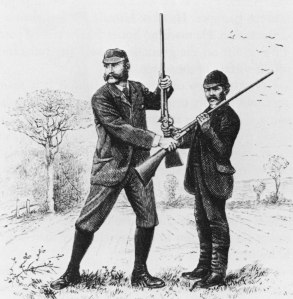
They don their breeks and sporting coats and jaunty caps, as the hired help clean and polish their Purdeys, their Grullas, their Krieghoffs.

They pay upwards of $6000 a week to re-enact a pantomine of hunting; what it has sadly become a continent away in a place that lost its wild places centuries ago, lost the bulk of its public opportunities to hunt and fish, and was left with this ritualized costume party, for the select who could afford it.

And now, in a western state that is over 60% public land, where fantastic wild bird hunting opportunities abound for anyone willing to do a little homework and put one foot in front of the other, they are paying top dollar to do this, behind a fence, for pen-raised birds instead.

The birds pile up in the hundreds, considered little more than clays with wings. But no matter – many more are released. And some, I’d like to think the smart ones, high-tail it for the property boundary, where a free and wild life await on the other side. Those that make it quickly become wily survivors, constant predation being the price they pay for freedom.

I walk a field a few hundred yards away. I hear laughter coming from the expansive porch of the lodge, carried on the breeze. My jeans mostly muddy, a trusty 16ga. pump in my hand. The shorthair locks. Spins and repositions. Locks again, amber eyes ablaze. There’s a rooster in there, on this free, CRP land, adjoining exclusivity. I can’t help but laugh my ass off. Sometimes trickle down economics actually work.

– Smithhammer

Seventy

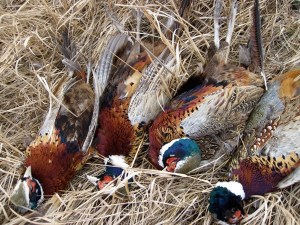
In the span of eight decades on Earth, the man has seen much. World history, to be sure. But pheasant history too. He has seen the rise and fall of borrow ditch and shelter belt. He has seen the eradication of weedy fence lines and weedy row crops. He has seen the genesis of CRP and, in the next Farm Bill, its possible extinction. Pheasants have come and gone, risen and fallen, risen again, and fallen again. Each time, the peak of the curve is significantly lower than the last peak years before. He has seen fields where he hunted pheasants as a child in eastern Colorado and western Kansas turn dry and barren and fill with weeds. The rows of corn he hunted in college have sprouted condos and shopping malls. He has seen the termination of a time when one simply found a patch of good cover and started hunting and the emergence of orange-painted fence posts and red-faced farmers. The end of “go ahead and hunt” and the onset of “it’s one hundred dollars a day.” He has seen the team-drawn plow fade into rusty history and the dawn of the $100,000 combine. He has seen the birth of pesticides and herbicides and the death of many living things as the result.
For seven decades, he has been hunting these Chinese ditch parrots. He hunted the first-ever season in Colorado, shooting his single-shot 20 at everything that rose before a black pointer of mixed lineage. When he finally started hitting, Dad told him, “Okay, that’s enough. Now you can shoot only roosters.”
He doesn’t lament the fields turned under, the loss of shelter belt, the consumptive appetite of clean farming. Instead, he looks back on seventy years of pheasant hunting and says, “I’ve been lucky.”
Today, with the wind whipping off the Rocky Mountain Front, drawing tears to the eye, snot to the nose, he turns his young setter into the wind and walks the tree rows on the lee side of a 40 mile per hour blast. There’s a walking stick in the truck, just in case, but he doesn’t reach for it. Instead, he balances a Belgian Browning, bluing worn to bare steel, in a gloved hand and he follows his young girl. She points.
A pheasant rises, banks, and falls. She brings it in. Seventy years before the gun, memories like elm leaves on a west wind.

Pre-chewed

I waved at them as the drove past.
It seemed like the neighborly thing to do. I was hunting a narrow patch of public ground edged by a gravel road, they were cruising the road in their orange getups on a similar quest for ditch parrots.
When they jumped out of the truck a few hundred yards in front of me to hunt a prime patch of Russian olive I was obviously headed toward I felt a hell of a lot less like waving anything but my middle finger.
What kind of road hunting scum bags would cut in front of a hunter, park in the middle of a road, jump out and hunt a 50 yard patch of cover, then slam the doors and speed away?
The kind of guys who would wave as they drove past you knowing they were about to screw you, I guess.
I’m not sure if they saw any birds, but I know they didn’t fire a shot.
A few minutes later and 75 yards short of that sweet but now pre-chewed patch of cover, the dog put up three birds and I shot my first double of the season.
Justice is sweet.
If I see those guys again I’ll be sure to wave.