Homestead Rhubarb

In the autumn, you dream of Huns bursting from the rubble that was the old milk house, and you carry your shotgun cradled ready. You follow the dogs, and they follow their noses.
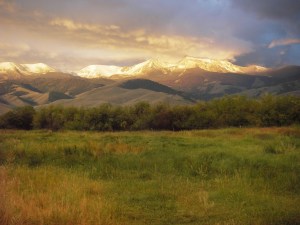
But now the land is sharp green from rains that don’t seem to quit and when you go, you don’t follow the dogs, they follow you, and they don’t pick up scent, they pick up the bothersome beggars’ ticks burs from last years dried stalks of houndstongue. You go where you want and sometimes, you walk among the old buildings and think about a different time, a different era.

There’s a hand-dug well and fifteen feet down, water. It is rock-lined and covered with rotting timbers. Peering down into those depths gives a tremor in your soul. A dark, wet, fearsome cavern. You think about being down in there, digging the damned thing by hand, and placing each one of those rocks. You think about the darkness, but then you look up and above, is freedom. Above, sky. Lots of sky.

Once, you ran into the old man whose grandparents homesteaded the place. 1898. Part of the Desert Land Act of 1877 which quadrupled the Homestead Act’s woeful 160 acres to 640 if you could irrigate the place within three years. Up on the mountain, you have seen the evidence of this – old dams and a series of ditches dug by hand and a walk-behind plow. Tough men. Tough women. Tough horses. Grandpa died in 1919 and Grandma in 1932. The old place was burned down by teenagers on a lark before the Second World War.

In this early summer in this new century, before the cows come out on the land and before the grass really comes, you ride your best saddle gelding and fix fence to keep the cows in and the neighbor’s cows out. You ride and you think of homesteaders because it’s too early to think about Huns and when they start pairing up, you quit bringing the dogs because you want the Huns to marry well, be happy, and raise lots of children. Besides, you are tired of picking burs.

As spring comes, you watch it coming: pasque flowers at first, up in the timber edges and sage benches. Phlox next, then spring beauties then avalanche lilies, then marsh marigolds up on the edge of the crick where young aspen are budding and ready to burst forth like words from a pen. It is a cacophony of chlorophyll.

Each day as you ride past the old place, with its scattered rock foundations and its still-stout railroad-tie post and rail fence, you think about hard land and hard people and tough living. And then you find it. Ridden past it many times, but now, up in the saddle, it is obvious and big: a patch of homestead rhubarb, 100 years or more old, growing out there feral among the sagebrush and spike fescue. Untended and still growing, still going, still here long after the humans who planted it have left and been forgotten except only in the mind of an old man who once was a boy who remembers. Everything else, every companion plant in the garden, has been gone for decades. Save rhubarb. Still here, still growing. How long since a pie cooled on a countertop that was made from that rhubarb? How long has that plant been growing and waving its big leaves and bright red stems in the Montana summer breeze? How long since laughter of children? How long since it was watered by hand with water from a hand-dug well?
One evening as the sun tilts west and it is still daylight at nine, you decide to take a drive out there, out west of your place and you walk among the sage with a plastic sack in your hand and a doe antelope with twin fawns barks at you from the ridgetop and you bend to the plant and pull a few stems, enough for one pie. You don’t want to pull it all. It needs to survive, as it has for more than a century. You will tell the old man about that rhubarb and he will smile and remember. A survivor.

-TR
Further Proof That Hunters Just Think Different (as if you needed it)

Background: It’s been a long, wet spring in the northern Rockies, with many places over 200% of normal snowpack. It’s now mid-June, and there have been precious few days that have felt like summer to date. But rather than pining for warm summer days, we have exchanges like this:

Hunter #1: “Well, I don’t want to jump the gun, but….it’s less than three months away…”

Hunter #2: “Funny you mention that, it was the first thing that popped into my head this morning.”

Hunter #1: “Yeah, normally I don’t let myself get excited until after summer solstice.”

Hunter #2: “Take heart – the days will start getting shorter soon…”


Yeah, we’re not right in the head.

Thunder Chicken Chronicles

It starts in February, with being notified that you’ve been lucky enough to draw a spring turkey tag for our local, limited lottery. You know people who have put in for it for years and never gotten it. For two months, you persevere through exponentially accumulating snowfall, uncharacteristially optimistic that, by late April it will mostly be gone. You spend too much time pondering the merits of various decoys and turkey calls online. Your spouse walks in on you watching an instructional video of three good ‘ol boys sitting on a porch, demonstrating calling techniques. She lifts an eyebrow as if to sardonically say, “really?” and closes the door. You feel a bit sheepish, but quickly become engrossed again in the finer points of yelping and purring.

The opening date approaches, and you start scouting. Most of this involves futilely post-holing up to your waist, and you truly begin to question why you ever thought you’d find turkeys in our valley.

As the opening date approaches, on a walk with the dogs, it happens. Tracks. More than one bird, maybe half a dozen. Criss-crossing each other as they all travel in the same general direction up a snowy slope. You can’t believe it. It’s like coming across a canteen full of water while crossing the Mojave on foot. You follow them for half an hour up a trail, over a ridge, into the forest, and suddenly, you get that eerie feeling that you’re not alone. There they go – a flock of Merriam’s  fleeing into dark cover. You stop and let them vanish, and suddenly, it occurs to you that you just might be able to pull this off.

1970 Bear K-Mag

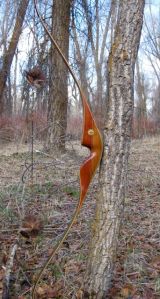
The alarm comes too soon, and it’s still dark and you wolf down a Pop Tart and a thermos of coffee and meld into the woods, bow in hand. You see a young bull elk. You spook coyotes in the steel blue of an overcast dawn. Mule deer everywhere. Sandhills sound as you hope they always will – like visitors from another planet. You are grateful for being here, so early, mixing with your elusive neighbors.

As you reach the end of the first week of your two-week tag, you realize that you have already spent over twenty-four cumulative hours in a small, dark blind – alone, staring at decoys, making no sounds other than something similar to a horny hen. There are people who would question your behavior, and reluctantly, you admit that they probably have every right to.

The time left progresses, and you see turkeys here and there, typically after you’ve just spent 4 hours hunkered and calling and you decide to pack it up and head home. A few hundred yards down the road, they run in front of your vehicle.

One day over a pint, someone asks you what you’ve been up to lately, and you tell them, fully knowing that it must sound a bit odd,

Jake Brakes

particularly as snow blows sideways past the windows of the tavern.

“There are turkeys around here?” they ask incredulously.

As your mind races through the possible responses, you find your mouth (as usual) crossing the finish line first with a simple, “Nope.”

Close Waters

It is, despite any charitable stretch of the imagination, a shithole. Plastic bags undulate like jellyfish in the tepid brown water. A thick layer of trash rings the shoreline. Thick wads of yellowed monofilament, snelled hook packages, beer cans, Styrofoam worm tubs, broken and discarded ten-dollar spincasting rods, cigarette butts, crooked sticks stuck in stinking mud, an abandoned flip-flop; the detritus of the don’t-give-a-shit demographic is everywhere. In a land where public water and open space for dog training and fishing is scarce and precious, I marvel, repulsively, at the fact that I can hardly bring my dogs here for the shiny matte of broken glass they must run over.

Last year someone dumped an old mattress and recliner in the pond. For a few months the waterlogged mattress floated aimlessly across the water. I used to aim for it when throwing marks for the dog, the bumper making a gelatinous thunk when it hit. She would climb up on the mattress, grab the bumper, briefly survey the world from her quivering ship and swim back to me. I once caught a bass from under it before it finally sunk into the filthy, inscrutable depths.

But it is the only water I have, so I fish it, throw bumpers into its water for my retriever, let my setter chase the tough, cat-wise urban quail that live on its edge. There are trade-offs to living on the plains –  the fishing, music and friends of the past for birds, solitude and unfettered horizon of present. This lack of decent water is just one of them. Someday – if the birds continue their slide and what few remain are found behind fences to which I will never be afforded a gate key – those trade-offs will become too much to bear and I will leave this place, but until then I keep coming here to fish and train. Better thin gruel than no gruel at all.

The bass I catch are pale and colorless, like most bass from muddy, turbid water, but they take a spinnerbait readily enough, and they’ve indulged my recent obsession for flyfishing by obliging me with the occasional thrill in that endeavor, despite my incompetence. As a reminder of what I’ve lost for what I’ve gained, they do their job, and as a touchstone for what keeps me sane, well, they do that, too.

So I come back here to find what comfort I can in what the water, the dogs and the bass offer, because water is water wherever it may be and as one who has always been obsessed with water, I have no choice but to seek it out when I hear its call.

While fishing here I once found a used syringe and a little black fake leather bag with traces of what the cops in the affidavits I used to read as a beat reporter always referred to as “a white powdery substance.”

I walk up to the water, look down and there it is, just lying there at my feet. I pick it up, carefully, and put it in the fake leather bag, wrap it in a McDonalds bag (there’s always a fucking McDonalds bag handy) and stuff the whole thing into the overflowing trash can at the parking area. As I walk back to the water, I think about how miserable that person’s existence must be to seek out this shitty, polluted spot and take – in such a hopeless manner – what fleeting solace they can find in this world.

I make a cast and do the same.

The Winter of Our Discontent

It is a poor substitute, to say the least. We go through the motions – I make him sit and hold while I go hide the dummy in the brush, make him wait till I return to his side, release him with a ‘fetch’ command. At this, he explodes, his hard-wired enthusiasm escaping in high-pitched barks as he charges toward the location.

He drops it at my feet and sits. He will do this with me all day, if I have the stamina – his, on the other hand, is not in question.

But there is no rich panoply of smells typical of an October day in pursuit of wild birds. We are not riding currents of air and ground scent, not feeling the same, simultaneous explosion in our hearts at a bird that launches skyward, not savoring the sharp tang of a spent shell carried on the breeze. There is only a feeble smell of rubber and plastic, the familiar heft of something bird-like in shape and weight. Something that, for reasons he probably can’t understand, is not a bird.

I feel cheap. I feel like I owe him a lot more. I feel like I’m trying to explain sex to my son, and I just copped out and bought him a blow-up doll instead.

But it is March and the snow continues to fall and another season is so goddam far away that I have no choice but to focus on more immediate distractions and put the thought of it out of my head. I imagine that his approach is not much different.

He drops the dummy at my feet.

Eye Candy

The upland photography of Kevin Emery.

Big country and little details.

Enjoy.

You can see more of Kevin’s upland work, and other galleries, here.

Prickly

It is the beginning of the longest season and temper flares now and then like bursts of gas refinery burn-off. Prickly. Irritable. Sloth. No long walks with dog and gun. Those are far ahead. Too far ahead. Irritable itch. We’ll get through. Somehow. Somehow. Some way.

I think.

–TR

A Texas Quail Hunter’s Haiku

Today is the end
The quail season that wasn’t
The drought lingers on


The Words We Use

“Language shapes the way we think, and determines what we can think about.” – Benjamin Lee Whorf

We have come to refer to rivers and forests, trout and elk as “resources.” They have become units that inhabit still other units. We now frequently hear the act of hunting referred to as “harvesting” or “collection,” or other, similarly clinical terminology. We have abstracted and reduced one of the most real, visceral experiences we have left in this modern world to the language of the bureaucrat and the commercial extractor.

There has, of course, been necessity to this. In order to converse with the bureaucrat and the extractor, to be taken seriously and to have a seat at the table, it’s become necessary to adopt their language, for this is the language that gets things done in our time. But in this linguistic shift, I believe something at the heart of this whole thing is lost, stripped of greater significance, reduced to the soulless level normally reserved for inanimate product or commodity.

Wildlife managers, and some in the conservation profession, maintain that this is the required approach for science-based conservation, and in a broad, and regrettably bland and mechanical sense, they are absolutely correct. Management of wildlife, and wilderness, has largely become about numbers, stats, population counts, carrying capacities, “maximum sustainable yields” and the like. It is not my goal to naively criticize this work, for I fully recognize its importance, just as I do its limitations. As mentioned above, statistics and quantifiable figures are essential in our day and age, if only in order to demonstrate value to a wider audience who apparently can value nothing else as highly. I know that this work is both important and well-intentioned. I  support it as much as I possibly can, and am eternally grateful that there are those willing to fight the good fight on these stark terms.

Yet we also see this shift in language occur in yielding, consciously or otherwise, to societal pressures; to distance the dialogue surrounding hunting from being about something as disagreeable as “killing,” and even from it being something that involves living, breathing beings at all. I suspect that these modifications in terminology are not coincidentally linked with greater shifting views in our culture toward hunting. How much easier, and more palatable, and less disruptive to the casual atmosphere of the cocktail party it is to say, in the presence of a hunting critic, that you spent the day “harvesting a local resource,” than it is to say that you killed several quail or a deer? Pass the smoked salmon, would you?

“Language is not an abstract construction of the learned, or of dictionary makers, but is something arising out of the work, needs, ties, joys, affections, tastes, of long generations of humanity, and has its bases broad and low, close to the ground”

– Noah Webster

Is the recently dead grouse, whose warmth I can still feel through the game bag in the back of my vest, merely a “resource?” Moments ago, it was an eruption of wing and feather and cackle and native life. It will also soon be cooked as part of a special meal, relished as it should be, with respect for the life it was. To consider a wild river, or an expanse of old, healthy forest, and the marvelous things that inhabit these places, as mere “resource,” or “unit” would mean a fundamental part of me has withered and died. I know these places, and their inhabitants, too intimately to do them that disservice.

As a hunter and angler, deeply involved in this wet, dirty and sometimes bloody process, I have to draw a line and distance myself from this linguistic trend. This terminology can stay where it should – in offices and negotiation rooms and urban environs. Words reflect how we perceive things, and I can’t let the sterility of agency-speak infiltrate my own word choices. I can’t consider the process of hunting and killing an animal as “resource collection,” and I’m at a loss for what to say to anyone who has come to view this sacred, ancient act as anything so sterile. I won’t distance myself from what this really is. It is hunting, and a part of hunting, at least sometimes, is taking a life. While this is far from the sole reason I am out here, neither is it a thing I take casually. Nor am I willing to trivialize or sanitize this act out of consideration for those who have become so removed from the fundamentals of natural processes, and the manner in which food arrives on their plates, that they can’t deal with it. That is their burden to philosophically dance around, not mine.

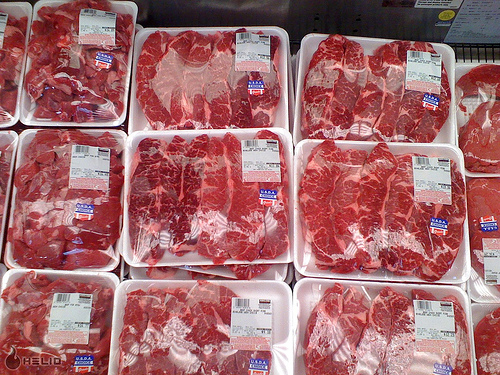
Do you prefer to detach yourself from the singular act of having to kill what you eat? Does the reality of it make you squeamish or offend you, yet you still crave your burger or breast or steak? Well then it’s easy – all too easy, really, and it comes in a plastic wrapped, styrofoam tray in the refrigerated section at your local grocery store. But don’t try to drag me down that frigid, flourescent-lit aisle with you.

Quickening

It has been shoved aside for months. Roughly. Put in a closet. Oiled perhaps, but discarded out of sight. And out of mind.
Then this morning you wake and there is snow up there. Last night–a Sunday–you were up at the best bar in America listening to live bluegrass and haunting lyric strained through the vocal cords of the prettiest undiscovered twenty year old talent in Montana. It rained while she sang and then this morning. Snow. Up there. High country snow in late August.
So long, you say, to the shortest summer on record. So long, you fickle minx. So long.
So to the closet, where it is pulled out, fondled, oiled again. And the dogs twirl and two-step and jitterbug. It is here. It is here. Now. Upon us. The spring has been wet, the summer reluctant. No matter. The best of all seasons is on us like the warmth of a September sun at the beginning of a day out with shotgun and bird dog. The sun looks sharper. The day brighter. The sky bluer, crisper.
Hello. Where have you been?

– TR