Road rage

The road there sings anticipation. Dogs grumble from the shell, butts and junk sniffed, dominance decided but as tentative and thin as September ice. In the cab, laughs and Dew and miles to go. This year a new place relayed by another with “don’t tell any-damn-one caution,” a place of memories yet made and you push it, this road. It stands in your way, between you and the reason, between the dogs and the birds, in the way of the canvas that awaits your paint and your brush. So you grasp steering wheel, cradle caffeinated drink in your crotch and shovel mini mart popcorn. At the end of the road,  you will work it off on canyon rim and shale.

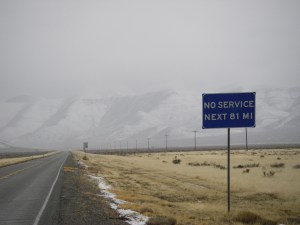
Once in a while you find a safe and lone ranch road–“no service”–and you pull down it and stand spraddle-legged and piss on cracked gumbo and tumble-weed scrap and let the pack out to piss on each other and sniff ass and walk stiff-legged around the stranger and grouch at him. Goddamnitttttttt, c’mon, Ike. Sonafabitch. And back onto the road, slab concrete beating radial in three-quarter time. When finally you hit dirt, ten hours of truck seat imprinted on your butt, BLM map folded out in your lap, camp circled in pencil, ridges marked with “CKR,” you crack the first beer and crescendo down gravel-clay. The dogs up on all four, nose to the crack-wind coming through. Wagging, whining. The blank sheet awaits your notes, maestro.

A week later the road home. Carrying one hundred pounds of Nevada gumbo in the undercarriage. One spare flat. Rock break. Cab stale cigar and jounced beer. Feet hot and damp in two-day socks. Legs tired and complaining of the hop from gas pump to steering wheel. Dogs flat and dead out, not moving for ten hours and then only to stiff-sore piss and back to bed. No whine no grumble. Founder on Winnemucca Basque, sleep in Motel Six between pipeline workers grilling Sunday dinner on homemade grills in pickup beds. Up at 3 into a gray dawn as overcast as your mood. Heading out, heading home and the road slapping on rubber . It went too quickly, this road, and a year is a long time.

Blood and Plunder

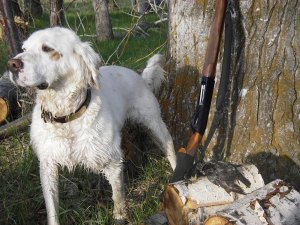
He’s a knife-in-the-teeth type, a run-hell, fast-go, wound-tight, son-of-a-bitch, so when he yelps down by the creek—out of sight (again)—I don’t think much of it. He comes roaring back and I can see blood dripping from his ear. The cut is perhaps a quarter of an inch in length and right at the tip and not bleeding very heavily. Yet. As a horseman friend of mine would say, “It’s a long way from the heart.”

The Bloody Duke pauses only long enough to check in.

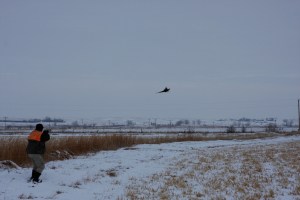
And we’re a long way from the truck. It’s 15 below zero and the pheasants are holding tight. There’s about one point five minutes of debate. We push on. If he could vote—and he can—he’d vote “aye.”

This is the way. His way. He’s pretty good at it. Full-fricking-tilt until he’s completely gassed and done. This is also the way of Western pheasant, those savage bastards of greasewood and buffaloberry, their craws stuffed with Russian olive pits, their hearts full of bitter fuck-you fire. No other bird evokes the chaos, the running pandemonium beneath the wide skies. Wild bird, of course. Feral is more apt. You hit the ground running and you need a “Katie-bar-the-door” dog. Barbwire, thorn, bur, be damned. Late season? Snow? Even more so. Those runnin’ sons-a-bitches. David Alan Coe, or perhaps it was Chris Ledoux captured it this way: “Oh, it’s forty below and I don’t give a fuck, got a heater in my truck, and I’m off to the rodeo.”

So we continue, despite the bleeding, because, darn it, the pheasants are holding tight and the injury is superficial. It is worth a repeat: the pheasants are holding tight. It’s too cold to hunt. But the pheasants are finally, for once, holding tight. This is the epic once-every-seven-years cicada hatch on the Green, for crying in a bucket. The pheasants are holding tight and you may not see this again in his lifetime. Maybe even yours. It’s too cold to hunt? Yeah, right. Unless you are a cold-hearted bastard. So, onward, blood flying from sliced ear. Hey, we’re hunting late season wild roosters. Call the ASPCA. Go ahead, call ’em.
In the whitewash of eastern Montana’s winter, he is lost quickly and then I pick him up again. The ear is bleeding freely now, and he’s frozen on point. I huff up and watch the blood dripping into the snow. He’s oblivious to anything but the smell in his nose and when the cock bird goes up and the shotgun barks, he’s on it. Hard on it. A 24-inch-tailed rooster and he retrieves, then blasts onward. I think for a moment, “Maybe I ought to do something about that ear.” But as soon as that thought enters, he’s gone again, romping into the snow, blood-be-damned, as if affirming my “long-way-from-the-heart” mantra.

Swingin'

By the time we get back to the truck (with three stone-dead rooster pheasants being flash-frozen by Montana December against my back), he’s a red and white setter. He looks like something out of a slasher movie, all from the flopping of an ear splattering blood everywhere, a minor cut with a major bleed. He doesn’t care, though. I tape him up as best I can, but the tape comes off and the ear bleeds more. I wrap his head and he digs into it and off comes the bandage. Screw it, he says, I’m a tough guy.
That night in the motel room, the bleeding finally stopped, he gobbles his feed, then promptly pukes it—and a wad of cocklebur and pheasant feather—up on my bed. Twice. “Get off the stage, you god-damned goof,” sings Ledoux. What an animal. Both. Or all three of us.

–TR

The Other

He may be the best dog I will ever walk the ground with. Perhaps not. Perhaps there will be another dog that will display and dazzle. But there will never be another dog like him. And there will never be another time like his. That I do know.

Some would say he was just a dog, but there are those of us who know the other plane. That place of which Henry Beston wrote: “In a world older and more complete than ours they move finished and complete, gifted with extensions of the senses we have lost or never attained, living by voices we shall never hear. They are not brethren, they are not underlings; they are other nations, caught with ourselves in the net of life and time, fellow prisoners of the splendour and travail of the earth.”

There are humans, though, who at a minimum understand Beston’s other nation. They may even live there. Perhaps. Many are my friends. Hunting men mostly, men who hunt because they have a dog and if they did not partner with a canine, they would find no pleasure in walking an autumn field with a shotgun no matter how much they enjoyed the taste of roasted pheasant. They certainly would find the cliffs and crags and rough tough of the chukar partridge much more empty. Perhaps they would draw upon the wildness and raw beauty of the desert, but without a dog pal the picture would be incomplete like Mona Lisa without her smile. Can an old woman with a Peekapoo experience the same kind of other plane, that melding of human and dog mind into a mutual understanding that transcends verbal language? Perhaps. But I think not. The reason is quarry. There is something very different about an animal that lives to hunt for you, that pursues what you pursue. You are caught up in a mutual joy of the hunt, a mutual drive that sinks deep to the soul into the core, the heart, the bone, the very cells that make up a living creature. This is in our DNA, those of us who hunt. I am sure that dogs that hunted held a different status in the ancient nomadic tribes of which we are rooted than dogs that plodded along at heel, eating food and in the end becoming food. Each type of dog—the food hunter and the food “on the hoof” certainly played a role in the survival, but it was hunting dog that actually earned its keep by living, not dying.

It was hot that day. Christ was it hot. June. People do not think of Wyoming as hot. Wyoming is snowy peaks and ice, wind and empty. That day it was over 100 and the sweat poured over my eyes. I took a half-splintered Pulaski bandaged by black electricians tape and a half-sharp shovel and made little progress. A more prudent man might have a sharp shovel and a strong-handled swinging tool, but I did not expect to be burying my dog. Maybe at twelve. Definitely not at six. He lay next to me in black plastic and I did not look over there very often. I swung the Pulaski and water ran off of me, out of me. I was miles from nowhere and the desert made me small. Tiny. Alone. Only a half year earlier, I had walked the same piece of ground with a shotgun in my hands and him out there before me. And now he was wrapped in black plastic. The desert had never made me feel so small. True enough it is a big place with sky flung in all directions, miles from water, miles from those snowfields on the Bighorns and the Absarokas. No it was not the desert that made me feel tiny, it was death. I was no longer a man with one hell of a bird dog. I was just a man.

– TR

Beer

My beer has been stolen. Pabst. Blue. Ribbon. It’s been stolen by the bro-bras. You know them. Nice enough guys, well-intentioned. Fun to hang out with. But the fuckers stole my beer.
My dad drank it. So I did too. Drank it for years. Chanted the famous Dennis Hopper quote: “What kind of beer do you drink? Heineken?! Fuck that shit!!! Pabst! Blue! Ribbon!!!” Thought about making the t-shirt. Didn’t. Better to just drink it.
Then I noticed everyone was drinking it. It was served in the trendiest bars in the trendiest towns. For four freakin’ dollars a can! You know the towns: the ones with good stuff on the edges like rivers and fields full of Huns. The kinds of places that sadly show up on Top Ten Outdoor Town lists. The places where people move and get the “Insert-Town-Name-Here Starter Kit.” Example, the Bozeman, Montana, starter kit is a drift boat, a Tacoma and a bird dog.
Then I overheard things like: “Bra, want to go drink some Peebers?” and “Hey bro, ‘nother PBR?” To which I thought: “WTF?”
This for a beer that won the blue ribbon in Chicago in another century. This for a beer that has been held in the calloused hands of loggers and miners and union head-crackers and oilfield trash for decades. Now poached by the New West minions and the Subaru cavalry. Alas. One of my pals, a bro-bra, even puts Clamato into his Peeber. To which I say: “WTF?”
So I’ve got a new brand. Or maybe I should say, a new old brand. Stay the fuck away from my Hamm’s. And my Oly. And my Old Milwaukee. And my Schlitz.

Sign of the times

– TR

Chukar Recess

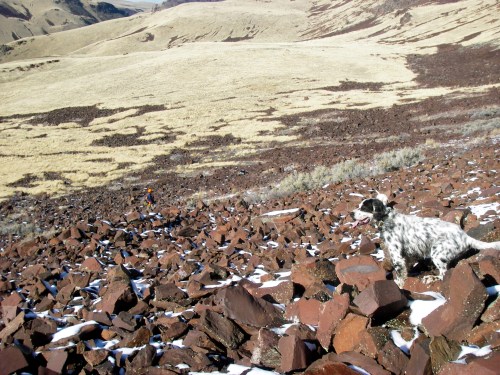
A scrape on my right knee, reminiscent of a ten-speed crash. A bruise on my shin, running knee-cap to ankle. Another on my ass. My shotgun has similar injuries. No matter. I’ve been playing.
I’m doing it again. Now running. She is on birds again, on the slope below, nose in the wind, working them. No doubt. Birds. Here we go boys! I skip over stone and slip on scree, and vault over cactus and long-jump small arroyos. I carry my shotgun in my right hand and sprint. She works the birds with care and expertise and still they go up out of range, no doubt spooked by the stampede of hunters to the white setter’s playground. No matter. It is good to be young again. I can’t stop giggling.

The school yard

– TR

Sweetness

Sometimes, she is lost in the crowd, run-over, crotch-sniffed and dry-humped by big males.

But somehow, she always finds her way to the front and she is there, frozen and steady. Cat-like on the creepers. Chukars and pheasant and sage chickens mostly. The walking birds. Moving now. Then frozen.

The males, if they pay attention, nearly always come in second. When she is second, or third, or fourth, she gives quarter without complaint. She honors. Literally. She honors friends’ Griffons and short-hairs. She honors big white rocks. She honors feed tubs and salt blocks.

And she honors me, especially on the days when it is just her and her fine nose and her glide and float, her creep.

A friend watches her from horseback. She’s working sage chickens. She is a cat, and looks over her shoulder: “Um is someone going to come shoot this bird?”

And she moves as the bird moves, never pushing too far, stopping now and looking back at us and the friend is off the horse and moving in. “Okay, it’s about time.”

And slinking and then frozen and then the bird goes up and the gun barks and she has honored me once again. Make it last, this rare privilege, this fine honor, this sweetness.

– TR

Last Call

Grasshoppers whirl at my feet like playing cards snapped into a stiff wind, a sound that is enough like a rattlesnake to skip my heart a couple of beats. This is snake country, and they are still active, even now with mornings frosted and the aspens stripped naked. I tell the white setter to watch out and stay close to my side.

We have only a few hours of light left in the afternoon and one thousand feet to descend. The air seems frenetic, everything sun-baked, hot, late in the day and year. Even the hoppers seem hurried. Or maybe it’s just me.
Most people are hunting elk and deer, but the river calls. I can’t hear it from way up here, but it sings to me. I know the flow is low enough now to wade and the water clear enough to fish. The last hoppers are on, defying autumn. Go. Headlamp in the pack, hair-and-feather hoppers tied the past winter in the box, cold dinner of elk salami and Havarti in the bag. Go.
So we drop off the rim, and I can feel the pain of it in my quads almost immediately, half jogging, power hiking down into the canyon. There is a faint game trail that someone, damn them, has flagged with plastic tape. My secret place discovered. I’ve been scrabbling down into this canyon every year for ten years. This is my one trip for the year, and this one only a few hours squeezed between walls of sheer limestone. Not many make the effort. There are easier fish and gentler places.
I stop long enough to yank the flagging down and call the dog off a family of grouse he’s pointing. The trail fades and then disappears, and I’m in the thick north-side Doug fir with gravity as my only guide. I ignore the feel of my toes hammering into the boots. Is that a hot spot developing? To heck with it.
Finally, the river. It is squashed down here, flowing season’s-end-low through limestone boulders shed from the top. The river pools, then rushes, twisting. Both banks are too steep and tangled to hike. The river is the only path and only if you are willing to get wet. I rig the fly rod and tie on a hopper, wading into the first pool, heading upstream. The dog stays at my side, pointing fish now instead of birds, happy to be trembling in cold water, watching the trout rise.
The first is a brown, ten inches, sides sprinkled like he’s been rolled in black pepper and cayenne. The fight on the two-weight is brief, fun, then over. The next is a rainbow, complete with rainbow acrobatics. The next is a brookie. And so it goes, good fishing in clear water with big flies. Reward for sweat. Made sweeter by the effort of the hike, the urgency of the late hour and season. We wade upstream in the shade of the canyon walls, in the fading light of an October day.
By the time I fish back downstream to my stowed pack, I can no longer see the hopper riding the waves. The hike out, up, will be in moonlight and headlamp. We will take our time on the climb, however, for now there is only sleep ahead.

Fall comes with a quickening in the heart. You smell it early, maybe. Even in the hot years, perhaps as early as August. It happens suddenly. One morning you are standing on your front porch sipping your coffee and it dawns on you how cool it is. There’s a smell in the air, too, a smell of grass cured by the sun, of leaves, of sap, of faint thin wood smoke. Now your attention turns to the aspens on the hill above town and to the alder along the creek, watching, waiting for them to signal the beginning of it.


One morning, you notice a thin line of ice on the horse trough, like salt rimming a margarita glass. It won’t be long. Not long now. You start to dream when you are awake, just as you did back in April. They were vivid conscious dreams of salmonflies and caddis and trout rising above willow-blanketed islands. Dreams of summer coming. But now your dreams are laced with the smell of wet, happy dog, of elk bugling, of leaves changing and falling, of grouse warm and sun-dappled in your hand, of gunpowder and dog bell.
Autumn is a season that sings of harvest and bounty. Yet, on some days, it is still hot and sweat streams down the center of your back and you worry about hanging meat and fret about blowflies and rattlesnakes and loud leaves crunching under your boots. But it is time to harvest and there is not much time. Most days leave you happy, harvesting, collecting, breathing those great smells.
And yet with fall comes a sadness that washes over you for no apparent reason until you realize you are mourning the good things of summer lost. Still, you remind yourself of the peril of this melancholy path, of the fact that summers, like loves, are remembered only for the good things. Summer may be gone, but gone, too, are the blistering long, hot days, the parched landscapes, the mosquitoes, the horseflies, and the rivers with water too warm and low for healthy trout.
Early on, you look at your calendar and cross out days. You’ve hoarded your vacation time for this season and the Xs made by your pen take up days, then weekends and finally, whole weeks. Bird hunting. Antelope hunting. Berry picking. Wood gathering. Bird hunting. Harvesting the garden. Canning. Elk hunting. Deer hunting. More bird hunting. Listening to the Denver Broncos and the Wyoming Cowboys on AM radio. Hauling hay. More wood. You are awash in a frantic river of activity and then it hits you.
Fishing. You almost forgot fishing.
Autumn fly fishing is for the dedicated. The rivers have cooled and the action, at least the action of humans, has chilled a bit as well. Most have gone home and are settling into a season of football and cheese dip. So here, at long last, you have the rivers to yourself. If you are lucky, the hoppers will still be going, sometimes as late as mid-October. And if you are really lucky, the big browns will be on the move.
In late October, from the Miracle Mile to the Big Horn to the Green, the fish that we have credited with legendary intelligence, a trout worthy of kings—King Brown himself—will be on the move.
They run into the rivers from the reservoirs and up the rivers into the streams, and up the streams to the cricks. In October, it is entirely possible to catch a brown trout as long as the crick is wide. Big spawners, with sides as yellowed as the meat of a ponderosa pine. If you tie into one of them on your new four-weight, you’ll pray for its spine, its soul, and thank gawd that the manufacturer has a breakage guarantee, and you thought to bring a back-up rod.
The big brown boys of autumn react quickly to well-presented flies, as if enjoying the cooling of the water. They’ll slash and slam into grasshoppers and other big dries, while beneath the surface, they hammer Montana nymphs, girdle bugs, and wooly buggers. There’s nothing subtle about a fall-run brown trout. They have sex on the brain, and like bull elk, thinking about sex can get them into trouble. No longer are they delicately sipping those size 22 midges on 7x tippet. Instead, they’ll knock the snot out of a size 6 muddler fished on 4x and leave a hole in the water that seems to take forever to fill back up.
Rainbows and cutthroats, too, seem to frolic in the cooling waters, taking some of the smaller stuff on top, perhaps following the spawn of their brown cousins, perhaps just feeling the urgency of the shortened days. Brook trout run now as well, wearing colors almost too gaudy for nature, reds and blues and greens. They are hungry, and they act quickly and seemingly without premeditation.
The beauty of fall fly fishing is you can wait for the sun to come up over the rimrock before you leave the truck. You can wait for the waters to warm a bit and for the scattered hatches to come on, for the frost to metamorphose into dew, before you rig up and pull on the waders.


You’ll fish well, for the whole summer of fishing is behind you and your moves are practiced and honed by solstice-length days.
This short fall day finds you moving carefully among spooky trout, false casting just enough to get the job done, easing over boulders slick with the dying algae of summer. In the cool water, the fish you land fight vigorously and swim off defiantly, still full of spark. Each one you land has you wondering, Is this the last one? Is this the last trout I’m going to land this year?
If you have planned your day well and have had enough smarts to leave the shotgun and bird dogs at home on this rare fall day, you will perhaps—midday and six trout landed—have enough time and the good sense to sit on the bank for a while. Here you can contemplate the vicissitudes of the sporting life in this urgent, too-short, best-of-all-seasons season. You’ll watch golden aspen leaves spinning boat-like in the water and once in a while, you’ll rise to your feet and cast again. You may even have planned well enough to have packed a lunch into your fly vest. Perhaps, you’ll take a break from this quickening of season, from that hurried feel in your heart.
But more likely, you’ll fish hard and return many trout to the water and then you’ll start to think about that dog. It sure would be nice to put him on some ruffed grouse today.
–TR

This essay is excerpted from Blue Lines, A Fishing Life, published September 2010 by Riverbend Publishing, Helena, Montana. For more information, check out http://www.tomreedbooks.com

Charged

I worried about the heat; 80 and rising and four dogs in fur coats out in it. I worried about the back end of the old man, breaking down now after nine hard years of sweeping before my guns. I thought of a girl who has my eye these days and I thought about work. Anything but the activity before me, anything but the hunt. That’s not an easy admission. But I was distracted, off my feed.

At the toe of the mountain, up against the wilderness boundary, we followed, my thoughts and I, and we climbed through hip-deep grass and pushed through alder and chokecherry and aspen.

Then it happened. He was there. Five hundred pounds, I’m guessing. I’ve been close to grizzlies before, but never this close. Twenty yards. He burst from a chokecherry patch and bounded down the hill, stotting like a flushed mule deer in fresh alfalfa. But this was a bear. And there was no doubt: the hump, the roll of silver on his shoulders, the head, the small ears, and the claws. They looked like they were eight inches long, but probably were half that.

The dogs were out in front, beyond the bear, sniffing out grouse, and the grizz ran a perpendicular path faster than I can write this sentence and you can read it. I had enough time to yell: “Hey bear!!” and I had enough time to think about firing off a shot into the air, those meager seven and a halfs. And I had enough time to think: “No, if I fire a shot, the dogs will get excited, see the bear and then it will be on. Or over.” So I yelled. I may have hit a high note. And then he was gone.

All four dogs at heel now and heading to the truck. I thought about wild country and animals that can snap you out of your mundane bag of thoughts and re-energize, invigorate, and excite. May there always be a wild place of the hunt where something is bigger and meaner and has better judgment than I. Now, at last, I was back to being a hunter; next time would be a time of alertness and stepping light, of open eyes and focused energy. I would be fired up and ready. Charged.

–TR

Quickening

It has been shoved aside for months. Roughly. Put in a closet. Oiled perhaps, but discarded out of sight. And out of mind.
Then this morning you wake and there is snow up there. Last night–a Sunday–you were up at the best bar in America listening to live bluegrass and haunting lyric strained through the vocal cords of the prettiest undiscovered twenty year old talent in Montana. It rained while she sang and then this morning. Snow. Up there. High country snow in late August.
So long, you say, to the shortest summer on record. So long, you fickle minx. So long.
So to the closet, where it is pulled out, fondled, oiled again. And the dogs twirl and two-step and jitterbug. It is here. It is here. Now. Upon us. The spring has been wet, the summer reluctant. No matter. The best of all seasons is on us like the warmth of a September sun at the beginning of a day out with shotgun and bird dog. The sun looks sharper. The day brighter. The sky bluer, crisper.
Hello. Where have you been?

– TR

Blood lust

I’m going to admit to a blood lust. I like to kill and I love to hate.
But only one thing in particular: starlings. Stinking, shitting, filthy starlings.
I stalk them in my bathrobe. They flutter and twitter about the eaves of my home and crap all over my porch. They tweet in nails-on-chalkboard tones while I sip my morning coffee and I slip up on them with a twenty and blast them while they sit. Sometimes I get out the twelve . . . really whatever is handy. The twelve sits upstairs where I can load fast and shoot from an open window. The twenty by the sliding glass door downstairs. It is work done in slippers on the front lawn, robe flapping. It’s good not to have neighbors.
A challenging wingshot, but I will take whatever shot there is. The dogs twist in circles, mistaking an uncased gun and a creeping owner for September partridge steppes. Little matter, for when I fell one of the stink birds with a load of sixes, they rush in and fetch, only to spit the mangled bird out.
I kill the parents first and then get a ladder out and pull four screeching nestlings out to drown in the creek while the setters dance happily.
A fella has got to do something with summer.

TR

There is little dignity for a bird dog posing next to a starling, but such is the off-season.