Rough shooting

As it turns out, I need a gun-bearer.

I’ve been reading a copy of Shooting By Moor, Field and Shore, an almanac of shooting in England, published 1929. It paints a portrait of a different time and a different world. Furthermore, it points out the inadequacy of my low brow ways. In the brief section on “walk up hunting” as opposed to shooting driven game, the authors point out the obvious burdens associated with “rough shooting.”

“In order to kill game on a rough shoot, you must either walk it up, or indulge in impromptu driving either with the help of a friend of friends. You have to carry your own gun all day, and most probably the game bag as well.”

Imagine the horror of having to “carry your own gun” and game whilst hunting. I should have flipped through this book before I logged a hundred or so miles to shoot only a handful of quail this season, carrying my own gun the whole time.

Beauty marks

I like shotguns.
Specifically, I like old, lightweight shotguns with two barrels and well-figured walnut.
Preferably in 28 ga. or 16 ga.
Some of my hunting buddies now carry guns made of black plastic that look like they might shoot lazer beams.
Personally, I don’t own anything I won’t hunt in the rain with, but I also don’t own any guns I would put a bumper sticker on.
When I was ten, I had a Remington Nylon 66 rifle. It was black plastic with white diamonds where the checkering should have been and it had glimmering stainless barrel and action.
It was the ugliest rifle I have ever owned and it could not dependably shoot beer-can sized groups at 20 yards.
Since then, I have stuck to guns that are made of dark-blue steel and checkered walnut.
I like them to smell of boiled linseed oil and 3-in-1 and if I leave it leaned against a fence, I want to be able to imagine my grampa standing next to it.
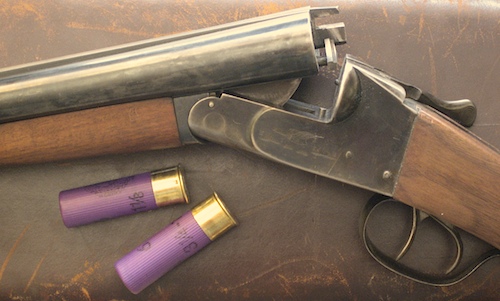
Last year I bought a 1936 Ithaca side-by-side 16 ga. with no butt stock.
I spent most of the spring fitting and shaping, sanding and oiling until I had a new-to-me upland gun.
She still has some of her case coloring and when the light is right, the barrels shine like obsidian. I added a few inches to the trigger tang and an english style stock in place of the Prince of Wales that would have adorned the gun originally.
The maker’s marks on the barrel denote ‘modified’ and ‘full’ chokes. On the pattern board, it’s more like ‘full’ and ‘rifle.’
Still, I managed to shoot a few birds with it this year and that brand new stock already has its first ding, earned high in the Pecos Wilderness on an early grouse hunt. I don’t worry much about the scratches and scuffs that mark the passing of the years.
I think what I like least about plastic guns is their inability to show the character that comes with age and use.
My guns carry their dings and scratches proudly, like little historical records of antlers and pack frames and chukar hunts gone wrong.
It’s how I like them.

GM

The lonely life of a desert Santa

Santa Claus was more emotionally needy than I expected him to be.
TR and I had stopped to refill our water jugs at a remote BLM outpost manned by volunteers.
“You guys here to see the museum,” he asked hopefully. He was a large man, sporting a full beard and was almost surely the real Santa.
“No. We’re just here for a little water.”

“Huntin’?”

He asked the question as if we weren’t covered in a week’s worth of dust and driving pickups loaded with camping gear and dogs.

“Yep.”

His wife, AKA Mrs. Claus, comes out and brings Santa a spotless cowboy hat. Were if it covered in grime, it would be a near twin of those worn by TR and myself.

“Those are our cats,” he gestured towards two big toms.

TR and I were non-committal, but they looked like quail killers and bird-dog fodder to us.

“One has different colored eyes and the other has different colored balls,” he said casually, adding, “I can tell them apart coming or going.”

That night over beers we speculated that Mrs. Claus might have brought out a different hat, depending on what the visitors were wearing.
We imagined Santa in a beanie, sombrero or maybe a cheesehead.
Weeks later I stop by again, ostensibly to get water. I throw my hat on the floor board and don a ball cap.

“Here to see the museum?”

Mrs. Claus walked out a moment later, bringing him a barely worn baseball cap.
I guess it’s a lonely life.

In search of the empty

Damn the red lines.

They crisscross the green and yellow areas on the map like bloody cracks.
On the ground, they are uglier and more numerous.
These are not the access routes that bring us to the edges. No, these are far from the rural route roads-the gravel arteries-that deliver us from here to “out there.”
Dusty, rutted trails, crosshatch the landscape. Parallel routes that go nowhere, achieve nothing except to reduce habitat and lessen the experience.
The ungulates see them as warning signs, for the quail they are deathtraps.
The red lines often begin and end at the same places. On the ground, they simply wander as if an unmanned machine had prowled the landscape at random, leaving ruts that will last a hundred years.
On the map, I search for an area devoid of the red lines. A place I can’t walk from one road to the next in the time it takes to smoke a decent cigar.
There are few.

Rock Star and the Old Lady

My sons are just starting to notice my dog. They follow her with their 2-month-old eyes as she ambles past their swing or give a baby yell when she stops to lick the milk off a tiny dangling hand.

My sons are just starting to notice my dog. They follow her with their 2-month-old eyes as she ambles past their swing or give a baby yell when she stops to lick the milk off a tiny dangling hand.
Today, she’s recovering from three days of hunting after a season with precious few days afield. A dog in her prime, she is nursing sore feet and moving like an old lady.
After the days of perfection she just turned in she is entitled to a little soreness.
In rough, dry country we cut a wide swath. Her zigzagging in front, never straying out of shotgun range but occasionally breaking her pattern to check out a particularly good piece of cover. She held tight, she flushed in range and she retrieved more dependably than any season past. She was more than steady, she was a rock star.
We had company this week and she put him on his first birds.

The first afternoon, he followed her lead into a patch of tall grass and Gambel oak and stopped when I called out. She put a pair of birds in the air and after his shot she brought a beautiful male Gambels to his hand.
When he looked back, I could tell she had just created an upland hunter.
My two upland hunters are years from their first shotgun.
The realization that Roxy will not be their dog brings an air of melancholy to the day. Her exploits will live on in my journal and stories but to them she will never be a rock star, just an old lady.

Camp coffee

The explosion wakes me from a mostly sleepless night
Outside the frost covered hood of my sleeping bag, a raging fire burns
My companions are huddled too close to the flames, one clutching a can of Coleman fuel
It’s too cold to stay in the bag
Out into the biting cold to rummage around for the coffee pot
The excesses of the previous night are evident
A tin coffee cup is frozen to the table; a solid whiskey and coke ice cube in the bottom
Stumble to the water, bust the ice, dunk the percolator
Coffee boils over a gasoline fueled fire of wet, frozen wood
Caffein
Early morning fix
Warms the body, defrosts the brain

Hunting alone

The water is warm and gritty but it will extend our range, so the taste doesn’t matter much.
Out here in the flat, away from the roads and far from the convenience store world we live in, it is the space in between that is most relevant.

There is nothing but the dog and I, the rolling hills and a cup of chemically purified water. It tastes almost sweet with the sense of self reliance.
The muscle aches that flared near the truck are gone and I’m walking easy now. We’ve been into a few coveys and our steady pace follows the terrain lines.
There is no sign that anyone has passed before us.
It feels good to be alone.
Self sufficient.
I came for the quail but now it is the horizon that pulls me along.
Besides the dog and my shotgun I have a handful of iodine tablets in my vest, a zippo and a two-bladed Case knife in my pocket. Everything a man might need to cross a barren landscape.
The urge to continue – to journey – is ever-present.
A biologist friend of mine told me about a female coyote that was collared out on the eastern edge of the Edwards Plateau in south Texas in the early 90’s. She turned up a few years later in the middle of Arizona, nearly 1,000 miles from where she started.
I often think of that coyote when I am afoot in wild country. Did she get run out of her territory or did she just have a touch of wanderlust? Did she journey west all at once or did she just gradually drift across the open spaces?
The sun has dropped well below it’s apex and if I turn back now, I will find the truck only a few minutes after full dark.
With a last look west I turn for home. The dog circles wide, still hunting.

GM

A dog’s calling

The early, excited conversations about bird dogs and shotguns have died out.
Now there is little but the quiet jitters of a sleepless night and an oncoming hunt, the silence punctuated by conspiracy theorist postulations on AM radio.
It’s 365 miles from my driveway to the first decent patch of public pheasant hunting at the southwest corner of Kansas. That’s a little over 5 hours of hard driving, leaving at midnight, arriving in the cold well before sunrise.

The early, excited conversations about bird dogs and shotguns have died out.
Now there is little but the quiet jitters of a sleepless night and an oncoming hunt, the silence punctuated by conspiracy theorist postulations on AM radio.
It’s 365 miles from my driveway to the first decent patch of public pheasant hunting at the southwest corner of Kansas. That’s a little over 5 hours of hard driving, leaving at midnight, arriving in the cold well before sunrise.
The dog is sleeping, finally past the nervous whine that pierced the first hour of the trip. Now she’s settled in, conserving energy for the day she surely expects at dawn. I am positive that she believes the trip is for her sake and this time she’s right.
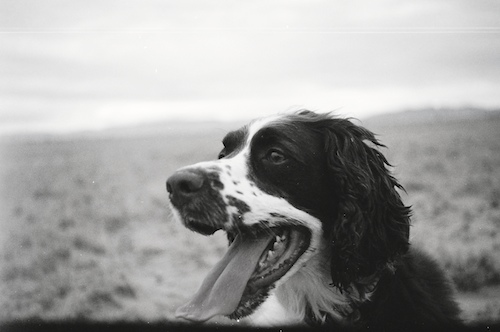
She has hunted almost every western specie of upland bird, but as a springer her calling is pheasants.
We blast through Boise City, Texas and I open the windows and let the sharp, cold air in to keep our eyelids pried open.
In the jet black of predawn Oklahoma, the rural world is stirring.
Old Ford pickups are idling in dirt driveways, creating little clouds of exhaust while their owners enjoy a few more minutes in a warm kitchen.
It’s late season and the early crowd at the cafe is mostly Stetsons and John Deere baseball caps, devoid of the hunter orange that litters the tables in November.
Back in the truck, Roxy starts the nervous whine again. We’re out of town, racing down dirt roads past cut grain and CRP looking for any sign of terrain in this vast expanse of ocean-flat prarie.
We bail out of the truck at a small draw with a thin strip of amaranth down the center. White, Walk in Hunting Access signs, the siren song for out-of-state pheasant hunters, border the edges.
The dog is booted. Last trip the sand spurs were prolific. She prances for a few steps then settles down to wait for us.
Barely 20 yards in Roxy makes an abrupt stop, miscalculates the boots and falls flat on her side. Her legs are sticking straight out and her nose is in a clump of switchgrass that erupts in a hen pheasant.
Before the hen is even out of sight, a rooster cackles out of heavy cover with Roxy tight to his tail feathers.
This dog chases quail and on occasion will refuse to make a retrieve on a bird she deems too big, but she was born to hunt pheasants.
A few years ago I heard there was a springer pup with a local rescue organization in the next town over. I called and asked about the pup, tempted to bring him home. A few questions into the conversation, the woman on the other end of the line changed her tone.
“Would you be using this dog as a hunting dog,” she asked.
After the obvious response, she told me that the pup wouldn’t be allowed to go to a home where it would be required to hunt.
“It’s not good for the dog,” she told me.
I imagine that pup ate every plant, chewed up all her left shoes and destroyed most of her furniture with its pent up energy. While the thought of all that sweet justice makes me smile, I feel sad for the pup that likely never discovered what he was hard wired to do.
My own dog quarters through thick CRP, hunting hard and barreling into and through the thickest cover. The deep grass sometimes covers her completely, but she reappears momentarily in vertical leaps that are her breed’s namesake.
A nose-to-the ground, brush-busting springer has no greater desire than the trail of a wile old rooster, staying afoot and trying to hunker down or run out of range.
This is her calling and it’s worth the drive.
GM

Learning curve

The dog and I are fresh into New Mexico, a return of sorts for me and a new adventure for the dog. We are out of our element here, short grass and cacti, everything spiny and dangerous.


The scalies and the gambels are sprinters. The first few coveys we tried to close in slowly, the dog straining against the tenuous strings of obedience as I waited for them to hunker down.
Instead, they simply ran away from us, climbing to the top of the ridge then jumping off the other side, never to be seen again.
That was ages ago, months and seasons and dog years.
Now, I let her run.
Bust them like an out-of-control mutt loose at a city duck pond.
I watch the covey rise and hear the mad beat of wings as the devil birds surge away just out of range. I whistle her back to heel and she comes, ecstatic, thrilled with the flush.
I mark the birds down and know that they will hold for a few minutes. We hike across the rocky hillside, past the cholla and up to the saddle where we saw them anchor.
Now we’re set, this flushing dog and I. The birds are holding tight and she knows it. She flies headlong into the clumps of tall grass, powers through a creosote bush and flushes a single.
At my shot, a second bird erupts from my near my feet and I spin to my right, unable to see him for a moment. Then I’m on him, swinging my gun past the square of my shoulders as he swerves downhill.
I miss.
She pauses for a moment and I like to think she is checking to see if the bird goes down, but I know it is not her belief in my shooting but a yearning – a fiery urge to chase that keeps her gaze locked on the disappearing speck.
Then we’re back in the saddle, working the patches of grass that won’t hide a dropped 28 ga. shell but can somehow cover a dozen birds. The dog lights up, shortening the strokes of her zigzag as she hones in on the foot trail of a quail. A flurry of feathers and they’re off. It’s half-a-dozen birds and I’m leaning hard, wanting the double and somehow connecting.
We pick up our birds. The dog is still hunting but we both know they’re gone, somewhere in the bottom now and not holding this time but running, hard and fast and without looking back.

GM