Jungle Dog

Guest Post

By Travis DuBois

The heat of the day has come and gone as I gently carry the anchor up a cutbank and set it, this would be a bad river to lose my boat to. Everything I do is intentional and quiet. Everything Kenai does is now intentional but very loud, her incessant whine is something I’ve become accustomed to but my level of annoyance never fades. As the river slips by her yips and yaps help me gauge how fast we’ll have to push this island. The collar on her neck is tight and the dam that holds her back from blowing the whole popsicle stand. The fire from the cottonwoods are a good representation of the butterflies and excitement I feel but try not to show. The fire never dies.

E3B4AC3E-FAF4-4CAB-B914-6C4C6E5AF2CE.jpeg

Glittery pages of hunting magazines with naked setters, Instagram posts with poetic points, advertisements with steely eyed labs and bearded hunters are great, but this is not my world. Fall with Kenai is a party, in every sense of the word. Her ten year old, fifty pound, yellow lab frame is built for pushing the dirtiest and nastiest, the jungle. If her eyelids don’t bleed and her joints don’t hurt by the end of the day she is not satisfied. Her nose is scarred from frantically chasing wounded birds through barbwire and thickets, she wouldn’t have it any other way.

I sometimes think I should have taken more time to train her properly, but I have grace for myself that I have been learning with her since she became mine. When I bought her as a year and a half old pup, sold by a family moving from rural Montana to the city, she was a trained duck hunter and I was a firefighter/paramedic in Idaho who missed his home in Alaska. I yearned to hunt upland birds like I did in my youth but in the field my new dog would barely leave a heel, not a complaint many people make. I guessed at the only solution, let her be free, let her run, let her grow with me and relearn the ways of the hills, the forest, and the river bottoms where the birds live.

I quickly learned after hunting with a few friends that my dog was not like the others, her speed was like a greyhound, her nose as keen as a lead cow elk, and her drive was something I had never seen before. When I watched her clear a 7 foot fence to retrieve a ball I realized that I had something special, all the other dogs were running around the fence for the open gate and she chose the hard road, the danger, and the reward. I learned to hunt with her, around her, and for her. I learned to stay in her orbit as we throttled through space. We found her species, which was ringneck pheasant. We found her cover, which was the most brutal terrain that pheasants live in, where the pointers shy away from and only the most driven dogs will venture, and so far she has been the only one.

This specific set of requirements initially presented a challenge, and a learning curve for me, but over the years we have become a cohesive unit. Once she is on the ground we make nary a sound. I know where she is without hearing or seeing, and I know where to be when the opportunity to take our quarry presents itself. We find success, but often it is just the two of us. Sitting on the edge of an island, or a sea of greasewood, or on the side of a brutal hill, we are covered in mud and breathless. She flops down panting, blood coming from somewhere always, I slip a warm bird into my game bag and dab my cheek to see if I am bleeding from my belly crawl through a thicket. There is no use in fancy upland pants because by the end of the season the barbwire and organic armor we push through destroys everything except our souls.

This day is different though, my good friend from Oregon is sharing the sprint with us on a Montana river island in October. It is a small piece of real estate but that is what we hunt and I have briefed him on the details, this is no John Day chukar hunt. In the essence of safety when I follow my dog with other humans I seldom pull up on a bird. I am so used to hunting alone and a 360 degree shooting window. Kenai has already flushed and retrieved a rooster that day, dragging it out of a log pile that it buried itself in, so she is primed and on fire.

Pushing the island we are now single file on the edge of a cutbank, it is 5 feet straight down to the river, which is flowing mightily. Kenai is up front, Tom behind her, and I take up the rear. Thick bushes, narrow shooting lanes, ridiculous cover, perfect. Kenai sends a bird into the air and it is brought down with a single shot but running. The linebacker masterfully chases the thick-legged bird down and pins it, waiting for us. Her soft mouth holds the rooster as we move to her when a second rooster explodes and flies out over the river. Time slows down and Tom drops the second bird with his last shell. All the colors of the rooster drop to the water 20 yards from the bank. We are close to Kenai now and I don’t say a word because she saw the whole thing. My perfect girl inflicts a death squeeze on the bird in her mouth so it won’t run away and in seconds is launching herself off the bank and into the swirling water below. I am breathless. She makes something so monumental look so simple as she propels her exhausted body to the middle of the river and grips the flopping bird in her teeth. As she returns to the shore I drop off the bank into the ribbon of shallow water below along the deep to retrieve the retriever and toss her and her prize up to dry ground. The mud and water in my boots felt like sweet honey as I watched her drop the bird and shake the water from her body. So much excitement and joy commanded the next few minutes.

Eight years is a long time to wait but my dream was always to have my companion return to her roots and retrieve a pheasant from a river, or any body of water. When my wife and I discuss life and God’s timing we are always amazed at the way He chooses to show us things, on His time and in His way. This moment was no different. It could not have happened in a more beautiful way, to a more beautiful dog, and in a more beautiful place. It felt like a culmination of years of boot leather, blood, lonely but fulfilling miles, and a lifetime of following that party animal. My jungle dog.

Travis DuBois

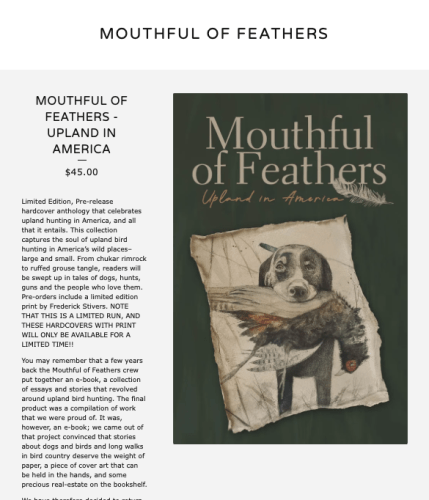
Mouthful of Feathers, Upland in America available in print

PRESS RELEASE

JULY 24, 2023

Much anticipated upland hunting anthology available

Mouthful of Feathers, Upland in America book for sale

With a foreword by the legendary actor, Michael Keaton, and an “afterword” by well-known upland author, Ben O. Williams, a long-awaited upland hunting anthology became available late this month. Mouthful of Feathers, Upland in America, is a collection of upland hunting stories now available online at Amazon. 

The book brings together 20 diverse authors, including five women, with tales of the hunts, dogs and wild landscapes that make upland hunting special. Stories are told of the dry desert canyons of Nevada to the lush uplands of New Hampshire and many other places. 

In addition to Keaton and Williams, authors include Blaine Peetso, Bruce Smithhammer, Greg McReynolds, Thomas Reed, Ryan Busse, Reid Bryant, Edgar Castillo, Jillian Lukiwski, Chris Dombrowski, T. Edward Nickens, Els Van Woert, Mike Neiduski, Shauna Stephenson, Eric Thompson, Marissa Jensen, David Zoby, Christine Peterson, and Chad Love. Cover art is by the well-known artist Frederick Stivers. McReynolds, Bryant, and Reed served as editors. 

A limited-edition hardcover with a signed Stivers print sold old in only a few months. The paperback is available on Amazon for $16.99. It is published by Cornmill Press, Bellevue, Washington. 

Building a book – hard cover update

It is humbling to have strangers, strung out across the country, buy a book sight unseen. When we opened the pre-orders for the limited edition copy of Mouthful of Feathers, I was staggered by the reception. Thank you to everyone who reached into your pocket and paid for a limited edition copy of the book. Your faith in us is overwhelming. And, you enabled us to bring this project to life.

You made this possible. 

I know many of you are waiting patiently for your hardcover. I am too. I am sorry for how long it is taking. It turns out that building a limited edition hardcover book is pretty hard.

But, the books are printed and we are expect them to arrive early next week. It will take a little time to package each book and print, label and mail them. It will take a little longer to journey to each of you. But you will get your book.in the coming weeks. And what’s inside is pretty damn good. And the print from Frederick Stivers is remarkable. 

Since the inception of the blog, we hung the best stuff up for free. When we created the first ebook, we sold enough copies to pay overhead. As a I recall, contributors got paid enough to buy a bottle of blended scotch (Famous Grouse, most likely.) But, over the years, we made a lot of friends and found a lot of people who valued the same things as us and maybe we wrote a few lines that meant something to the select few.

This go round, we paid the contributors up front, (this time maybe enough for a good pair of hunting boots.) But the editors (Tom, Reid and myself) are just hoping we break even. Mostly, we hope that this book will mean something to each of you. We hope you will find some passage inside that lights up your heart like a young dog on a wild bird.

For us, bringing this book to life has been a privilege, bestowed on us by all of you. Thank you for trusting us. Thank you for reading. Thank you for investing in this book. 

And if you’re waiting for a hardcover, know it’s coming. And know that it is going to be worth the wait.

GM

On retrieving

The water was prime and the birds were flying. We made a quick scout to a log pile near the water’s edge. It was shooting light, so I gave Luke the go ahead to if he had the opportunity while I grabbed a few decoys and a minimal setup. 

It was the youth waterfowl weekend, a two-day jumpstart for the under-18 crowd, and it was warm enough for T-shirts and rubber boots. Over the last few years hunting with my twin boys – sometimes with their younger sister in tow – I have learned to be nimble and flexible. I have learned that it’s not always important to be on time or even kill birds. Instead, it’s important have fun, to pack sunflower seeds and to never underestimate the volume of ammo you might need. We eat ramen noodles and granola bars by the case – even an occasional gas-station corn dog ­– and we try not to take our pursuits or ourselves too seriously. 

Today only one kid was up for hunting, so it was just the two of us. As I headed for the truck, I turned back for a last look and said, “If you get a good shot, take it. But whatever you do, don’t shoot a bird way out in front where it will land in the deep water.” He nodded and smiled and I knew he was happy and proud to be left hunting on his own for a bit. 

We were dogless on this trip, a symptom of being an upland hunter and diehard setter man. When I was younger, I had springers that could do double duty. Now, I have a pair of setters. Only one retrieves reliably, both are reluctant swimmers, and neither can sit still for more than a moment. Personally, I’m not much of a duck hunter. When we sit in a blind and try to decoy ducks, the boys pepper me with questions that are mostly answered with, “I’m not sure, we are  learning to hunt ducks together.” But 12-year-old boys are blood-thirsty creatures, eager to hunt and not always content to follow a pointing dog patiently waiting for everything to line up in a perfect sequence. So sometimes we craft a makeshift blind and retrieve our own ducks. 

A couple of years ago, I met two friends on a cold winter morning for a quick duck hunt and not one of us brought a dog. Between the three of us, we owned 7 different pointing dogs and we still arrived planning to retrieve our own birds. On that frosty morning, shortly after the first shot, a chocolate lab from a nearby farm simply showed up and waited patiently until he got a chance to retrieve. He was an outstanding dog, retrieving to hand and patient as a saint. The irony of a random lab that wanders into a duck-hunting trio with a stable of “not labs” at home was not lost on us. 

I hunted that spot again the next year and no lab showed up. I wondered if he had moved on or maybe had his hall pass revoked. Luckily, I knew what to do and I focused on shooting birds that would land in the shallows. 

At the truck, I shoved half-a-dozen decoys, mostly feeders, into a bag along with a roll of netting and a water bottle. I was almost back when I heard the first shot. Luke was grinning when I arrived, and he didn’t bat an eye when I asked where the bird was. “Right there,” he said, pointing to a dead mallard floating in the very center of the dank pond we were hunting. 

This was a moment of reflection where I stopped to ponder the important questions, like, why didn’t I bring waders? Why did I walk away from a red-blooded 12-year-old boy with only vague instructions about what not to shoot? How deep exactly would the waterfowl poop be in this particular pond?

In a turnabout, I hoped for a wind that didn’t show. As my son expertly dropped other birds on dry land and in shallow water, I tried to will that lone bird to shore, but it stayed anchored in the center. Eventually, the day wore out and I called it. He offered to swim for it, and for a moment I considered sending him before I emptied my pockets and waded out. 

I made it waist deep before I was in danger of losing my boots, not even halfway there. I turned back, pulled off the boots and threw them on the shore. It was 200 miles and five years since that lab had come to my rescue on a cold day. Still, I couldn’t help but scan the horizon for any sort of miracle, like a stashed canoe, a 30-foot-long pole or a random, enthusiastic Labrador. 

There were no miracles to be had, so I waded back out, this time with my sock-clad feet clearly communicating the depth of the muck. About two feet deep. Two feet of duck muck, pulling at my socks. The water was surprisingly cold, but when it reached my chest I was glad to swim because at least my legs were free of the slime. At least I didn’t have to turn back and take off my waders before I kicked into a mediocre dog paddle.

Mallard in hand, I swam, then slogged back to shore. Luke stood on the bank, chagrined, but not enough to keep from smiling.  At the truck, he helped me pull off the muck filled boots and found a piece of cardboard for me to sit on during the drive home. He said he was sorry, but I wasn’t mad and he knew it. 

On the drive home, we ate sunflower seeds and I told him about the time a rogue Labrador retriever came to my rescue years before. 

And then I gently steered the conversation toward taking the setters after grouse the next weekend. 

Book update: March

A huge thanks to all of you who pre-ordered the book. You guys are the ones bringing this print copy of MOF to life. We couldn’t have done it without you and we are so grateful to each and every one of you.

We have stories from 18 writers and we are so proud of the incredible stories in the book.

If you pre-ordered a book, you will hear from us about our progress in the coming weeks via email.

After we ship the pre-order hard covers in early June, we will have a soft-cover book available to buy. Stay tuned for more information about the soft cover.

Thank you.

Thank you for reading. Thanks understanding this thing that we do here at MOF. And thank you for supporting this project.

Mouthful of Feathers hardcover limited edition available for preorder

It’s always been about the dogs and the words.

The words are still here at the blog – 337 blogs over the last 13 years – enough to fill a collection of books. We still had a few new things to say and so did some of our favorite writers. I am happy to say that the Mouthful of Feathers print book, featuring exciting new material and due out this summer, is available for pre-order.

We are starting out with a limited amount of hard cover, limited edition books and a print from our friend Frederick Stivers. You can learn more or to pre-order a copy, here.

We expect to deliver books summer 2023 and once we sell out of the initial hard cover run, we will be offering a paperback as well.

Thanks for the support. Thanks for the encouragement. Thanks for reading.

Peak Bird Dog

This story originally appeared in the Fall 2019 issue of Quail Forever Journal.

By Greg McReynolds

It’s big country and birds are thin, so I let her run. No other dogs, no other hunters, just the setter and me.

It’s been an odd season. I haven’t hunted alone much. I’ve asked much of her to put friends on birds and counted on her to make a good showing in front of people I respect. I committed her to a charity hunt and called on her to rise to the occasion of hunting with some exceptional dogs. And she did.

For the first time in a while, it’s just us. I’m not handling her at all. Just walking across big country in the sage and the grass and watching her run until she drops over a bump in the horizon and disappears. If I had a friend in tow or someone else’s dog on my left, I would have turned her or stopped her to wait for me. Today, I let her run.

I hear the beeper when I crest the top of the hill, but it takes me a bit to get my bearings and then jog toward a creek-bottom thicket on the edge of a CRP field. 

I see the setter tail cocked at angle, bent where she has contorted herself into a point amongst the brush. There is no way to walk in and flush and still be able to take a shot, so I try to release her, but she’s held fast. I resort to tossing a stick. It doesn’t work, so I move and then wait. The setter is solid, but I can see her trembling.

After a long minute, the birds burst upward, looking for clear air. Just above the trees, I take a snap shot and hit one solidly. It flies downhill for 50 yards, towers and then plummets into a patch of cover. We search hard, but don’t pick it up. It’s stick-in-the-eye thick in here, and now that I’m in it, I realize my mark was poor. It would be easier to find if it was alive. After 10 minutes of bushwhacking and yelling and keeping the dog in the cover, she finally locates a hard-earned bird, lying dead on a bed of red and yellow leaves.

I slip the bird in my vest and call her back when she starts out again. I pour her water and sit down in the leaves with my back against a tree. She comes and sits next to me, still anxious to hunt, but willing to humor me for a minute. This is my best dog — 6 years in — as steady as I can get her, but still with the fire of a young dog.

She’s the middle of the pack I’ve always wanted. One old dog, one in her prime and one coming up. Three different dogs, three different eras.

A dog’s life is a parabola. An arc, heading skyward from a crying, whining ball of fuzz peeing the floor and barking in the kennel before plummeting downward toward an ending peeing the floor and barking at the ceiling.

There is a moment of weightlessness at the apex. It’s pulling the tow release on a sailplane and feeling the bottom drop out before you nose over into glide speed. It’s topping a hill at 17 years old, redlining fourth gear in an ’82 mustang.

The apex is a dog, running steady at a pace that eats up the country, cutting it into tiny blocks, breathing the air and floating past vast swaths of “no birds” until she locates them and holds them tight and steady so that you never fear whether she will wait for you.

There are the upward milestones, house trained, name recognition, recall, frustration, steady, first point, first bird, first retrieve, frustration, first road trip, first scare, pride, perfection, imperfection, frustration.

This setter took a gradual course to apex with some notable dips in altitude along the way. There was a beautiful October day when as a young dog, she blew through a field at light speed, flushing three different species of birds without ever tapping the brakes.

And there was one particular cold, wet day late in the season a few years back. My number one dog at the time had hunted the first field, but my hunting partner — my 14-year-old nephew — hadn’t yet had a good shot. I let her out with a little trepidation only to have her run with perfection.

She ran big and pinned down a pair of roosters and held them fast. He walked in a wing tipped a wild, mature bird which my little setter tracked down and brought back. I stood and watched a young man and a young dog and couldn’t tell which of them was happiest about that bird. I wasn’t even carrying a gun and it is one of my fondest memories afield.

There are the downward milestones as well, hardheadedness, blind, deaf, not-give-a-damn, last bird, last retrieve, last hunt. There comes a day where every point or retrieve is a gift. And the day when you have to pat her head to wake her in the morning so she will get up and go out. And then we lament how short the life of a good bird dog is and how the true burden of having dogs is outliving them.

It all matters. It’s all love and memories and life-altering companionship. But sometimes you see the apex — a moment where a dog reaches peak altitude. Her legs are strong and her stride is as efficient as it will ever be. She is no longer an out of control starship headed for another galaxy. She is a ballistic missile, headed for an ending that I know is coming far too soon.

That’s the trouble with peak bird dog: it’s fleeting. Two seasons, more if you’re lucky, before the gradual decline begins. A good dog will make up for it — hunt smarter, pace themselves — try to milk the golden years. And we will help them. Give them shorter runs and better conditioning, let them have the choicest spots.

But it’s still too damn short. So I stand and dust off the leaves. I fold and store the bowl in the pocket of my vest. When I pick up the gun and reach for shells, she is off like a bolt. I watch her stretch out. She checks back once, then begins to make long, wide sweeps, each one taking her farther out front. With the good weight of a wild bird in my vest, I strike west following the dog and savoring the apex. 

Mentors

BY BRANDON RAPP

It’s not always easy asking for help. Sometimes you don’t know you need it, while others you’re too stubborn to admit that you do. As a hunter, it can be at times, nearly impossible to force to question out of your mouth. 

Still, as an enthusiastic bird hunter that came to the pursuit shortly after their 30th birthday, early successive years of complete failure left me exasperated and ready to reach out to any benevolent voice of experience. 

A breakroom invitation from a few fellows at work got me into bird hunting. These were classic Pennsylvania “all-arounders” who graciously added me to their mid-October strolls in hopes of getting a few pheasants before it was time to sight in rifles and prep for frosty post-Thanksgiving deer stands. 

No dogs, tattered gear, and more pump guns than pomp were stored in truck beds and blanketed back seats. It was perfect. 

Those early experiences would breathe air into coals that grew flames of enthusiasm for the sport in a place where the best days of birds and habitat were long gone by the time my father had his 30th birthday. Despite making the financial and lifestyle commitments of new gear, more time in the field, and my first bird dog, I still hadn’t put my first bird in the bag. 

I finally did what so many of us find impossible to do, and asked for help. I was able to locate two local gentlemen easily 30 years my senior and secured an invitation to hunt with them. Confusion clouded most of that first early morning meeting in a state game land parking lot. These are far from the days when my generation seeks out mentors. It seems like you’re either blessed with them at birth, or you exist without them. 

We started our stroll that morning with usual and customary pleasantries set to the sound of wind brushing dry autumn leaves and bells on the collars of eager young dogs. 

“Where do you work? Where are you from? How do you like your truck? Any kids?”

Asking more questions than I answered, we made our way through tall grass and gnarled hedgerows. I watched my dog learn from their dogs as I did the same emulating their movements as hunters and absorbing it all. 

At the end of one such hedgerow, the dogs went on point and rooster cackles gave way to an explosive flush. Mounting, aiming, and firing I dropped one of the pheasants on a going away shot and my setter was quick on the fallen bird. A skill he knew he had, but not me. 

There’s no quantitative measure for the value of a good mentor. No dollar amount, no volume, no number of any kind will ever express our appreciation for their guidance. We keep the ability to go to them when we’re lost tucked away like a treasure. 

When I was shopping for my first double gun, I went to them. When I was buying my first house, I went to them. When an unexpected illness took our first dog at a young age, our bird dog’s older sister, I went to them. 

I still don’t know everything, so I keep a closed mouth and open ears when around those that are telling me something I’m thirsting to learn. How to take better care of my dogs or my guns. How to put better shots on birds. How to be more patient and a better man as a whole.  

Sitting in my truck after that first hunt, I marinated in appreciation at the fortune of now having these mentors in my life. Of how a little effort on my part by asking the question was rewarded with an invaluable resource in the form of two pleasant souls. This was one of those few times I knew something was changing, and I was moving into a new chapter I was excited to read. I sat there thinking about all of those wonderful heavy thoughts when I remembered I had a bird to clean, so I put the gear lever on my truck to “D” and let off the brake. 

Contributor to magazines, newspapers, and various blogs Brandon perennially seeks the marrow out of life by searching for his next experience. Whether it be less than sure about his location on a mountain top in Vermont, to pleading for a single bluegill on a local park stream, he appreciates the beauty of being out there. He’s been in way over his head with bird dogs for a few years now and sees no real reason to pivot from that trajectory.

Mouthful of Feathers lives!

The e-book is out of print. 

No one reads blogs any longer. 

No one (even us) blogs anymore. 

Instagram wants you to watch video influencers. 

Facebook wants you to shop. 

So we are doing the most punk thing we can come up with.

We are doubling down on the blog. 

We are recruiting new contributors. 

We are printing a book. 

Evidence of interlopers

On the tailgate of a pickup covered in the grime of four states, I pull out my boots and lace them while Tom buys green chile cheeseburgers at Blake’s Lottaburger.

It was a long drive through the night. A February snow hammered us for 300 miles from Utah until we drove out of it near Albuquerque at daybreak. The mid-day desert air is warmer than I have felt in a month, but when I pull on the boots they are still full of cold, Northern Rockies air.

There are a handful of chukar feathers stuck in the laces, a remnant of a last day Idaho hunt. I pick them off and watch them flutter across the parking lot and catch in the grass at the edge. I wonder if some other rig packed with bird dogs and desperate for a green chili fix. Will they raise an eyebrow? Will they get a chuckle? Or will they think, “go home you miserable spot stealing bastards!”

I hope it’s the latter.