Cowboy Logic

Call me pretentious or a purist, or worse if you must, but some things are just inherently better than others. Dry-fly fishing and homemade bread, film photography and pasta from scratch, wing-shooting wild birds and archery elk all hold intangibles that make them superior to their analogues. That doesn’t mean there’s anything wrong with Wonderbread or bobber-fishing, they just lack the same charm that stems from the countless hours spent developing a specific set of skills to accomplish what is, in essence, a more difficult and less efficient task. To do anything in such a way, to sacrifice our most precious commodities of time and effort, can only mean that we truly care about it. Not just in the end result, but also in the process of getting there.

Working cattle with horses and heelers certainly falls into this category and there are places out there where cowboys still cowboy. Where they still sort cows on horseback and drag calves to the fire come branding time. Where a hat and a slicker aren’t cosplay but still tools of a trade mostly done in unwelcoming weather.

Places like Battle Creek, SK , Broadus, MT and Kaycee, WY

As well as Longview, AB where I happened to find myself at a table with just such a gentleman. Bill sat there all crow’s feet creases and taciturn manner, nursing a Kokanee while his nephew Jake and I talked bird dogs.

I was there, back in my wife’s hometown this past summer for the occasion of her mother’s wedding, a marriage between a couple widowers well into their 70s. I was letting the dog out of the camper for a leak and some fresh air when Jake came up to me with a question I get fairly often.

“What breed is that?”

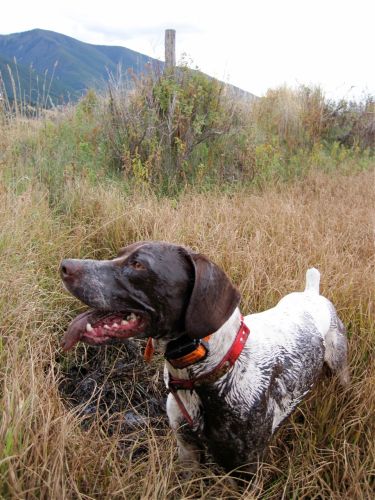
“He’s a Small Munsterlander.”

“I’ve never seen one. Knew it couldn’t be a mutt though, he’s just too well put together. You hunt him?”

This was all we needed to spend most of our evening drinking too many beers and conversing about all things out of doors, while the grandkids did the “Juicy Wiggle” and everyone else did their best to politely decline the groom’s homebrew.

Jake ran Springers, preferred to hunt pheasants and had recently converted to a hardcore lake fisherman because the rivers had gotten too damn busy for his liking. Jake and I talked of places and people we both knew, while Bill didn’t say a whole lot of anything. His only tangible contribution to the conversation was to offer a quiet correction when I got a piece of local knowledge mixed up. Bill’s family had a ranched “out West” for four generations and had land with a certain creek running through it that I would dearly love to get access to. Any tentative query I offered about said access, wasn’t met with much more than a shrug.

As always seems to happen with birddog folks, we ended up talking about the past exploits of our dogs, which inevitably left us just talking about dogs that have passed. Jake and I had both recently lost beloved dogs. Mine had a good run, 15 years until time finally told us “that’s enough”. His favourite springer Molly, cut down pretty much in her prime still. Jake’s wife, Susan, sat next to him holding back tears as he recounted Molly’s last days.

“There’s just something special about a bird dog.”

“There’s nothing like a good bird dog.”

We kept repeating some iteration of this phrase for lack of any way to move the conversation forward after reopening fairly fresh wounds, when another guest, Shane who’d been lingering around, took a seat at our table.

“Shit. All dogs are special” he chimed in, a few too many whiskeys deep and intent on talking before doing any of the prerequisite listening.

I’d met Shane a few times, he’s loud and brash and opinionated, not exactly a rare breed nowadays, but all in all he’s probably a pretty good guy who would be the first to stop and help if he saw you broke down on the shoulder, but reading a room ain’t his strong suit.

Jake just looked at him.

“Oh for sure, they’re all special, but there’s just something more to it when you have that bond you only get when you and a dog are working together as a team.”

Shane did a sort of half chuckle.

“You bird hunting guys make me laugh. You guys just think you’re special, is all it is. The dumbest birds. They just sit there. You can just shoot them with a .22 driving around on a side-by-side. “

Susan got up and left the table, Jake and I looked at each other.

Anyone who has ever hunted behind a birddog knows about the beauty and magic and value in doing so, and the only reason we personally feel special about it at all is because we got to witness it. I was about to get up on the soapbox and launch into a longwinded soliloquy stating just that, when the old timer in the Stetson to my left finally spoke in earnest.

“Sorry son, I didn’t catch your name.”

“Shane.”

“Shane. Nice to meet you. I’m Bill. You, uh, seem like the type of fella that would rather fuck five twos instead of make love to one ten.”

I suppose that’s one way of putting it.

Maybe not as eloquent as I was hoping to have said it, but then again I don’t spend most of my time speaking to a herd of Herefords.

Another mouthful

This post comes to us from Steven Brutger, a good friend and bird hunting buddy of MOF. We can’t tell if he’s making fun of himself, of a certain type of hunter, or of us specifically. Regardless, it’s funny.

Mouthful of Shit

By Steven Brutger

Scent fills her nostrils.  Her tail cracks back and forth like a windshield wiper.  She quarters into the wind.  My finger creeps near the safety.

Her ancestors, training, years of experience all lead to this moment.  Muscles ripple down her sides as she hones in on the target.  A lone, compact turd of cow shit.

Without missing a stride she scoops it up, swallows and quarters.

The Dark Side

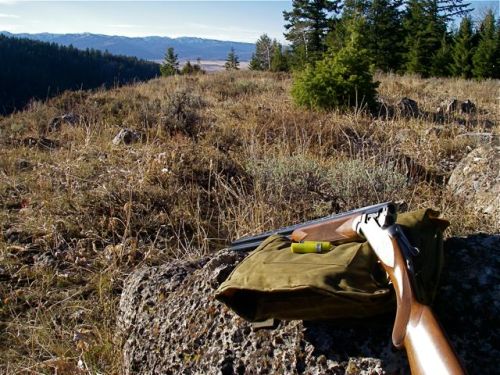
Finely-finished wood. Detailed, craftsman engraving. I confess to loving well-made, beautiful guns.

But I also confess to hating the painful experience of seeing a nice gun that I’ve spent hard-earned money on getting scratched up. I know this is silly, and I believe that guns are meant to be used, not sit on the shelf. If you’re buying a gun for hunting you should expect that it’s going to start looking well-used after a while. But still, every time I put a new scratch in a nice piece of walnut, I feel the pain.

And with that pain, the dark thoughts began creeping in. Thoughts of a gun I wouldn’t have to worry about so much. Thoughts of a field gun that *gasp*  – didn’t have nice wood or a fancy receiver. I don’t exaggerate when I call these “dark” thoughts, as they became filled with visions of sacrilegious black synthetics.

I’ve had these thoughts for years, but have never gotten around to acting on them. I always rationalized the idea to myself with the notion that it would merely be a dedicated chukar gun. That harsh, nasty, devil-bird country would be the singular application for which I wouldn’t prefer to have one of my nice wood guns in my hands. And I kept telling myself that as I tracked down the model I wanted and tentatively pulled out the credit card. It would still be a few weeks till the first chukar trip, so I figured I would take it out that afternoon for grouse and just, “see how it shot.” The first thing I noticed is that it was light. Very light. As in a 1/2 pound lighter than my esteemed Browning “Superlight.” I could carry this gun all day and hardly notice it, I found myself thinking.

And as these seductive thoughts started to pervade, I saw the dog slam on point. Three birds got up and the gun flew to my shoulder like it was meant to be there and with the very first two shots out of this dark new piece of machinery I dropped a double on sharpies. Holy shit, I mumbled. Far more than just being a pragmatic choice for limited applications, this gun really shoots. And with that, the dark thoughts dug their roots in further and began to grow.

By the time I got home, concerns that my dirty little affair might blossom into something more were taking hold. I broke down the gun and cleaned it, finding the task no more complicated than disassembling and cleaning an O/U. My old bias about semis being a chore to maintain was thrown out the window. I went out again the following afternoon with the same gun, and again limited on a double. And with that second outing, the lid was permanently blown off the Pandora’s box and the deal was sealed.

I’ve even started to see a certain unconventional beauty in this new gun. A sleek, stark, functional aesthetic, combined with design that is no less craftsmanship for being modern. And I began to acknowledge that this might not just turn out to be a dedicated chukar gun. That lamentably, some of my “nicer” guns might just be spending more time in the closet. That this might become the gun I grab whenever I want something lightweight and well- balanced, that I shoot as well as anything if not more so, and that I don’t have to worry about. Which is to say, pretty much all the time.

There. I’ve gotten it off of my chest. I own a black gun. Nothing ‘traditional’ about it. A testament to pure performance. And dammit, I’m loving it.

The Purge.

There are those that are diligent about cleaning their gear at the end of the season, putting it all away properly. Truth be told, with the exception of guns, I’m not one of those.

My bird vest usually gets tossed in the closet shortly after chukar ends around the first week of February, and doesn’t emerge again ’till…well, right about now – a few days before the next season starts.

Somewhere in Idaho

Empty purple and yellow shells clink together in the pockets as I take the vest off the hook.

A granola bar wrapper is still in there, which I ate the contents of atop Nunya Peak, as the increasing wind ushered in a black wall of storm in the distance, and the birds called each other into the safety of the cliffs below me. We proceeded to take a few stragglers from the base of that cliff; birds that didn’t heed the call to safety. It was snowing sideways on the way out, and it took a while to find the truck, even longer to regain the feeling in my hands.

There is still a smorgasbord of remnant feathers all mixed together in the back of the vest, representing a rough stratigraphic timeline from early season ruffies at the base, through the solid mid-layer of sharpies and roosters and the occasional Hun, topped off with a dusting of chuks. Dirt, dried grass and twigs hold it all together.

There is that small hole that should probably have been mended (but likely never will be), from where I took a break against a fence post that hid a rusty old square nail, somewhere in southern Montana.

A small projectile point made of chert that I almost stepped on walking the canyon country of Nevada. I stood there for a while after I picked it up, sliding the cool smoothness of it between my thumb and forefinger, taking in a view that extended far, far into the distance.

Drops of dried blood remain on the lining of the game bag, reminding me that this isn’t just a game.

In some weird way, purging my vest of all these things is almost as difficult as accepting the end of another season. I put the vest back in the closet. There are still a few more days before this really needs to be done.

Cleanliness is far from Dogliness.

I was looking back through some of last season’s pics the other day, and came across this one:

I stared at this pic for a while, remembering that fine fall day with a good friend in Montana. But more than anything, the sheer unbridled, unashamed joy of a dog covered in mud brought the smile to my face. It was a great day to be alive, for both of us. And at the end of the day, whether the game bag is full or empty, what more can you ask for?