
No middle-aged man should scramble through the bramble on his hands and knees looking for a wayward wounded pheasant. It’s a mismatch.
Nothing runs like a pheasant. Nothing hides like a pheasant. The odds lie with the bird and briar.
Bleeding and cussing.
But then my little dog appears at my side as I slither through a tight runway in the chokecherry, roughly following the path of the departed runaway. She’s at my heels and there’s not enough room for her to pass. So I lie flat. No shit. The dog vaults, steps on my head, and passes over me in hot pursuit of a rooster I cannot see but she can smell.
Twenty yards ahead, I hear a mad scrambling and then the muffled, distinctive sound of a panting dog with her mouth full of bird. She has him and I shout praise and curses and claw my way out of the coulee. The setter emerges with the bird. Still alive.
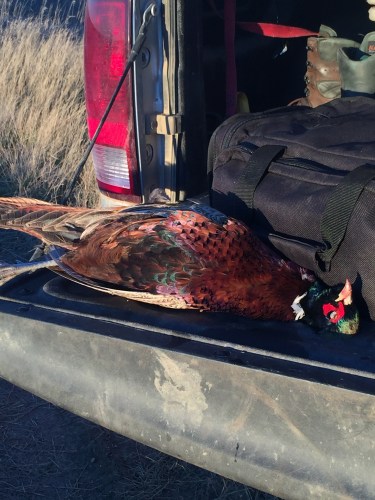 I have to walk around to the head of the coulee and through the farmer’s cut corn to retrieve my gear and gun. Staunch the flow of a minor cut on the lip and one on the ear. Load the gun and walk on. Still bleeding.
We make birds again on the other side of the coulee, heading toward an old field that now is more weed than wheat, but the birds roost there when they aren’t running from a setter nose.
The third bird proves hardest of all. A point on the edge and the wrong side chosen by hunter and the right side chosen by rooster. A nice big tree between. No shot. Another point. Hen. Another point. Hen. We work to the edge of a large pond, where a blanket of snowberry meets the tules and I lose the dog. I know she’s on point. But as an advocate of the so-called silent hunt, I do not use beeper collars. So the dog is lost. For what seems like ten minutes. I stomp past a little tuft of cattail feather for the sixth or seventh time and then I realize that the weed in fact is just the barest tip of the bird dog’s tail sticking out of the sea of cover. Trembling ever so slightly. So I stomp into the brush, guessing at what should be four feet in front of her nose. This time a big rooster goes up and then down at my shot. Head up. Running. Damnit.
When last seen, he veered in the direction of the pond and the thick tules there. The dog goes into the forest of cattails and then freezes, pointing the cripple, I’m guessing, though I only have sound to guide me. Then moving again, fast. Scrambling and panting. Then stopping again, near the base of a Russian olive pond side. This is all determined by sound alone for I see nothing but tules. It’s machete country.
When I find the dog, she’s pointing downward. Into a badger hole. There’s a flank feather at the mouth of the hole. Not good. I unload the gun. Set aside. And start to dig.
We take turns digging. She, frantic, whining. Biting at the dirt and the roots of the olive. The hole is large enough for my arm. All the way to the shoulder. Too small for the dog, though. We widen the tunnel. Dig some more. Whine some more. Both of us. This goes on, a major excavation project, a dark tunnel to god-knows-where. The bird has gone to ground. And he’s gone.
The word trudge was designed for the long walk to the truck by a beaten pheasant hunter. The “grounded” pheasant gone. The “treed” pheasant in the bag next to the only clean kill of the day. En route, the setter had made one more point. This one in the middle of a field. No trees around for hundreds of yards. Rock solid and walk in. And a rooster takes to the sky. And I miss. Twice. Trudge.
A western hunter hunting the eastern edge of his state knows the thin air that is a full bag of wild pheasants. Two is enough, I implore. Back home, miles of prairie road behind me, I place the two roosters up on top of the stand-up freezer, letting them thaw after the deep freeze of a long drive. Tomorrow, I tell myself, I will clean them and think about wild birds on a wild land.
In the night, one of the house cats gets up on the freezer and eats one of the roosters.
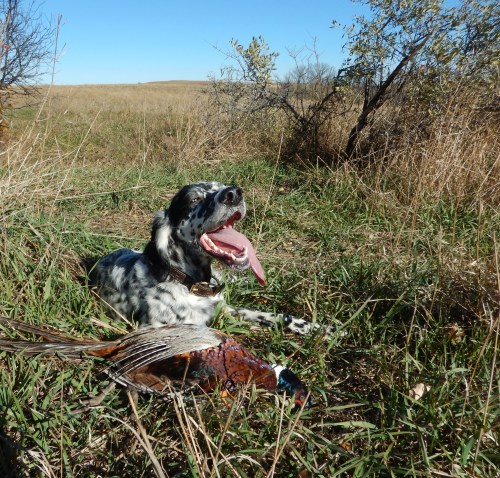

 September sweating up through willows, scratching through gooseberries and raspberries. It’s always a solo trip because there’s only been one grouse in all this time. There have been bears and burrs and brambles. There has been mud and blood and, after, beer. But no grouse. That setter has been buried two years now and I have new one to chase the ghost. Different boots, less hair, more aches. Still going.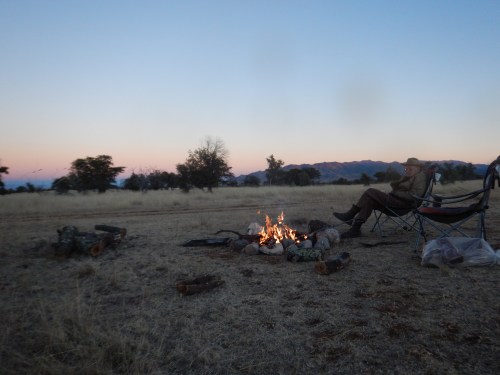
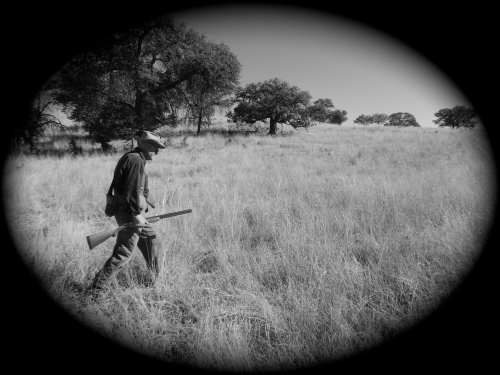 There will come a time. I know this to be true, but I cannot acknowledge the truth. The truth is gossamer, whispy, a fog that shifts, thickens, then blows away. Elders speak these truths—the days go faster the older you get, enjoy it while you can because it won’t last, someday you won’t be able to climb those hills—and yet the depth of those words cannot be realized by the synapses of youth. Or even middle age. We deny that ache in the lower back in the morning after a day of work on the ranch, we ignore that tightness in the knee on the climb to laughing chukar, and that blood pounding in lung and temple is merely the price of exercise and not the product of a slowing physicality. We hear those words of things to come, but we don’t listen. They don’t sink. There is no overt repudiation of them. It is more of a “yeah, right, okay.”
 Less than a week into the trip, Pat pulls up lame. Favoring the left hind.
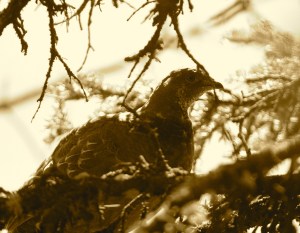 Ned pointed and a big old male blue grouse clattered up and I swung on him and folded him and Ned pointed again and that one went up and then down too. The sky blued on and we went on. Stopped for an elk meatloaf sandwich. Olives. A crisp fresh red and yellow apple. Leaned against one of those old trees. Got acquainted as men do when they are new to one another. Treading somewhat carefully. Finding commonalities. He talked of pointing dogs and double guns and somehow, even at that pup stage of my life, I knew where I would be heading.
 It was the trash, more than anything. Discards of a people on the move. Empty plastic jugs. Fuel cans. Pop cans worded only in Spanish. A shoe. Plastic sheeting. A tattered jacket, stuffing flying everywhere. You half expected to walk up on someone sitting in the shade of an oak as you followed your dog. Your heart beat a little more frantically than it does as a mere aficionado of the hunt and the canine. It felt dangerous. Still does sometimes.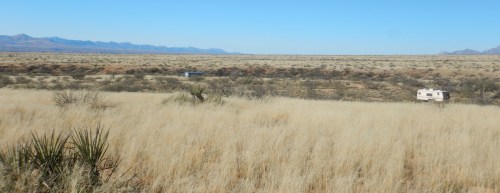
 Mouthful of Feathers