Death grip

How do you kill them?

Do you hope the dog takes care of them before he brings them back to hand or are you such a good shooter than you stone every one of them?

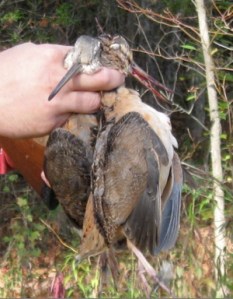
Or are you like me? Do you find a few of them, blinking and half alive? Do you stand there for a moment and think about what’s transpired in the last few seconds? You made a decision, a big boy decision, to pull the trigger. You hit your target. You brought the bird down. It flopped and flapped and absorbed more lead than you though avianly possible, but it’s not dead. Not yet. That last part is now up to you. And your hands.

Do you dispatch, terminate, put ’em down, finish ’em off, snuff ’em out, exterminate or harvest ’em?

I don’t. I kill them. Quickly. Swiftly. Without fanfare. Without much thought really, because too much thought and you’d stand there like a fool leaving everything open to contemplation.

So it’s a twist of the neck, maybe a head rapped against a nearby tree. Not pretty, but not overly dramatic, either. The hunter bringing the end near. Life running out of the hunted. You can feel it go. Almost like when you’re fishing and the hook dislodges. It’s just…gone.

Not so much remorse as just a pause. And then you move on.

– Crawford

Trapped

It  wasn’t a conscious decision; we had merely started moving in slightly different trajectories, and in this sort of country that means that before long we were almost a mile, and a deep gorge, away from each other. I look across the rim at the small figures, the even smaller brown and white dots that represented the dogs. Even at this distance it is obvious that they are covering ten times the amount of ground that the humans are.

I find reasonably stable footing amidst the slippery skateboards of sandstone talus piled atop each other, and look over the rim. Even in February, the creek flows assertively. Yes, people would have lived here, and probably would have done pretty well at it, considering the harshness that lay to the horizon beyond.

In the distance, the rooftops and glass reflections of a border gambling town can be seen. I am less than an hour hike from the road, but I know that no one has likely stood where I am in a long time. They come in vehicles of sealed, conditioned air, never leaving pavement, and head straight to the dim cacaphony of casinos where it could be any time of night or day. Indeed, this lack of any reference to time of day is the deliberate strategy from the casino’s point of view. And then, broke, satiated, guilty, elated, hungover or maybe even lucky, they get back in their cars and move on, their feet likely never touching real soil, their menthol-pickled lungs taking in as little fresh air as possible throughout the entire endeavor.

I drop below the band of rimrock and continue to parallel the ridge, the creek now audible below. Here and there are concentrations of tiny obsidian flakes on the ground, doubtless in the very same spot where they initially fell, as someone ages before fashioned a tool or killing instrument of some sort. I continue on, lost in various thoughts of the people who used to live here, losing recollection of the quarry I came here to find, not even sure exactly where my dog is. It feels good to be alone in this place, walking, consumed by the moment, surrounded by scatterings of human evidence, reminded that I am but one in a long chain that stretches way back. Something incongruous catches my eye and I bend down. A tiny chert arrowhead, perfectly formed.

I move on, still deep in thought, looking down as I pick my way along, only half-heartedly still in the hunt. Hank pops over the rim above to check on me and then disappears again.

And then suddenly, there it is.
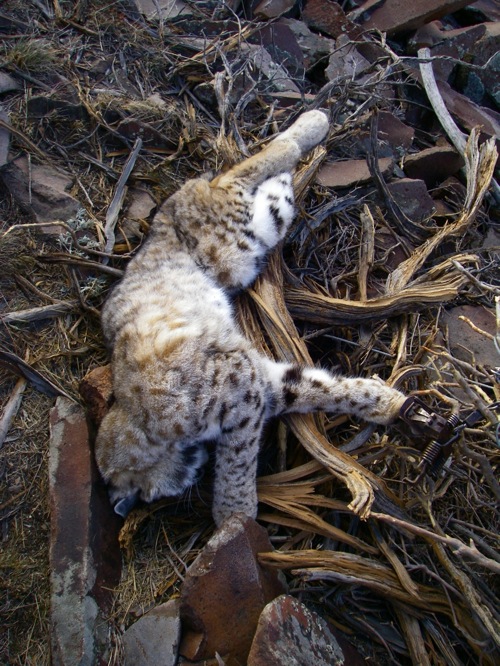
I stand there stunned as everything around me slows and focuses in the middle, on what lies in front of me, blurred around the edges, like an old tintype. Despite the mid-day temps hovering around freezing, it is clear that the cat hasn’t been dead for long. It is also clear that this had not been a quick death; that nothing dies quickly this way. There would have been hours, if not days, of struggle, of life slowly ebbing, of creeping cold, until this. Wind moves the soft fur, and I can’t resist – I kneel down and run my fingers through it. There is this brief, purely sensory moment where my thinking, judgmental mind is as numb as the carcass before me. This incredibly soft coat. I want to continue running my hand through it and not think about anything, but thoughts begin to creep back. I stand up and wonder if the trapper is watching me from somewhere in the distance. This is easy country to remain undetected in.

I try to get it back, but the rest of the day is not the same. The usual burning desire to continue hunting and covering country has been dimmed to a flicker and all I want to do is put the gun and the rest of it all away and go sit somewhere with a flask of whiskey and a good view and not think about anything but the biting February wind chafing my face and the little chert arrowhead, smooth between my fingers.

– Smithhammer

Blood and Plunder

He’s a knife-in-the-teeth type, a run-hell, fast-go, wound-tight, son-of-a-bitch, so when he yelps down by the creek—out of sight (again)—I don’t think much of it. He comes roaring back and I can see blood dripping from his ear. The cut is perhaps a quarter of an inch in length and right at the tip and not bleeding very heavily. Yet. As a horseman friend of mine would say, “It’s a long way from the heart.”

The Bloody Duke pauses only long enough to check in.

And we’re a long way from the truck. It’s 15 below zero and the pheasants are holding tight. There’s about one point five minutes of debate. We push on. If he could vote—and he can—he’d vote “aye.”

This is the way. His way. He’s pretty good at it. Full-fricking-tilt until he’s completely gassed and done. This is also the way of Western pheasant, those savage bastards of greasewood and buffaloberry, their craws stuffed with Russian olive pits, their hearts full of bitter fuck-you fire. No other bird evokes the chaos, the running pandemonium beneath the wide skies. Wild bird, of course. Feral is more apt. You hit the ground running and you need a “Katie-bar-the-door” dog. Barbwire, thorn, bur, be damned. Late season? Snow? Even more so. Those runnin’ sons-a-bitches. David Alan Coe, or perhaps it was Chris Ledoux captured it this way: “Oh, it’s forty below and I don’t give a fuck, got a heater in my truck, and I’m off to the rodeo.”

So we continue, despite the bleeding, because, darn it, the pheasants are holding tight and the injury is superficial. It is worth a repeat: the pheasants are holding tight. It’s too cold to hunt. But the pheasants are finally, for once, holding tight. This is the epic once-every-seven-years cicada hatch on the Green, for crying in a bucket. The pheasants are holding tight and you may not see this again in his lifetime. Maybe even yours. It’s too cold to hunt? Yeah, right. Unless you are a cold-hearted bastard. So, onward, blood flying from sliced ear. Hey, we’re hunting late season wild roosters. Call the ASPCA. Go ahead, call ’em.
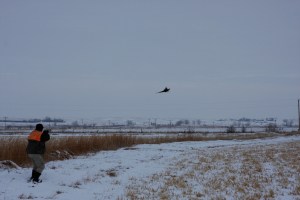
In the whitewash of eastern Montana’s winter, he is lost quickly and then I pick him up again. The ear is bleeding freely now, and he’s frozen on point. I huff up and watch the blood dripping into the snow. He’s oblivious to anything but the smell in his nose and when the cock bird goes up and the shotgun barks, he’s on it. Hard on it. A 24-inch-tailed rooster and he retrieves, then blasts onward. I think for a moment, “Maybe I ought to do something about that ear.” But as soon as that thought enters, he’s gone again, romping into the snow, blood-be-damned, as if affirming my “long-way-from-the-heart” mantra.

Swingin'

By the time we get back to the truck (with three stone-dead rooster pheasants being flash-frozen by Montana December against my back), he’s a red and white setter. He looks like something out of a slasher movie, all from the flopping of an ear splattering blood everywhere, a minor cut with a major bleed. He doesn’t care, though. I tape him up as best I can, but the tape comes off and the ear bleeds more. I wrap his head and he digs into it and off comes the bandage. Screw it, he says, I’m a tough guy.
That night in the motel room, the bleeding finally stopped, he gobbles his feed, then promptly pukes it—and a wad of cocklebur and pheasant feather—up on my bed. Twice. “Get off the stage, you god-damned goof,” sings Ledoux. What an animal. Both. Or all three of us.

–TR

Begin Anew

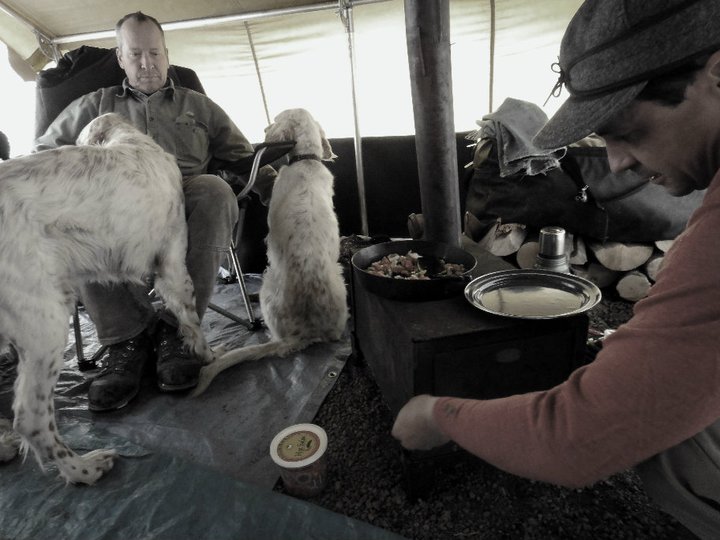
It begins with hearing the creak of the stove door opening, with someone throwing a few sticks on the coals from last night. Before long, you hear a little crackling and periscope one eye toward the still tightly drawn opening of your sleeping bag to find a greyish hint of daylight. No one really moves much, but a gradual, collective realization that morning has arrived seems to pervade. Before long, it’s almost too warm in the wall tent to stay inside the bag, and a restlessness follows and people start to emerge. A dog stretches before curling up and laying down again, a little closer to the heat source.

Photo by Ty Traxler

Muscles are stiff, and there’s the faint remnant of retribution from last night’s whiskey, preventing much conversation. Or coordination, for that matter. An empty bottle or two get knocked over in an effort to get the coffee pot on the stove. Someone throws on boots and trips over the tent door, cursing, on a relief mission.

Presently, frying garlic and onions awake what is left of dormant senses and the mental fog begins to lift. Sausage and peppers get added to the mix and take it to a new level. Something which probably wouldn’t be funny in an otherwise full state of consciousness cracks all of you up. Soon glorious caffeine is infusing the body with fresh fire. Yesterday’s beatdown, traversing steep cliffs, slipping and falling on greasy rock, and the ensuing aches, forgotten. Tails start to wag and a cup of coffee goes over. So the day begins anew and nothing else really matters in high, windswept country where humans and dogs and chukar sometimes cross paths.

– Smithhammer

The Other

He may be the best dog I will ever walk the ground with. Perhaps not. Perhaps there will be another dog that will display and dazzle. But there will never be another dog like him. And there will never be another time like his. That I do know.

Some would say he was just a dog, but there are those of us who know the other plane. That place of which Henry Beston wrote: “In a world older and more complete than ours they move finished and complete, gifted with extensions of the senses we have lost or never attained, living by voices we shall never hear. They are not brethren, they are not underlings; they are other nations, caught with ourselves in the net of life and time, fellow prisoners of the splendour and travail of the earth.”

There are humans, though, who at a minimum understand Beston’s other nation. They may even live there. Perhaps. Many are my friends. Hunting men mostly, men who hunt because they have a dog and if they did not partner with a canine, they would find no pleasure in walking an autumn field with a shotgun no matter how much they enjoyed the taste of roasted pheasant. They certainly would find the cliffs and crags and rough tough of the chukar partridge much more empty. Perhaps they would draw upon the wildness and raw beauty of the desert, but without a dog pal the picture would be incomplete like Mona Lisa without her smile. Can an old woman with a Peekapoo experience the same kind of other plane, that melding of human and dog mind into a mutual understanding that transcends verbal language? Perhaps. But I think not. The reason is quarry. There is something very different about an animal that lives to hunt for you, that pursues what you pursue. You are caught up in a mutual joy of the hunt, a mutual drive that sinks deep to the soul into the core, the heart, the bone, the very cells that make up a living creature. This is in our DNA, those of us who hunt. I am sure that dogs that hunted held a different status in the ancient nomadic tribes of which we are rooted than dogs that plodded along at heel, eating food and in the end becoming food. Each type of dog—the food hunter and the food “on the hoof” certainly played a role in the survival, but it was hunting dog that actually earned its keep by living, not dying.

It was hot that day. Christ was it hot. June. People do not think of Wyoming as hot. Wyoming is snowy peaks and ice, wind and empty. That day it was over 100 and the sweat poured over my eyes. I took a half-splintered Pulaski bandaged by black electricians tape and a half-sharp shovel and made little progress. A more prudent man might have a sharp shovel and a strong-handled swinging tool, but I did not expect to be burying my dog. Maybe at twelve. Definitely not at six. He lay next to me in black plastic and I did not look over there very often. I swung the Pulaski and water ran off of me, out of me. I was miles from nowhere and the desert made me small. Tiny. Alone. Only a half year earlier, I had walked the same piece of ground with a shotgun in my hands and him out there before me. And now he was wrapped in black plastic. The desert had never made me feel so small. True enough it is a big place with sky flung in all directions, miles from water, miles from those snowfields on the Bighorns and the Absarokas. No it was not the desert that made me feel tiny, it was death. I was no longer a man with one hell of a bird dog. I was just a man.

– TR