Sharp-dressed Bird

I really like sharptails. If we ever run out of bobwhites in Texico, I’ll probably move north and hunt them fulltime.

Looking, first, at some of the sharpie’s kinfolk, I’d classify the ruffed grouse as the haughty blue-blood of the clan. He frequents the upper east and he’s often chased by folks who smoke pipes and belong to gunclubs. The spruce grouse is the inbred mountain-man of the family. He’s dumber than a stump, and that’s usually where he’s standing and staring blankly when a shotgun points his way.

Between these two intellectual extremes, we have the sharptail. He’s the sodbusting prairie-dweller that wakes up each morning with a different M.O. When it’s hot and windy he’ll flush underfoot and give you a decent chance. On cold days he’ll jump from the grass when the truck door slams and fly out of sight. I like his furry little feets and the way he cackles when he flushes. It’s a nasal, mocking, staccato, yodel that reminds me of the grade school punk that always needed an ass-whooping, but never got one.

Most endearing, though, is the sharpie’s little stomping and spinning jiggy-jag that he does when the ladies of spring are around. Thanks to Dawson Dunning for shooting this incredibly cool footage. – TB

The sounds

My eyes won’t stop watering. It’s the lack of sleep. Three a.m. wake-ups are by far the biggest drawback to turkey hunting.

To stop the spigot, I close my eyes. Surely I’ll hear a gobbler if he lets loose. To make sure, I take an auditory inventory. I start with the close sounds first – the buzz of the mosquitoes, the warblers and wrens, breeze through the trees. Now I expand – vehicle hum of a far-away road. Maybe a dog bark, way off? Maybe.

And then, seemingly from within my head, a “Bum. Bum, bum. Bumbumbumbumbumbum.” Sort of like a lawnmower starting. Then it’s gone.

It’s a male ruffed grouse, somewhere within a quarter mile of the pine tree I’m nestled up against. He’s drumming, which is his way of marking out his spring breeding territory.

I’ve been told drumming creates a mini sonic boom. It might. For me, it creates hope.

Lamenting empty pockets

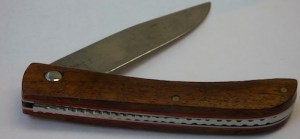
A pair of .22 rimfire case heads adorn the pivot pin, covering the cracked walnut scales. The quick and dirty repair job has held up for nearly two decades now. Abused it may be, but still the most useful tool ever invented.

It can slice cheese, open boxes or trim sheets of paper. It can cut rope or trim arrow shafts from straight-stalked dogwood.
Last year, it boned out a 3×3 muley and cut a mesquite thorn from my swollen pinky finger.
Years ago, with the help of several glasses of whiskey and a Zippo, it seared a relief hole in a friend’s blackened finger nail at a bar room table.
Countless times, I have used a half-open knife to pull a piece of cholla cactus from the dog’s leg and sometimes from my own.
Every once in a while, I head into the workshop and build a new folding knife for myself.

Always though, I end up giving the new knife away and returning to my old standbys. A two-bladed Case that was a gift and the carbon bladed slip-joint knife my dad gave me decades ago.
There are others, an auto I built on a whim, several variations of factory-made liner locks, lockbacks and other stainless steel contraptions that were made for intentions other than whittling and minor surgery. They lie in a drawer, unused. Pointless in their existence.
It’s the little brown knife that proves most useful, though I fear even it faces an uphill battle.
Knives are steadily becoming relics, feared weapons of mass destruction.
Only a few years ago, I traveled on flights all across the country with a modest knife in my pocket.
I took it to school every day from the 4th grade on. Now, I can’t go into the Post Office, the County Courthouse or dozens of other places because of a small carbon-steel blade that doesn’t even lock open.
How do I teach my sons to carry knives? How will they be able to trim a nail or cut a toothpick when a Swiss Army knife can get you kicked out of school?
The post 911 era has brought some worthwhile security reforms, but in my opinion it has limited what I consider a basic right.
In the grand scheme of things, my 3-inch knife is not any more dangerous than a ballpoint pen or a medium-sized rock. It’s certainly less dangerous than the two-ton cars which we routinely let 17-year-olds drive to school.
That schools trust kids with cars and condoms but can’t trust them with a pocket knife baffles me. That adults can’t be trusted with a knife in many public places blows my mind.
Who are these people that think a pocket knife is to be feared?
Maybe the more pertinent question, who are these people that don’t carry a knife and what do they do when they need to cut something?
The people without a knife are foreign to me, unknown and unknowing.
Familiar is the feel of smooth walnut and filed tool steel.
Adrift in my pocket, surrounded by loose change and lint, the little brown knife awaits its next task.

– G. M.

Materials

So little of what we’re left with at the end of the upland season is tangible. Sure, there are guns to clean, maybe some birds still left in the freezer (though I rarely show that much self-discipline), and inevitably, finding new ways to try and occupy highly-energetic four-legged athletes. Ultimately, though, most of it will live on only in memory.

But then there are these feathers laying in front of me on the tying table. Ruffed grouse. Sharptail. Pheasant. These aren’t detached, consumable products in neatly-labeled plastic bags purchased from the fly store, packaged and shipped from Dog Knows Where – these came from birds my dog and I worked hard to find, birds I caused to drop from the sky, birds that, well, to be totally honest, he only sometimes half-heartedly retrieved in that way that so many pointers do who can’t be bothered with such mundane tasks, tearing off already to find the next holding covey instead.

These feathers sit in front of me on the table now, haphazardly strewn about amongst threads, tinsels, furs, tying tools, in a system of highly-subjective organization that others would likely call a mess; raw material from which I hope something useful will eventually emerge. The flies that will come of these feathers will occupy a special place, if not in my fly box, then at least in my mind, easily recognizable as different than those commercially tied by others in Sri Lanka or the Phillipines from materials of mysterious origin.

And when I remove that ragged, grouse bedecked fly from the cutthroat’s mouth, and release it back into that little creek high up in the newly melted alpine, I’ll flash back to that day last October when I was up to my knees in mud, shotgun in hand, trying in vain to keep up with a dog tracing currents of bird scent across a sweeping landscape, pulled along by compulsions I’ve never fully understood or bothered to explore; satisfied instead by knowing that not doing these things would cause a slow withering of my soul, which is simply not an option.

– Smithhammer