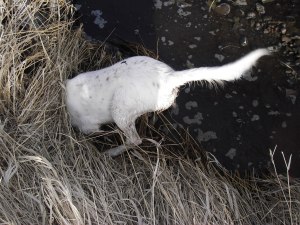
The setter people entertain themselves these days by mouse hunting. We take our daily walks on the bench above the home place now in the light of spring, not the dark of winter. North Willow Creek is still fairly clear, but it is coming up and will be over the banks in a few weeks. The ice has abandoned its shoulders. The geese are hooked up and flying in pairs. Mallards jump from the ponds beneath the high ditch and yesterday, I thought I heard the first sandhill of the season.
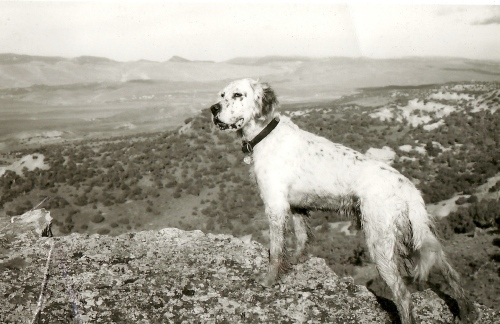
The classic hard point with two honoring.
My thoughts trend to fishing now and a new six weight in the quiver and a section of the Missouri I haven’t fished yet. Screwing around with a spey rod, as if I need another hobby. Reminds me of when I transitioned to tele from downhill skiing. More crap to buy, more gear. I rounded out the fly rod collection this spring and have a whole box full of articulated streamers.
Hunting is off somewhere on a far rim and if I follow the Solstice Rule–no conversations about hunting are allowed until the days start getting shorter–then I can’t even talk about it. We invented the Solstice Rule to avoid the pain of not hunting, but it really is poor salve for such.
And yet, the major trips are already blocked out for the fall: up to the Front the first week of September, down to Arizona (they are getting a lot of quail rain this spring) in December, Nevada chukar in late October . . . . But now I’m hunting big rainbows and browns and planning summer pack trips. The other day a lady friend and I rode the horses to the Pony Bar and flushed two sets of paired-up Huns on the neighbor’s ranch. I have permission to hunt there. I tried to not think about that–that time so distant.
The finest mouse hunter in all the Realm.
And so, sandhills and trumpeter swans and Candada geese and red-winged blackbirds. The guns are cleaned and gun-safed and the only shooting I’m doing is my .45 Kimber auto at targets. For fun. For something that goes bang. Kind of like how a brown hits a hopper. The smell of sap rises in the cottonwoods and there’s a drift scent of beefsteak sizzling over the alder coals of the season’s first barbecue. It’s gin and tonic season. Spritzer season. I’ll survive.
The setter people? Mouse hunting and chewing on the legs of winter killed whitetails. Damned carnivores.
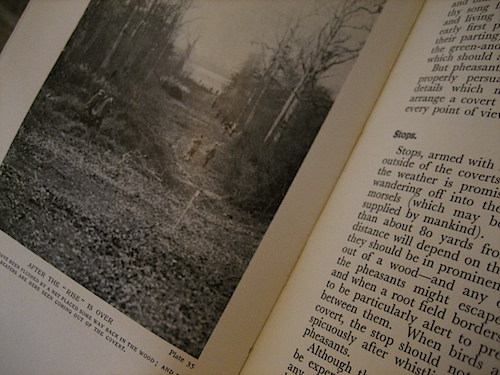
I’ve been reading a copy of Shooting By Moor, Field and Shore, an almanac of shooting in England, published 1929. It paints a portrait of a different time and a different world. Furthermore, it points out the inadequacy of my low brow ways. In the brief section on “walk up hunting” as opposed to shooting driven game, the authors point out the obvious burdens associated with “rough shooting.”
“In order to kill game on a rough shoot, you must either walk it up, or indulge in impromptu driving either with the help of a friend of friends. You have to carry your own gun all day, and most probably the game bag as well.”
Imagine the horror of having to “carry your own gun” and game whilst hunting. I should have flipped through this book before I logged a hundred or so miles to shoot only a handful of quail this season, carrying my own gun the whole time.
I like shotguns.
Specifically, I like old, lightweight shotguns with two barrels and well-figured walnut.
Preferably in 28 ga. or 16 ga.
Some of my hunting buddies now carry guns made of black plastic that look like they might shoot lazer beams.
Personally, I don’t own anything I won’t hunt in the rain with, but I also don’t own any guns I would put a bumper sticker on.
When I was ten, I had a Remington Nylon 66 rifle. It was black plastic with white diamonds where the checkering should have been and it had glimmering stainless barrel and action.
It was the ugliest rifle I have ever owned and it could not dependably shoot beer-can sized groups at 20 yards.
Since then, I have stuck to guns that are made of dark-blue steel and checkered walnut.
I like them to smell of boiled linseed oil and 3-in-1 and if I leave it leaned against a fence, I want to be able to imagine my grampa standing next to it.
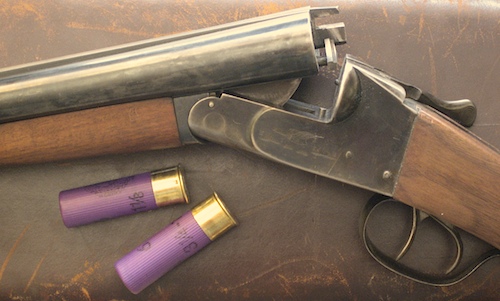
Last year I bought a 1936 Ithaca side-by-side 16 ga. with no butt stock. I spent most of the spring fitting and shaping, sanding and oiling until I had a new-to-me upland gun.
She still has some of her case coloring and when the light is right, the barrels shine like obsidian. I added a few inches to the trigger tang and an english style stock in place of the Prince of Wales that would have adorned the gun originally.
The maker’s marks on the barrel denote ‘modified’ and ‘full’ chokes. On the pattern board, it’s more like ‘full’ and ‘rifle.’
Still, I managed to shoot a few birds with it this year and that brand new stock already has its first ding, earned high in the Pecos Wilderness on an early grouse hunt. I don’t worry much about the scratches and scuffs that mark the passing of the years.
I think what I like least about plastic guns is their inability to show the character that comes with age and use.
My guns carry their dings and scratches proudly, like little historical records of antlers and pack frames and chukar hunts gone wrong.
It’s how I like them.
Santa Claus was more emotionally needy than I expected him to be.
TR and I had stopped to refill our water jugs at a remote BLM outpost manned by volunteers.
“You guys here to see the museum,” he asked hopefully. He was a large man, sporting a full beard and was almost surely the real Santa.
“No. We’re just here for a little water.”
“Huntin’?”
He asked the question as if we weren’t covered in a week’s worth of dust and driving pickups loaded with camping gear and dogs.
“Yep.”
His wife, AKA Mrs. Claus, comes out and brings Santa a spotless cowboy hat. Were if it covered in grime, it would be a near twin of those worn by TR and myself.
“Those are our cats,” he gestured towards two big toms.
TR and I were non-committal, but they looked like quail killers and bird-dog fodder to us.
“One has different colored eyes and the other has different colored balls,” he said casually, adding, “I can tell them apart coming or going.”
That night over beers we speculated that Mrs. Claus might have brought out a different hat, depending on what the visitors were wearing.
We imagined Santa in a beanie, sombrero or maybe a cheesehead.
Weeks later I stop by again, ostensibly to get water. I throw my hat on the floor board and don a ball cap.
“Here to see the museum?”
Mrs. Claus walked out a moment later, bringing him a barely worn baseball cap.
I guess it’s a lonely life.
Consider the sage chicken. Take your time at it. He is a mighty bird, his pointed tail, his black-feathered breast, his mottled and muted yet beautiful hues, his huge feet. Many writers, attempting to describe his flight have penned imagery of Air Force bombers, kites, sails. Indeed, the pet name for the big ones, the old ones, is “bomber.” Others have sneered at the big grouse as a game bird, shuddered at the thought of eating his dark breast, laughed when talking about the sporting dog aspect of hunting “chickens.”
Yet I submit that those who turn their noses up at Mr. Chicken might in fact be deeply saddened if those big beautiful birds no longer dotted our sagebrush steppe, no longer flew our wide Western skies.
There are those among us who have grown up hunting chickens. Here, on the broad ocean that is the sagebrush sea, are a few of us whose first shotgunning experience was sage grouse, whose family reunions were on the high prairies of states like Utah, Colorado, Wyoming, Nevada, Montana. I love how the names of those states sound on the tongue, and when I think of sage grouse and of those places, I think of old Willys jeeps and Ford Broncos covered in alkali dust, of big heavy Labs panting in the shade of a September wall tent, of Winchester pump guns, of windy Labor Days in the middle of nowhere, of grape soda in a tub of ice–and when I was deemed old enough–Hamm’s, Oly and Coors. I remember listening to the Wyoming Cowboys or the Colorado Buffaloes or the Denver Broncos on AM radio, and I remember those big birds taking wing and my shotgun on my shoulder and that huge, huge target, and I remember missing. They were deceptively fast and the shotgun sometimes swung as if it were twenty feet long. Sometimes, I remember hitting. Always, sage chicken season was about family and laughter and the music of loved ones.
Not too many people have family reunions around sage chicken season any more. Perhaps it is a function of a fattening society, of lard-assed kids who would rather play video games or text-message their pals. But the real reason, I think, is because we’ve failed as a society to appreciate this bird, failed as a people to treasure the wide open sagebrush flanks of our land–the very openness that defines the West–and failed, ultimately to be good stewards. Lyrical ground like Sweetwater, Oregon Buttes, Vinegar Hill, Horse Prairie, Choke-A-Man Draw . . . I can’t even think of those places without sage grouse. Without them, they are truly empty.
Six dogs and one wife ago, I was the cocky young editor of a small town western Colorado newspaper. Back then, I hunted with a beat-up Remington autoloader that jammed often, and a mutt named after my favorite beverage at the time. JD had been born under a house in Carbondale the year I dropped out of college to spend a season ski bumming in Aspen. The bastard child of a Springer mother and a Lab father, she was black and white, just like the Jack Daniels’ label.
Eventually, I went back to college, finished up that degree, put a few years of Arizona quail hunting and Colorado pheasant hunting in front of JD’s eager nose, and then found myself in the Gunnison Basin. I was editing a newspaper with an absentee owner and given free reign over the editorial pages. The pay was light, but the benefits were fantastic. The newspaper’s owner also had claim to a few miles of the Taylor River to which I had access, and there was wild country right out the door.
JD and the chickens
And there were chickens. The high country held blue grouse, but if you were a serious bird hunter (and with JD, I thought I was a terror to the game birds of the basin), you had to be a chicken hunter. They were everywhere. You could hunt chickens on the sage-blanketed sweep of the rising mountains and have a staggering Colorado mountain view as a backdrop.
It was pretty tall cotton then and I didn’t even know it. I must have killed dozens in my time in Gunnison and I cooked their meat to medium rare over aspen coals and savored every bit of it. Cooked beyond medium rare and their flesh was as palatable as an old shoe, but medium-rare and you were in business. A friend would gather a large group of us–a banker, a professor at the local college, a PR man, a county assessor, a county manager, and the young punk newspaper editor with his mutt and clunker gun–and we’d head out to Flattop and hunt for a day behind his Brits and my Splab. We’d laugh and drink beer at the end and admire our chicken harvest. The hunts were about friendships, about sharing a passion and were an annual ritual.
Everywhere, in every Western state, the story is the same. South Dakota has a silly two-day season with a one bird limit. Why even have it? Eastern Oregon has a permit draw system much like we have with big game. Nevada–with its mighty, tossing ocean of sage–has a two week season and most of the state is closed to nonresidents. And Wyoming–Wyoming, the state that defines sagebrush, the state that is antelope and sage chickens and wide open–has a two-week season with a two-bird limit, four in possession. It used to run a month and you could sack up three birds a day with nine in possession. Sad times. While we have built our Pheasants Forevers and our Quail Unlimiteds, and our Ruffed Grouse Societys, the very symbol of the West for the upland gunner has dwindled, lost ground and died.
Oil and gas development, predation, range fire, intentional sagebrush eradication funded by the feds and states, the looming shadow of renewable energy and its transmission lines, livestock grazing, “wild” horses, even West Nile virus . . . the sage chicken is in trouble. It is teetering close to being put on the endangered species list and if it ends up there, we hunter-conservationists should be deeply ashamed of ourselves. Sick. And it happened in finger-snap time; unless you are younger than 8, this has happened in your lifetime.
In my living room, mounted in a place of honor, is a big old bomber chicken. Whenever I look at him, I am back on the Big Empty. The memory of a girlfriend after the broken marriage, of a beautiful September Wyoming day, of golden aspen leaves and soft breezes scented by sage, of a talented dog on solid point, of swing and trigger pull, and retrieve to hand all come back to me. But there’s more. There’s a symbol. Of the West. Of families that got together in the outdoors and walked hallowed ground. Of simpler times? Perhaps. But we had problems back then. We just knew how to stick together, how to laugh, what family felt like, how to appreciate nature without motors and batteries and games . . . Our people seem to have lost those things.
I have to be honest – I rarely ever think about you. Which, I suppose, is the ultimate testament to how good you are at what you do. At times, however, I know this may come across as ingratitude, and for that, I’m sorry. You’ve accused me of being a fickle S.O.B. and I know there is a certain amount of truth to that. I expect a lot in a lamentably short period of time, and offer little more than neglect the rest of the year. I’ve smeared you in various pastes, oils and creams, seeking to improve upon perfection. I’ve even experimented with others, and you keep taking me back without question. You continue to endure these indignities with a level of class well above my own.
There was that time when the conditions were a lot muddier than I had expected, and I caught myself wondering out loud why I hadn’t worn a good pair of rubber boots instead. You took it silently, as is your way, and then sent me ass over tea kettle as I tried to remove you while standing balanced on one foot in the mud room when we got home. I knew I had it coming, and I can only hope the warm bath and oil rub you got that night made everything ok again.
We both know there will come a time when you’ll need help – there’s no use beating around the bush on that account. Hell, the day will come when I’ll need it too. Trust that I’ll spare no expense, and thank Dog we live in one of those places where skillful cobblers haven’t yet gone totally by the wayside. Your seams and soles will be lovingly taken care of. I imagine by that time my lustful, wandering eye will have been cured as well. We’ll settle into a comfortable, if seasonal, monogamy. Frankly, I’m looking forward to it.


 I spent most of the spring fitting and shaping, sanding and oiling until I had a new-to-me upland gun.


 Mouthful of Feathers